

idea that a prism is able to separate the different chromatic components and does not
operate a transformation. Students are elicited to propose an experiment able to
decide between the two interpretations.
The evidence that light can be chromatically decomposed is used as a starting
point to search for other dispersive mechanisms for light, as the diffraction, for
which an experimental activity allows to identify its phenomenological laws and the
dispersion role of a grating in the analysis of polychromatic lights.
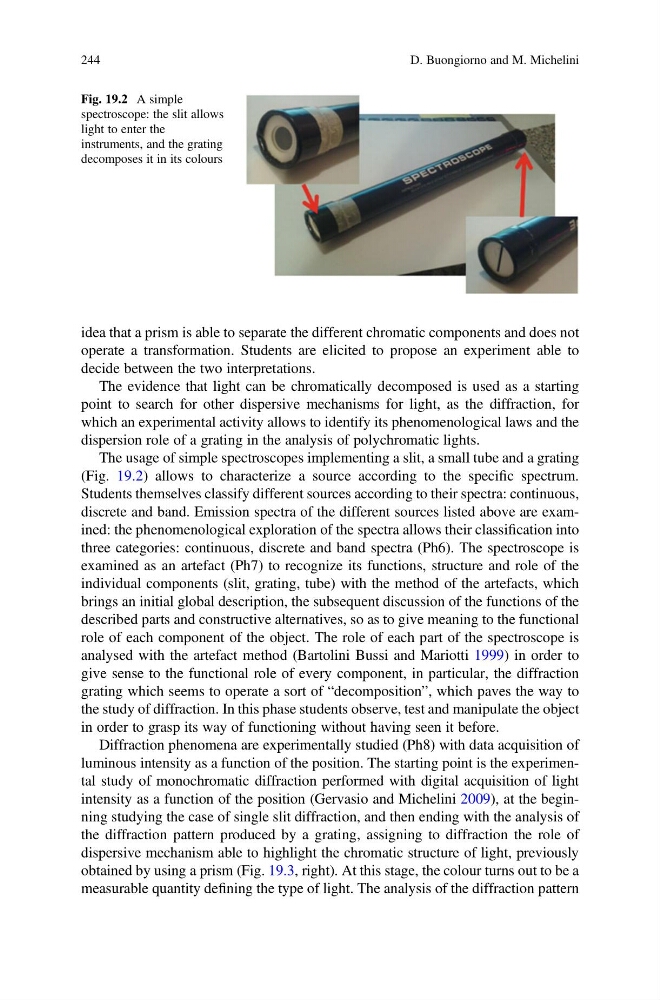
The usage of simple spectroscopes implementing a slit, a small tube and a grating
(Fig. 19.2) allows to characterize a source according to the specific spectrum.
Students themselves classify different sources according to their spectra: continuous,
discrete and band. Emission spectra of the different sources listed above are examined: the phenomenological exploration of the spectra allows their classification into
three categories: continuous, discrete and band spectra (Ph6). The spectroscope is
examined as an artefact (Ph7) to recognize its functions, structure and role of the
individual components (slit, grating, tube) with the method of the artefacts, which
brings an initial global description, the subsequent discussion of the functions of the
described parts and constructive alternatives, so as to give meaning to the functional
role of each component of the object. The role of each part of the spectroscope is
analysed with the artefact method (Bartolini Bussi and Mariotti 1999) in order to
give sense to the functional role of every component, in particular, the diffraction
grating which seems to operate a sort of “decomposition”, which paves the way to
the study of diffraction. In this phase students observe, test and manipulate the object
in order to grasp its way of functioning without having seen it before.
Diffraction phenomena are experimentally studied (Ph8) with data acquisition of
luminous intensity as a function of the position. The starting point is the experimental study of monochromatic diffraction performed with digital acquisition of light
intensity as a function of the position (Gervasio and Michelini 2009), at the beginning studying the case of single slit diffraction, and then ending with the analysis of
the diffraction pattern produced by a grating, assigning to diffraction the role of
dispersive mechanism able to highlight the chromatic structure of light, previously
obtained by using a prism (Fig. 19.3, right). At this stage, the colour turns out to be a
measurable quantity defining the type of light. The analysis of the diffraction pattern
Fig. 19.2 A simple
spectroscope: the slit allows
light to enter the
instruments, and the grating
decomposes it in its colours
244
D. Buongiorno and M. Michelini
operate a transformation. Students are elicited to propose an experiment able to
decide between the two interpretations.
The evidence that light can be chromatically decomposed is used as a starting
point to search for other dispersive mechanisms for light, as the diffraction, for
which an experimental activity allows to identify its phenomenological laws and the
dispersion role of a grating in the analysis of polychromatic lights.
The usage of simple spectroscopes implementing a slit, a small tube and a grating
(Fig. 19.2) allows to characterize a source according to the specific spectrum.
Students themselves classify different sources according to their spectra: continuous,
discrete and band. Emission spectra of the different sources listed above are examined: the phenomenological exploration of the spectra allows their classification into
three categories: continuous, discrete and band spectra (Ph6). The spectroscope is
examined as an artefact (Ph7) to recognize its functions, structure and role of the
individual components (slit, grating, tube) with the method of the artefacts, which
brings an initial global description, the subsequent discussion of the functions of the
described parts and constructive alternatives, so as to give meaning to the functional
role of each component of the object. The role of each part of the spectroscope is
analysed with the artefact method (Bartolini Bussi and Mariotti 1999) in order to
give sense to the functional role of every component, in particular, the diffraction
grating which seems to operate a sort of “decomposition”, which paves the way to
the study of diffraction. In this phase students observe, test and manipulate the object
in order to grasp its way of functioning without having seen it before.
Diffraction phenomena are experimentally studied (Ph8) with data acquisition of
luminous intensity as a function of the position. The starting point is the experimental study of monochromatic diffraction performed with digital acquisition of light
intensity as a function of the position (Gervasio and Michelini 2009), at the beginning studying the case of single slit diffraction, and then ending with the analysis of
the diffraction pattern produced by a grating, assigning to diffraction the role of
dispersive mechanism able to highlight the chromatic structure of light, previously
obtained by using a prism (Fig. 19.3, right). At this stage, the colour turns out to be a
measurable quantity defining the type of light. The analysis of the diffraction pattern
Fig. 19.2 A simple
spectroscope: the slit allows
light to enter the
instruments, and the grating
decomposes it in its colours
244
D. Buongiorno and M. Michelini