

additive and subtractive mechanisms, exploring if the light could be generated
inherently coloured, performing also flame essays of different chemical compounds/elements. The presence of an energy exchange within a light source emerges
from the analysis of the emission of an incandescent bulb: as the electric power
supplied to the system increases, emitted light appears of different intensities and
colours. The Stefan-Boltzmann phenomenological laws, the identification of the
emissive and absorbing power and of the important law of nature that their relationship is only a function of temperature, leads to the examination of the emission
process with the increase of the power supplied to a source.
The description of the historical discovery of infrared and ultraviolet radiation
consolidates the idea that the emission of radiation can occur beyond the visible,
having different interactions with matter and different effects: heating, penetration
and ionization. Such historical experiences are recalled with the role of identifying
light in more general terms of broad-spectrum radiation, not only visible, and to
identify differentiated effects regarding light-matter interaction. The discovery of
infrared radiation lies in this context, in which the idea that the emission of radiation
occurs at every temperature and that the radiation emitted by the bodies can be
outside the visible is consolidated. The discovery of ultraviolet radiation confirms
this idea experimentally and accustoms to see the colours of the visible spectrum as
different radiations of different energy and with different effects (heating for the IR
radiation and activation of chemical reactions for the UV radiation).
The question if white light can be considered a colour is answered by analysing
Newton’s double prism experiment, confirming that white light is composed of
different colours. Newton’s reasoning on white light dispersion by means of a
prism has been exploited in terms of problematic issues in order to support the
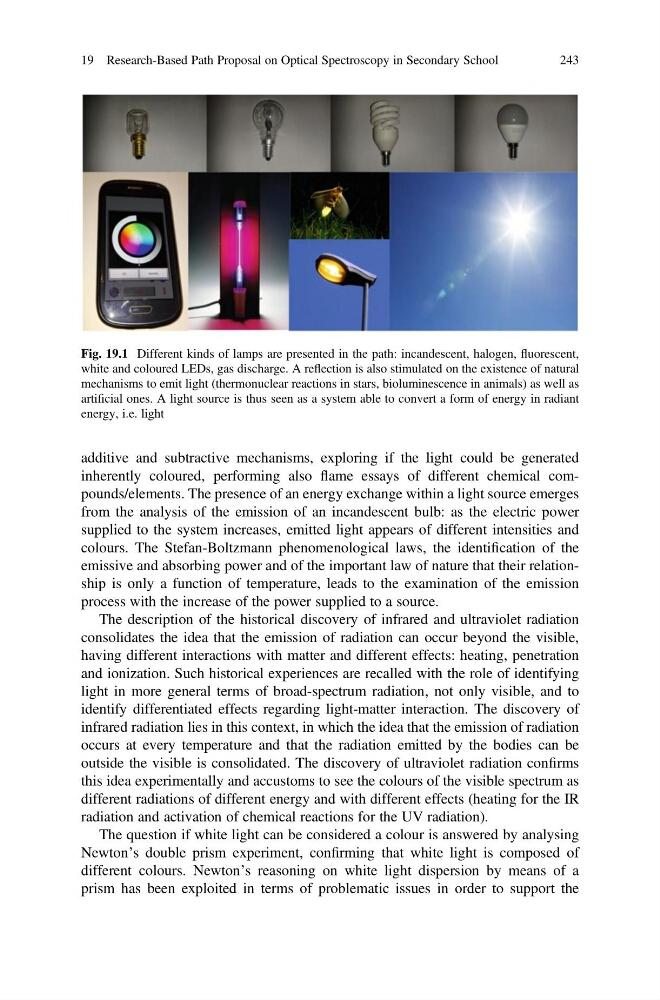
Fig. 19.1 Different kinds of lamps are presented in the path: incandescent, halogen, fluorescent,
white and coloured LEDs, gas discharge. A reflection is also stimulated on the existence of natural
mechanisms to emit light (thermonuclear reactions in stars, bioluminescence in animals) as well as
artificial ones. A light source is thus seen as a system able to convert a form of energy in radiant
energy, i.e. light
19 Research-Based Path Proposal on Optical Spectroscopy in Secondary School
243
inherently coloured, performing also flame essays of different chemical compounds/elements. The presence of an energy exchange within a light source emerges
from the analysis of the emission of an incandescent bulb: as the electric power
supplied to the system increases, emitted light appears of different intensities and
colours. The Stefan-Boltzmann phenomenological laws, the identification of the
emissive and absorbing power and of the important law of nature that their relationship is only a function of temperature, leads to the examination of the emission
process with the increase of the power supplied to a source.
The description of the historical discovery of infrared and ultraviolet radiation
consolidates the idea that the emission of radiation can occur beyond the visible,
having different interactions with matter and different effects: heating, penetration
and ionization. Such historical experiences are recalled with the role of identifying
light in more general terms of broad-spectrum radiation, not only visible, and to
identify differentiated effects regarding light-matter interaction. The discovery of
infrared radiation lies in this context, in which the idea that the emission of radiation
occurs at every temperature and that the radiation emitted by the bodies can be
outside the visible is consolidated. The discovery of ultraviolet radiation confirms
this idea experimentally and accustoms to see the colours of the visible spectrum as
different radiations of different energy and with different effects (heating for the IR
radiation and activation of chemical reactions for the UV radiation).
The question if white light can be considered a colour is answered by analysing
Newton’s double prism experiment, confirming that white light is composed of
different colours. Newton’s reasoning on white light dispersion by means of a
prism has been exploited in terms of problematic issues in order to support the
Fig. 19.1 Different kinds of lamps are presented in the path: incandescent, halogen, fluorescent,
white and coloured LEDs, gas discharge. A reflection is also stimulated on the existence of natural
mechanisms to emit light (thermonuclear reactions in stars, bioluminescence in animals) as well as
artificial ones. A light source is thus seen as a system able to convert a form of energy in radiant
energy, i.e. light
19 Research-Based Path Proposal on Optical Spectroscopy in Secondary School
243