

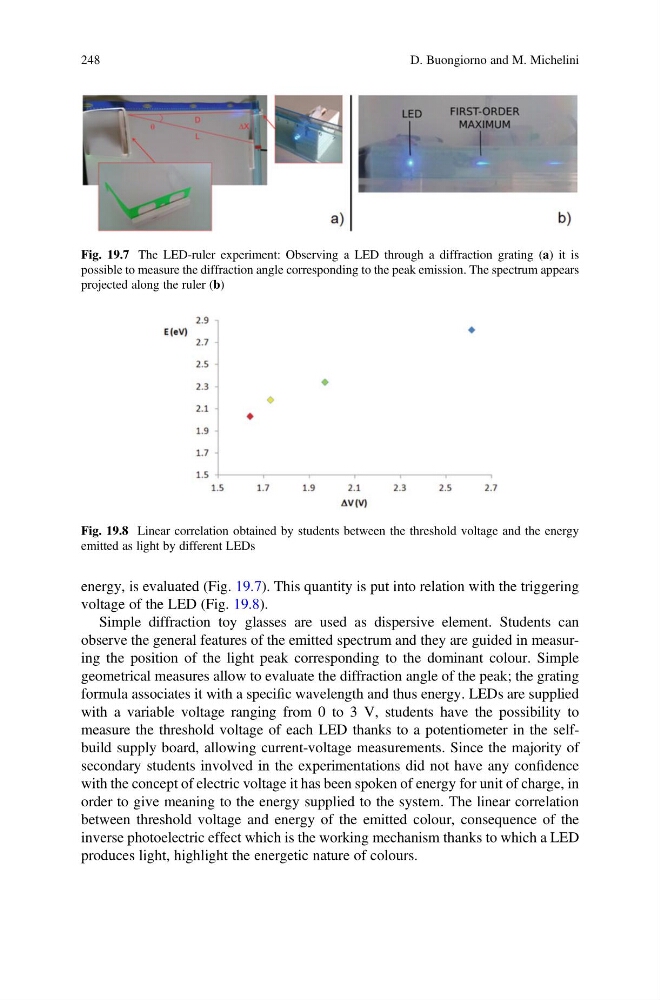
energy, is evaluated (Fig. 19.7). This quantity is put into relation with the triggering
voltage of the LED (Fig. 19.8).
Simple diffraction toy glasses are used as dispersive element. Students can
observe the general features of the emitted spectrum and they are guided in measuring the position of the light peak corresponding to the dominant colour. Simple
geometrical measures allow to evaluate the diffraction angle of the peak; the grating
formula associates it with a specific wavelength and thus energy. LEDs are supplied
with a variable voltage ranging from 0 to 3 V, students have the possibility to
measure the threshold voltage of each LED thanks to a potentiometer in the selfbuild supply board, allowing current-voltage measurements. Since the majority of
secondary students involved in the experimentations did not have any confidence
with the concept of electric voltage it has been spoken of energy for unit of charge, in
order to give meaning to the energy supplied to the system. The linear correlation
between threshold voltage and energy of the emitted colour, consequence of the
inverse photoelectric effect which is the working mechanism thanks to which a LED
produces light, highlight the energetic nature of colours.
Fig. 19.7 The LED-ruler experiment: Observing a LED through a diffraction grating (a) it is
possible to measure the diffraction angle corresponding to the peak emission. The spectrum appears
projected along the ruler (b)
Fig. 19.8 Linear correlation obtained by students between the threshold voltage and the energy
emitted as light by different LEDs
248
D. Buongiorno and M. Michelini
voltage of the LED (Fig. 19.8).
Simple diffraction toy glasses are used as dispersive element. Students can
observe the general features of the emitted spectrum and they are guided in measuring the position of the light peak corresponding to the dominant colour. Simple
geometrical measures allow to evaluate the diffraction angle of the peak; the grating
formula associates it with a specific wavelength and thus energy. LEDs are supplied
with a variable voltage ranging from 0 to 3 V, students have the possibility to
measure the threshold voltage of each LED thanks to a potentiometer in the selfbuild supply board, allowing current-voltage measurements. Since the majority of
secondary students involved in the experimentations did not have any confidence
with the concept of electric voltage it has been spoken of energy for unit of charge, in
order to give meaning to the energy supplied to the system. The linear correlation
between threshold voltage and energy of the emitted colour, consequence of the
inverse photoelectric effect which is the working mechanism thanks to which a LED
produces light, highlight the energetic nature of colours.
Fig. 19.7 The LED-ruler experiment: Observing a LED through a diffraction grating (a) it is
possible to measure the diffraction angle corresponding to the peak emission. The spectrum appears
projected along the ruler (b)
Fig. 19.8 Linear correlation obtained by students between the threshold voltage and the energy
emitted as light by different LEDs
248
D. Buongiorno and M. Michelini