

1.3.5 Gauge Anomalies: Quark-Lepton Symmetry
A gauge anomaly is a feature of quantum physics, a one-loop diagram, invalidating
the gauge symmetry of a quantum field theory. All gauge anomalies must cancel out.
Anomalies in gauge symmetries would destroy the required cancellation of
unphysical degrees of freedom, such as a photon polarization in time direction.
Are gauge anomalies cancelled in the standard model? Anomalies appear in even
D spacetime dimensions with CHIRAL fermions running in the loop with n ¼ 1 + D/
2 vertices. For D ¼ 4, n ¼ 3, it corresponds to vector-vector-axial couplings! The
condition for cancellation involves the particle content and the relations among their
couplings (Fujikawa and Suzuki 2004): the symmetrized trace over the generators of
the gauge group vanishes
tr τ i , τ j
È
É τ k
À
Á ¼ 0
ð1:8Þ
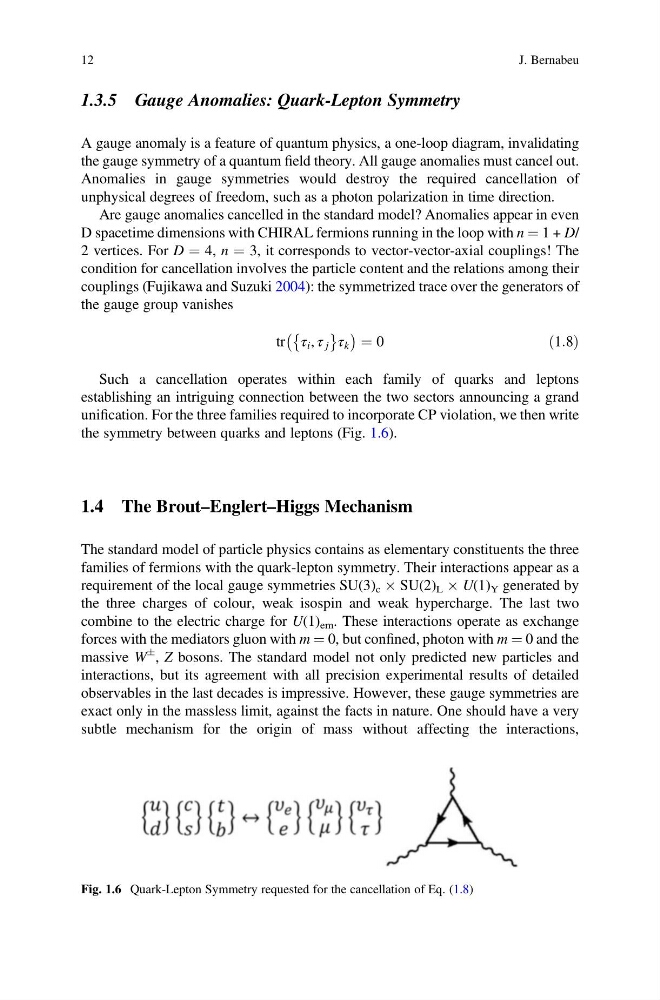
Such a cancellation operates within each family of quarks and leptons
establishing an intriguing connection between the two sectors announcing a grand
unification. For the three families required to incorporate CP violation, we then write
the symmetry between quarks and leptons (Fig. 1.6).
1.4 The Brout–Englert–Higgs Mechanism
The standard model of particle physics contains as elementary constituents the three
families of fermions with the quark-lepton symmetry. Their interactions appear as a
requirement of the local gauge symmetries SU(3) c  SU(2) L  U(1) Y generated by
the three charges of colour, weak isospin and weak hypercharge. The last two
combine to the electric charge for U(1) em . These interactions operate as exchange
forces with the mediators gluon with m ¼ 0, but confined, photon with m ¼ 0 and the
massive W
Æ , Z bosons. The standard model not only predicted new particles and
interactions, but its agreement with all precision experimental results of detailed
observables in the last decades is impressive. However, these gauge symmetries are
exact only in the massless limit, against the facts in nature. One should have a very
subtle mechanism for the origin of mass without affecting the interactions,
Fig. 1.6 Quark-Lepton Symmetry requested for the cancellation of Eq. (1.8)
12
J. Bernabeu
A gauge anomaly is a feature of quantum physics, a one-loop diagram, invalidating
the gauge symmetry of a quantum field theory. All gauge anomalies must cancel out.
Anomalies in gauge symmetries would destroy the required cancellation of
unphysical degrees of freedom, such as a photon polarization in time direction.
Are gauge anomalies cancelled in the standard model? Anomalies appear in even
D spacetime dimensions with CHIRAL fermions running in the loop with n ¼ 1 + D/
2 vertices. For D ¼ 4, n ¼ 3, it corresponds to vector-vector-axial couplings! The
condition for cancellation involves the particle content and the relations among their
couplings (Fujikawa and Suzuki 2004): the symmetrized trace over the generators of
the gauge group vanishes
tr τ i , τ j
È
É τ k
À
Á ¼ 0
ð1:8Þ
Such a cancellation operates within each family of quarks and leptons
establishing an intriguing connection between the two sectors announcing a grand
unification. For the three families required to incorporate CP violation, we then write
the symmetry between quarks and leptons (Fig. 1.6).
1.4 The Brout–Englert–Higgs Mechanism
The standard model of particle physics contains as elementary constituents the three
families of fermions with the quark-lepton symmetry. Their interactions appear as a
requirement of the local gauge symmetries SU(3) c  SU(2) L  U(1) Y generated by
the three charges of colour, weak isospin and weak hypercharge. The last two
combine to the electric charge for U(1) em . These interactions operate as exchange
forces with the mediators gluon with m ¼ 0, but confined, photon with m ¼ 0 and the
massive W
Æ , Z bosons. The standard model not only predicted new particles and
interactions, but its agreement with all precision experimental results of detailed
observables in the last decades is impressive. However, these gauge symmetries are
exact only in the massless limit, against the facts in nature. One should have a very
subtle mechanism for the origin of mass without affecting the interactions,
Fig. 1.6 Quark-Lepton Symmetry requested for the cancellation of Eq. (1.8)
12
J. Bernabeu