

responsible of the SU(2) L Â U(1) Y gauge symmetry breaking into U(1) em . This is the
Brout–Englert–Higgs mechanism (Englert and Brout 1964; Higgs 1964).
The Spontaneous ElectroWeak Symmetry Breaking (SEWSB) is based on the
possibility that a symmetric Law of Physics can lead to asymmetric solutions. One
should be aware that a quantum field theory needs for its precise definition not only
the Lagrangian (the physical law) but also the quantum vacuum, the lowest energy
state from which particles are created and annihilated. SEWSB means that the
physical law is symmetric and the vacuum is asymmetric. How?
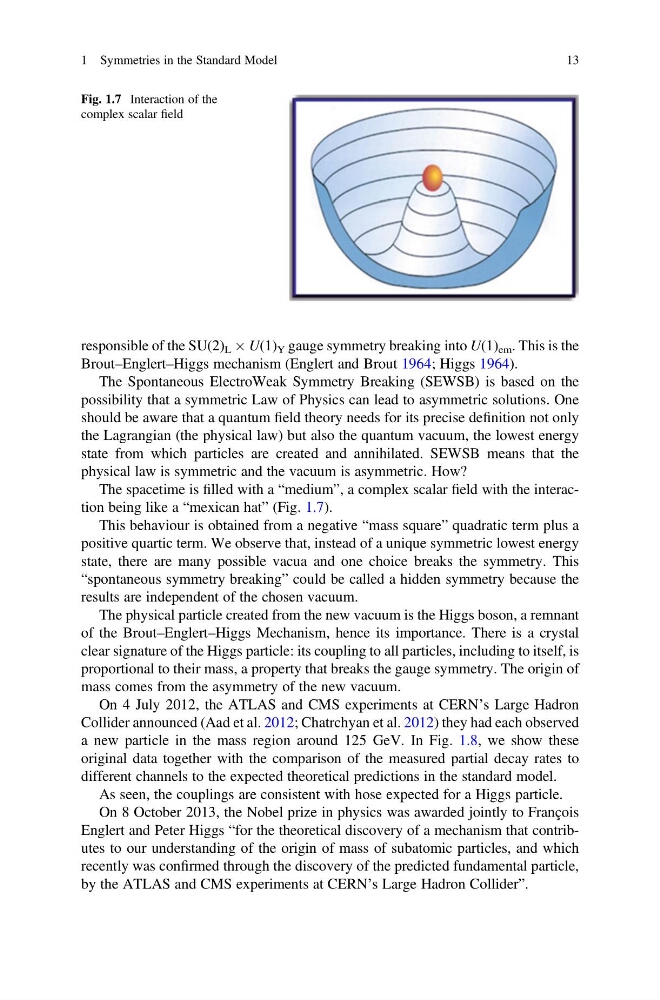
The spacetime is filled with a “medium”, a complex scalar field with the interaction being like a “mexican hat” (Fig. 1.7).
This behaviour is obtained from a negative “mass square” quadratic term plus a
positive quartic term. We observe that, instead of a unique symmetric lowest energy
state, there are many possible vacua and one choice breaks the symmetry. This
“spontaneous symmetry breaking” could be called a hidden symmetry because the
results are independent of the chosen vacuum.
The physical particle created from the new vacuum is the Higgs boson, a remnant
of the Brout–Englert–Higgs Mechanism, hence its importance. There is a crystal
clear signature of the Higgs particle: its coupling to all particles, including to itself, is
proportional to their mass, a property that breaks the gauge symmetry. The origin of
mass comes from the asymmetry of the new vacuum.
On 4 July 2012, the ATLAS and CMS experiments at CERN’s Large Hadron
Collider announced (Aad et al. 2012; Chatrchyan et al. 2012) they had each observed
a new particle in the mass region around 125 GeV. In Fig. 1.8, we show these
original data together with the comparison of the measured partial decay rates to
different channels to the expected theoretical predictions in the standard model.
As seen, the couplings are consistent with hose expected for a Higgs particle.
On 8 October 2013, the Nobel prize in physics was awarded jointly to François
Englert and Peter Higgs “for the theoretical discovery of a mechanism that contributes to our understanding of the origin of mass of subatomic particles, and which
recently was confirmed through the discovery of the predicted fundamental particle,
by the ATLAS and CMS experiments at CERN’s Large Hadron Collider”.
Fig. 1.7 Interaction of the
complex scalar field
1 Symmetries in the Standard Model
13
Brout–Englert–Higgs mechanism (Englert and Brout 1964; Higgs 1964).
The Spontaneous ElectroWeak Symmetry Breaking (SEWSB) is based on the
possibility that a symmetric Law of Physics can lead to asymmetric solutions. One
should be aware that a quantum field theory needs for its precise definition not only
the Lagrangian (the physical law) but also the quantum vacuum, the lowest energy
state from which particles are created and annihilated. SEWSB means that the
physical law is symmetric and the vacuum is asymmetric. How?
The spacetime is filled with a “medium”, a complex scalar field with the interaction being like a “mexican hat” (Fig. 1.7).
This behaviour is obtained from a negative “mass square” quadratic term plus a
positive quartic term. We observe that, instead of a unique symmetric lowest energy
state, there are many possible vacua and one choice breaks the symmetry. This
“spontaneous symmetry breaking” could be called a hidden symmetry because the
results are independent of the chosen vacuum.
The physical particle created from the new vacuum is the Higgs boson, a remnant
of the Brout–Englert–Higgs Mechanism, hence its importance. There is a crystal
clear signature of the Higgs particle: its coupling to all particles, including to itself, is
proportional to their mass, a property that breaks the gauge symmetry. The origin of
mass comes from the asymmetry of the new vacuum.
On 4 July 2012, the ATLAS and CMS experiments at CERN’s Large Hadron
Collider announced (Aad et al. 2012; Chatrchyan et al. 2012) they had each observed
a new particle in the mass region around 125 GeV. In Fig. 1.8, we show these
original data together with the comparison of the measured partial decay rates to
different channels to the expected theoretical predictions in the standard model.
As seen, the couplings are consistent with hose expected for a Higgs particle.
On 8 October 2013, the Nobel prize in physics was awarded jointly to François
Englert and Peter Higgs “for the theoretical discovery of a mechanism that contributes to our understanding of the origin of mass of subatomic particles, and which
recently was confirmed through the discovery of the predicted fundamental particle,
by the ATLAS and CMS experiments at CERN’s Large Hadron Collider”.
Fig. 1.7 Interaction of the
complex scalar field
1 Symmetries in the Standard Model
13