

1.3.4 Time Reversal
A symmetry transformation T that changes the dynamics of a physical system into
another with an inverted sense of time evolution is called time reversal (reversal-intime). It is implemented in the space of states by an antiunitary operator implying
that its study has to be made with asymmetries built under the exchange of in, out
states.
The decay is an irreversible process indicating that a true TRV observable,
needing a definite preparation and filtering of the appropriate initial and final particle
state, looks impossible for transitions in the case of decaying particles. A bypass to
this NO-GO argument was found (Banuls and Bernabéu 1999, 2000) using
entangled systems of unstable particles with the ingredients: (a) The decay as a
filtering measurement; (b) Entanglement implying the information transfer from the
decayed particle to its living partner. For the entangled B
0
À B
0 system produced by
e
+ e
À collisions at the Υ(4S) peak, one may study the time dependence in meson
transitions associated to the definite flavour-CP eigenstate decay products. There are
2(Flavour) Â 2(CP)—2(time ordering) ¼ 8 transitions of this kind which can be
connected by different separate genuine T, CP, CPT symmetry transformations.
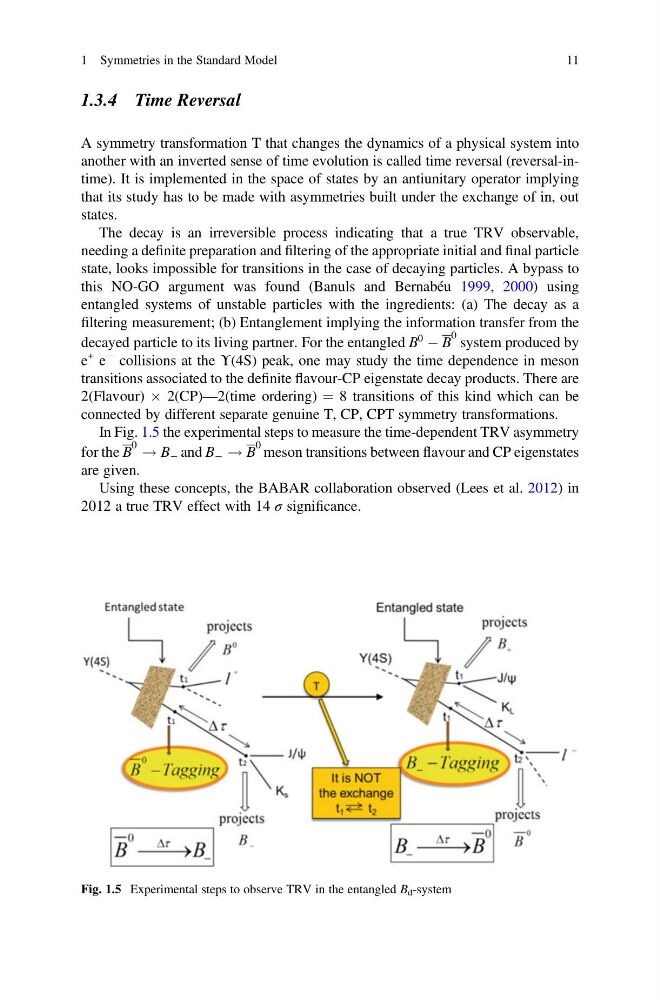
In Fig. 1.5 the experimental steps to measure the time-dependent TRV asymmetry
for the B
0 ! B À and B À ! B
0 meson transitions between flavour and CP eigenstates
are given.
Using these concepts, the BABAR collaboration observed (Lees et al. 2012) in
2012 a true TRV effect with 14 σ significance.
Fig. 1.5 Experimental steps to observe TRV in the entangled B d -system
1 Symmetries in the Standard Model
11
A symmetry transformation T that changes the dynamics of a physical system into
another with an inverted sense of time evolution is called time reversal (reversal-intime). It is implemented in the space of states by an antiunitary operator implying
that its study has to be made with asymmetries built under the exchange of in, out
states.
The decay is an irreversible process indicating that a true TRV observable,
needing a definite preparation and filtering of the appropriate initial and final particle
state, looks impossible for transitions in the case of decaying particles. A bypass to
this NO-GO argument was found (Banuls and Bernabéu 1999, 2000) using
entangled systems of unstable particles with the ingredients: (a) The decay as a
filtering measurement; (b) Entanglement implying the information transfer from the
decayed particle to its living partner. For the entangled B
0
À B
0 system produced by
e
+ e
À collisions at the Υ(4S) peak, one may study the time dependence in meson
transitions associated to the definite flavour-CP eigenstate decay products. There are
2(Flavour) Â 2(CP)—2(time ordering) ¼ 8 transitions of this kind which can be
connected by different separate genuine T, CP, CPT symmetry transformations.
In Fig. 1.5 the experimental steps to measure the time-dependent TRV asymmetry
for the B
0 ! B À and B À ! B
0 meson transitions between flavour and CP eigenstates
are given.
Using these concepts, the BABAR collaboration observed (Lees et al. 2012) in
2012 a true TRV effect with 14 σ significance.
Fig. 1.5 Experimental steps to observe TRV in the entangled B d -system
1 Symmetries in the Standard Model
11