

most general mismatch mixing matrix U between weak and mass eigenstates for d-sb quarks contains a physical relative phase such that for antiquarks becomes its
complex conjugate U*. One would need three families of fermions at least!
The b b Υ meson was discovered in 1977 at FermiLab and B-mesons later. Since
then all known laboratory experimental results on CP violation for K, B and
D physics are in agreement with the unitary mixing matrix paradigm U (CKM)
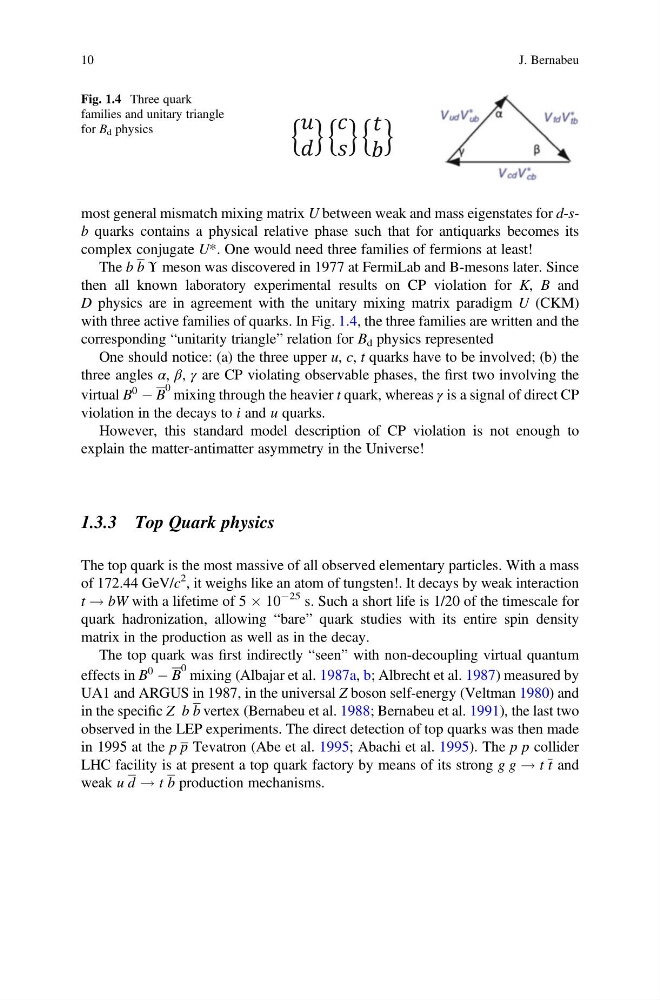
with three active families of quarks. In Fig. 1.4, the three families are written and the
corresponding “unitarity triangle” relation for B d physics represented
One should notice: (a) the three upper u, c, t quarks have to be involved; (b) the
three angles α, β, γ are CP violating observable phases, the first two involving the
virtual B
0
À B
0 mixing through the heavier t quark, whereas γ is a signal of direct CP
violation in the decays to i and u quarks.
However, this standard model description of CP violation is not enough to
explain the matter-antimatter asymmetry in the Universe!
1.3.3 Top Quark physics
The top quark is the most massive of all observed elementary particles. With a mass
of 172.44 GeV/c
2 , it weighs like an atom of tungsten!. It decays by weak interaction
t ! bW with a lifetime of 5 Â 10
À25 s. Such a short life is 1/20 of the timescale for
quark hadronization, allowing “bare” quark studies with its entire spin density
matrix in the production as well as in the decay.
The top quark was first indirectly “seen” with non-decoupling virtual quantum
effects in B
0
À B
0 mixing (Albajar et al. 1987a, b; Albrecht et al. 1987) measured by
UA1 and ARGUS in 1987, in the universal Z boson self-energy (Veltman 1980) and
in the specific Z b b vertex (Bernabeu et al. 1988; Bernabeu et al. 1991), the last two
observed in the LEP experiments. The direct detection of top quarks was then made
in 1995 at the p p Tevatron (Abe et al. 1995; Abachi et al. 1995). The p p collider
LHC facility is at present a top quark factory by means of its strong g g ! t t and
weak u d ! t b production mechanisms.
Fig. 1.4 Three quark
families and unitary triangle
for B d physics
10
J. Bernabeu
complex conjugate U*. One would need three families of fermions at least!
The b b Υ meson was discovered in 1977 at FermiLab and B-mesons later. Since
then all known laboratory experimental results on CP violation for K, B and
D physics are in agreement with the unitary mixing matrix paradigm U (CKM)
with three active families of quarks. In Fig. 1.4, the three families are written and the
corresponding “unitarity triangle” relation for B d physics represented
One should notice: (a) the three upper u, c, t quarks have to be involved; (b) the
three angles α, β, γ are CP violating observable phases, the first two involving the
virtual B
0
À B
0 mixing through the heavier t quark, whereas γ is a signal of direct CP
violation in the decays to i and u quarks.
However, this standard model description of CP violation is not enough to
explain the matter-antimatter asymmetry in the Universe!
1.3.3 Top Quark physics
The top quark is the most massive of all observed elementary particles. With a mass
of 172.44 GeV/c
2 , it weighs like an atom of tungsten!. It decays by weak interaction
t ! bW with a lifetime of 5 Â 10
À25 s. Such a short life is 1/20 of the timescale for
quark hadronization, allowing “bare” quark studies with its entire spin density
matrix in the production as well as in the decay.
The top quark was first indirectly “seen” with non-decoupling virtual quantum
effects in B
0
À B
0 mixing (Albajar et al. 1987a, b; Albrecht et al. 1987) measured by
UA1 and ARGUS in 1987, in the universal Z boson self-energy (Veltman 1980) and
in the specific Z b b vertex (Bernabeu et al. 1988; Bernabeu et al. 1991), the last two
observed in the LEP experiments. The direct detection of top quarks was then made
in 1995 at the p p Tevatron (Abe et al. 1995; Abachi et al. 1995). The p p collider
LHC facility is at present a top quark factory by means of its strong g g ! t t and
weak u d ! t b production mechanisms.
Fig. 1.4 Three quark
families and unitary triangle
for B d physics
10
J. Bernabeu