

et al. 1983; Bagnaia et al. 1983) decays. These CERN discoveries established the
triumph of the standard model of electroweak interactions.
1.3.1 GIM Mechanism: Need of Charm
With u, d, s quarks only, the Cabibbo d-s mixing in the charged weak current leads,
by the SU(2) L symmetry of the standard model, to strangeness-changing-neutral
current at tree level implying, for example, fast K L ! μ
+
μ
À decay, against
experiment. In 1970, Glashow–Iliopoulos–Maiani (Glashow et al. 1970) solved
this problem with an additional fourth quark flavour c completing two families of
quark doublets
u
d
( )
c
s
( )
, U ¼
cos θ À sin θ
sin θ
cos θ
!
ð1:7Þ
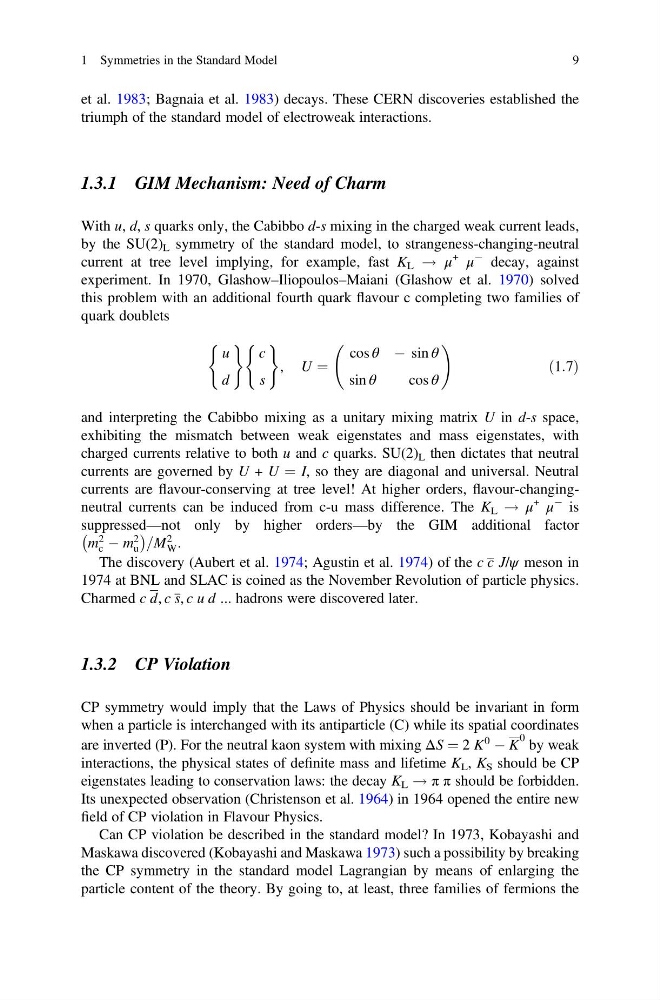
and interpreting the Cabibbo mixing as a unitary mixing matrix U in d-s space,
exhibiting the mismatch between weak eigenstates and mass eigenstates, with
charged currents relative to both u and c quarks. SU(2) L then dictates that neutral
currents are governed by U + U ¼ I, so they are diagonal and universal. Neutral
currents are flavour-conserving at tree level! At higher orders, flavour-changingneutral currents can be induced from c-u mass difference. The K L ! μ
+
μ
À is
suppressed—not only by higher orders—by the GIM additional factor
m
2
c À m
2
u
À
Á
=M
2
W .
The discovery (Aubert et al. 1974; Agustin et al. 1974) of the c c J/ψ meson in
1974 at BNL and SLAC is coined as the November Revolution of particle physics.
Charmed c d, c s, c u d ... hadrons were discovered later.
1.3.2 CP Violation
CP symmetry would imply that the Laws of Physics should be invariant in form
when a particle is interchanged with its antiparticle (C) while its spatial coordinates
are inverted (P). For the neutral kaon system with mixing ΔS ¼ 2 K
0
À K
0 by weak
interactions, the physical states of definite mass and lifetime K L , K S should be CP
eigenstates leading to conservation laws: the decay K L ! π π should be forbidden.
Its unexpected observation (Christenson et al. 1964) in 1964 opened the entire new
field of CP violation in Flavour Physics.
Can CP violation be described in the standard model? In 1973, Kobayashi and
Maskawa discovered (Kobayashi and Maskawa 1973) such a possibility by breaking
the CP symmetry in the standard model Lagrangian by means of enlarging the
particle content of the theory. By going to, at least, three families of fermions the
1 Symmetries in the Standard Model
9
triumph of the standard model of electroweak interactions.
1.3.1 GIM Mechanism: Need of Charm
With u, d, s quarks only, the Cabibbo d-s mixing in the charged weak current leads,
by the SU(2) L symmetry of the standard model, to strangeness-changing-neutral
current at tree level implying, for example, fast K L ! μ
+
μ
À decay, against
experiment. In 1970, Glashow–Iliopoulos–Maiani (Glashow et al. 1970) solved
this problem with an additional fourth quark flavour c completing two families of
quark doublets
u
d
( )
c
s
( )
, U ¼
cos θ À sin θ
sin θ
cos θ
!
ð1:7Þ
and interpreting the Cabibbo mixing as a unitary mixing matrix U in d-s space,
exhibiting the mismatch between weak eigenstates and mass eigenstates, with
charged currents relative to both u and c quarks. SU(2) L then dictates that neutral
currents are governed by U + U ¼ I, so they are diagonal and universal. Neutral
currents are flavour-conserving at tree level! At higher orders, flavour-changingneutral currents can be induced from c-u mass difference. The K L ! μ
+
μ
À is
suppressed—not only by higher orders—by the GIM additional factor
m
2
c À m
2
u
À
Á
=M
2
W .
The discovery (Aubert et al. 1974; Agustin et al. 1974) of the c c J/ψ meson in
1974 at BNL and SLAC is coined as the November Revolution of particle physics.
Charmed c d, c s, c u d ... hadrons were discovered later.
1.3.2 CP Violation
CP symmetry would imply that the Laws of Physics should be invariant in form
when a particle is interchanged with its antiparticle (C) while its spatial coordinates
are inverted (P). For the neutral kaon system with mixing ΔS ¼ 2 K
0
À K
0 by weak
interactions, the physical states of definite mass and lifetime K L , K S should be CP
eigenstates leading to conservation laws: the decay K L ! π π should be forbidden.
Its unexpected observation (Christenson et al. 1964) in 1964 opened the entire new
field of CP violation in Flavour Physics.
Can CP violation be described in the standard model? In 1973, Kobayashi and
Maskawa discovered (Kobayashi and Maskawa 1973) such a possibility by breaking
the CP symmetry in the standard model Lagrangian by means of enlarging the
particle content of the theory. By going to, at least, three families of fermions the
1 Symmetries in the Standard Model
9