

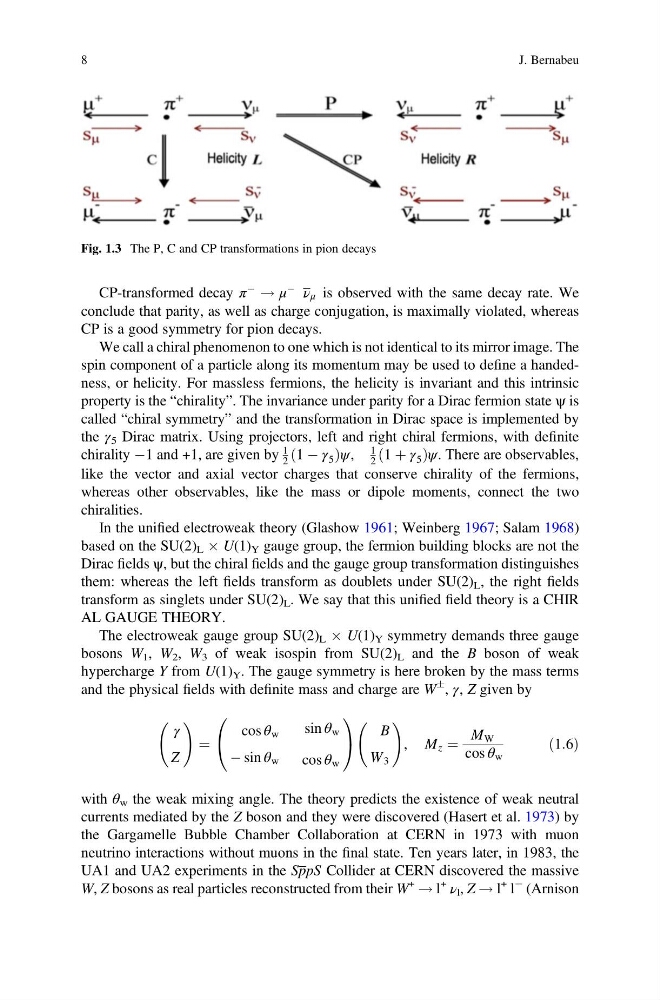
CP-transformed decay π
À
! μ
À
ν μ is observed with the same decay rate. We
conclude that parity, as well as charge conjugation, is maximally violated, whereas
CP is a good symmetry for pion decays.
We call a chiral phenomenon to one which is not identical to its mirror image. The
spin component of a particle along its momentum may be used to define a handedness, or helicity. For massless fermions, the helicity is invariant and this intrinsic
property is the “chirality”. The invariance under parity for a Dirac fermion state ψ is
called “chiral symmetry” and the transformation in Dirac space is implemented by
the γ 5 Dirac matrix. Using projectors, left and right chiral fermions, with definite
chirality À1 and +1, are given by
1
2 1 À γ 5
ð
Þψ,
1
2 1 þ γ 5
ð
Þψ. There are observables,
like the vector and axial vector charges that conserve chirality of the fermions,
whereas other observables, like the mass or dipole moments, connect the two
chiralities.
In the unified electroweak theory (Glashow 1961; Weinberg 1967; Salam 1968)
based on the SU(2) L Â U(1) Y gauge group, the fermion building blocks are not the
Dirac fields ψ, but the chiral fields and the gauge group transformation distinguishes
them: whereas the left fields transform as doublets under SU(2) L , the right fields
transform as singlets under SU(2) L . We say that this unified field theory is a CHIR
AL GAUGE THEORY.
The electroweak gauge group SU(2) L Â U(1) Y symmetry demands three gauge
bosons W 1 , W 2 , W 3 of weak isospin from SU(2) L and the B boson of weak
hypercharge Y from U(1) Y . The gauge symmetry is here broken by the mass terms
and the physical fields with definite mass and charge are W
Æ , γ, Z given by
γ
Z
!
¼
cos θ w
À sin θ w
sin θ w
cos θ w
0
@
1
A
B
W 3
!
, M z ¼
M W
cos θ w
ð1:6Þ
with θ w the weak mixing angle. The theory predicts the existence of weak neutral
currents mediated by the Z boson and they were discovered (Hasert et al. 1973) by
the Gargamelle Bubble Chamber Collaboration at CERN in 1973 with muon
neutrino interactions without muons in the final state. Ten years later, in 1983, the
UA1 and UA2 experiments in the SppS Collider at CERN discovered the massive
W, Z bosons as real particles reconstructed from their W
+
! l
+
ν l , Z ! l
+ l
À (Arnison
Fig. 1.3 The P, C and CP transformations in pion decays
8
J. Bernabeu
À
! μ
À
ν μ is observed with the same decay rate. We
conclude that parity, as well as charge conjugation, is maximally violated, whereas
CP is a good symmetry for pion decays.
We call a chiral phenomenon to one which is not identical to its mirror image. The
spin component of a particle along its momentum may be used to define a handedness, or helicity. For massless fermions, the helicity is invariant and this intrinsic
property is the “chirality”. The invariance under parity for a Dirac fermion state ψ is
called “chiral symmetry” and the transformation in Dirac space is implemented by
the γ 5 Dirac matrix. Using projectors, left and right chiral fermions, with definite
chirality À1 and +1, are given by
1
2 1 À γ 5
ð
Þψ,
1
2 1 þ γ 5
ð
Þψ. There are observables,
like the vector and axial vector charges that conserve chirality of the fermions,
whereas other observables, like the mass or dipole moments, connect the two
chiralities.
In the unified electroweak theory (Glashow 1961; Weinberg 1967; Salam 1968)
based on the SU(2) L Â U(1) Y gauge group, the fermion building blocks are not the
Dirac fields ψ, but the chiral fields and the gauge group transformation distinguishes
them: whereas the left fields transform as doublets under SU(2) L , the right fields
transform as singlets under SU(2) L . We say that this unified field theory is a CHIR
AL GAUGE THEORY.
The electroweak gauge group SU(2) L Â U(1) Y symmetry demands three gauge
bosons W 1 , W 2 , W 3 of weak isospin from SU(2) L and the B boson of weak
hypercharge Y from U(1) Y . The gauge symmetry is here broken by the mass terms
and the physical fields with definite mass and charge are W
Æ , γ, Z given by
γ
Z
!
¼
cos θ w
À sin θ w
sin θ w
cos θ w
0
@
1
A
B
W 3
!
, M z ¼
M W
cos θ w
ð1:6Þ
with θ w the weak mixing angle. The theory predicts the existence of weak neutral
currents mediated by the Z boson and they were discovered (Hasert et al. 1973) by
the Gargamelle Bubble Chamber Collaboration at CERN in 1973 with muon
neutrino interactions without muons in the final state. Ten years later, in 1983, the
UA1 and UA2 experiments in the SppS Collider at CERN discovered the massive
W, Z bosons as real particles reconstructed from their W
+
! l
+
ν l , Z ! l
+ l
À (Arnison
Fig. 1.3 The P, C and CP transformations in pion decays
8
J. Bernabeu