

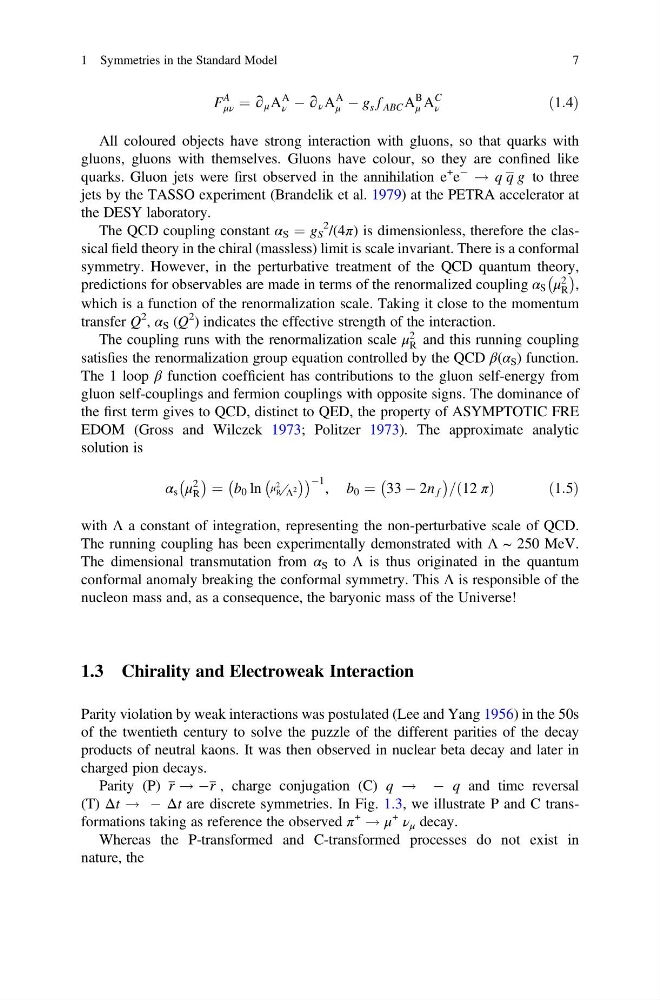
F
A
μν ¼ ∂ μ Α
Α
ν À ∂ ν Α
Α
μ À g s f ABC Α
B
μ Α
C
ν
ð1:4Þ
All coloured objects have strong interaction with gluons, so that quarks with
gluons, gluons with themselves. Gluons have colour, so they are confined like
quarks. Gluon jets were first observed in the annihilation e
+
e
À
! q q g to three
jets by the TASSO experiment (Brandelik et al. 1979) at the PETRA accelerator at
the DESY laboratory.
The QCD coupling constant α S ¼ g S
2 /(4π) is dimensionless, therefore the classical field theory in the chiral (massless) limit is scale invariant. There is a conformal
symmetry. However, in the perturbative treatment of the QCD quantum theory,
predictions for observables are made in terms of the renormalized coupling α S μ
2
R
À Á
,
which is a function of the renormalization scale. Taking it close to the momentum
transfer Q
2 , α S (Q
2 ) indicates the effective strength of the interaction.
The coupling runs with the renormalization scale μ
2
R and this running coupling
satisfies the renormalization group equation controlled by the QCD β(α S ) function.
The 1 loop β function coefficient has contributions to the gluon self-energy from
gluon self-couplings and fermion couplings with opposite signs. The dominance of
the first term gives to QCD, distinct to QED, the property of ASYMPTOTIC FRE
EDOM (Gross and Wilczek 1973; Politzer 1973). The approximate analytic
solution is
α s μ
2
R
À Á ¼ b 0 ln μ
2
R= Λ
2
À
Á
À
Á À1 , b 0 ¼ 33 À 2n f
À
Á = 12 π
ð
Þ
ð1:5Þ
with Λ a constant of integration, representing the non-perturbative scale of QCD.
The running coupling has been experimentally demonstrated with Λ ~ 250 MeV.
The dimensional transmutation from α S to Λ is thus originated in the quantum
conformal anomaly breaking the conformal symmetry. This Λ is responsible of the
nucleon mass and, as a consequence, the baryonic mass of the Universe!
1.3 Chirality and Electroweak Interaction
Parity violation by weak interactions was postulated (Lee and Yang 1956) in the 50s
of the twentieth century to solve the puzzle of the different parities of the decay
products of neutral kaons. It was then observed in nuclear beta decay and later in
charged pion decays.
Parity (P) r ! Àr , charge conjugation (C) q ! À q and time reversal
(T) Δt ! À Δt are discrete symmetries. In Fig. 1.3, we illustrate P and C transformations taking as reference the observed π
+
! μ
+
ν μ decay.
Whereas the P-transformed and C-transformed processes do not exist in
nature, the
1 Symmetries in the Standard Model
7
A
μν ¼ ∂ μ Α
Α
ν À ∂ ν Α
Α
μ À g s f ABC Α
B
μ Α
C
ν
ð1:4Þ
All coloured objects have strong interaction with gluons, so that quarks with
gluons, gluons with themselves. Gluons have colour, so they are confined like
quarks. Gluon jets were first observed in the annihilation e
+
e
À
! q q g to three
jets by the TASSO experiment (Brandelik et al. 1979) at the PETRA accelerator at
the DESY laboratory.
The QCD coupling constant α S ¼ g S
2 /(4π) is dimensionless, therefore the classical field theory in the chiral (massless) limit is scale invariant. There is a conformal
symmetry. However, in the perturbative treatment of the QCD quantum theory,
predictions for observables are made in terms of the renormalized coupling α S μ
2
R
À Á
,
which is a function of the renormalization scale. Taking it close to the momentum
transfer Q
2 , α S (Q
2 ) indicates the effective strength of the interaction.
The coupling runs with the renormalization scale μ
2
R and this running coupling
satisfies the renormalization group equation controlled by the QCD β(α S ) function.
The 1 loop β function coefficient has contributions to the gluon self-energy from
gluon self-couplings and fermion couplings with opposite signs. The dominance of
the first term gives to QCD, distinct to QED, the property of ASYMPTOTIC FRE
EDOM (Gross and Wilczek 1973; Politzer 1973). The approximate analytic
solution is
α s μ
2
R
À Á ¼ b 0 ln μ
2
R= Λ
2
À
Á
À
Á À1 , b 0 ¼ 33 À 2n f
À
Á = 12 π
ð
Þ
ð1:5Þ
with Λ a constant of integration, representing the non-perturbative scale of QCD.
The running coupling has been experimentally demonstrated with Λ ~ 250 MeV.
The dimensional transmutation from α S to Λ is thus originated in the quantum
conformal anomaly breaking the conformal symmetry. This Λ is responsible of the
nucleon mass and, as a consequence, the baryonic mass of the Universe!
1.3 Chirality and Electroweak Interaction
Parity violation by weak interactions was postulated (Lee and Yang 1956) in the 50s
of the twentieth century to solve the puzzle of the different parities of the decay
products of neutral kaons. It was then observed in nuclear beta decay and later in
charged pion decays.
Parity (P) r ! Àr , charge conjugation (C) q ! À q and time reversal
(T) Δt ! À Δt are discrete symmetries. In Fig. 1.3, we illustrate P and C transformations taking as reference the observed π
+
! μ
+
ν μ decay.
Whereas the P-transformed and C-transformed processes do not exist in
nature, the
1 Symmetries in the Standard Model
7