

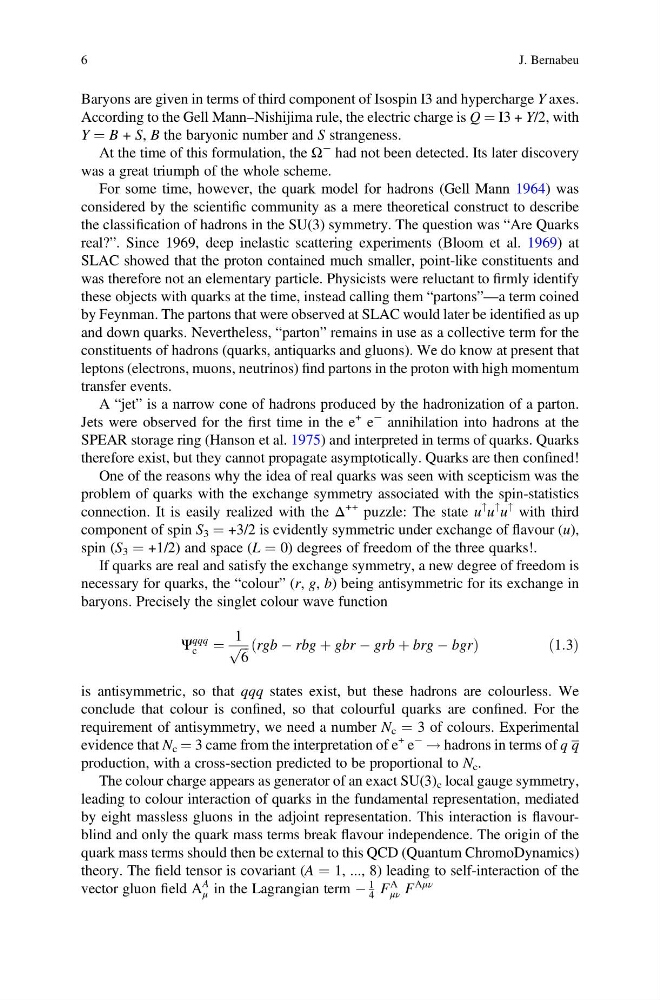
Baryons are given in terms of third component of Isospin I3 and hypercharge Y axes.
According to the Gell Mann–Nishijima rule, the electric charge is Q ¼ I3 + Y/2, with
Y ¼ B + S, B the baryonic number and S strangeness.
At the time of this formulation, the Ω
À had not been detected. Its later discovery
was a great triumph of the whole scheme.
For some time, however, the quark model for hadrons (Gell Mann 1964) was
considered by the scientific community as a mere theoretical construct to describe
the classification of hadrons in the SU(3) symmetry. The question was “Are Quarks
real?”. Since 1969, deep inelastic scattering experiments (Bloom et al. 1969) at
SLAC showed that the proton contained much smaller, point-like constituents and
was therefore not an elementary particle. Physicists were reluctant to firmly identify
these objects with quarks at the time, instead calling them “partons”—a term coined
by Feynman. The partons that were observed at SLAC would later be identified as up
and down quarks. Nevertheless, “parton” remains in use as a collective term for the
constituents of hadrons (quarks, antiquarks and gluons). We do know at present that
leptons (electrons, muons, neutrinos) find partons in the proton with high momentum
transfer events.
A “jet” is a narrow cone of hadrons produced by the hadronization of a parton.
Jets were observed for the first time in the e
+ e
À annihilation into hadrons at the
SPEAR storage ring (Hanson et al. 1975) and interpreted in terms of quarks. Quarks
therefore exist, but they cannot propagate asymptotically. Quarks are then confined!
One of the reasons why the idea of real quarks was seen with scepticism was the
problem of quarks with the exchange symmetry associated with the spin-statistics
connection. It is easily realized with the Δ
++ puzzle: The state u
" u
" u
" with third
component of spin S 3 ¼ +3/2 is evidently symmetric under exchange of flavour (u),
spin (S 3 ¼ +1/2) and space (L ¼ 0) degrees of freedom of the three quarks!.
If quarks are real and satisfy the exchange symmetry, a new degree of freedom is
necessary for quarks, the “colour” (r, g, b) being antisymmetric for its exchange in
baryons. Precisely the singlet colour wave function
Ψ
qqq
c
¼
1
ffiffi ffi
6
p rgb À rbg þ gbr À grb þ brg À bgr
ð
Þ
ð 1:3Þ
is antisymmetric, so that qqq states exist, but these hadrons are colourless. We
conclude that colour is confined, so that colourful quarks are confined. For the
requirement of antisymmetry, we need a number N c ¼ 3 of colours. Experimental
evidence that N c ¼ 3 came from the interpretation of e
+ e
À
! hadrons in terms of q q
production, with a cross-section predicted to be proportional to N c .
The colour charge appears as generator of an exact SU(3) c local gauge symmetry,
leading to colour interaction of quarks in the fundamental representation, mediated
by eight massless gluons in the adjoint representation. This interaction is flavourblind and only the quark mass terms break flavour independence. The origin of the
quark mass terms should then be external to this QCD (Quantum ChromoDynamics)
theory. The field tensor is covariant (A ¼ 1, ..., 8) leading to self-interaction of the
vector gluon field Α
A
μ in the Lagrangian term À
1
4 F
Α
μν F
Αμν
6
J. Bernabeu
According to the Gell Mann–Nishijima rule, the electric charge is Q ¼ I3 + Y/2, with
Y ¼ B + S, B the baryonic number and S strangeness.
At the time of this formulation, the Ω
À had not been detected. Its later discovery
was a great triumph of the whole scheme.
For some time, however, the quark model for hadrons (Gell Mann 1964) was
considered by the scientific community as a mere theoretical construct to describe
the classification of hadrons in the SU(3) symmetry. The question was “Are Quarks
real?”. Since 1969, deep inelastic scattering experiments (Bloom et al. 1969) at
SLAC showed that the proton contained much smaller, point-like constituents and
was therefore not an elementary particle. Physicists were reluctant to firmly identify
these objects with quarks at the time, instead calling them “partons”—a term coined
by Feynman. The partons that were observed at SLAC would later be identified as up
and down quarks. Nevertheless, “parton” remains in use as a collective term for the
constituents of hadrons (quarks, antiquarks and gluons). We do know at present that
leptons (electrons, muons, neutrinos) find partons in the proton with high momentum
transfer events.
A “jet” is a narrow cone of hadrons produced by the hadronization of a parton.
Jets were observed for the first time in the e
+ e
À annihilation into hadrons at the
SPEAR storage ring (Hanson et al. 1975) and interpreted in terms of quarks. Quarks
therefore exist, but they cannot propagate asymptotically. Quarks are then confined!
One of the reasons why the idea of real quarks was seen with scepticism was the
problem of quarks with the exchange symmetry associated with the spin-statistics
connection. It is easily realized with the Δ
++ puzzle: The state u
" u
" u
" with third
component of spin S 3 ¼ +3/2 is evidently symmetric under exchange of flavour (u),
spin (S 3 ¼ +1/2) and space (L ¼ 0) degrees of freedom of the three quarks!.
If quarks are real and satisfy the exchange symmetry, a new degree of freedom is
necessary for quarks, the “colour” (r, g, b) being antisymmetric for its exchange in
baryons. Precisely the singlet colour wave function
Ψ
qqq
c
¼
1
ffiffi ffi
6
p rgb À rbg þ gbr À grb þ brg À bgr
ð
Þ
ð 1:3Þ
is antisymmetric, so that qqq states exist, but these hadrons are colourless. We
conclude that colour is confined, so that colourful quarks are confined. For the
requirement of antisymmetry, we need a number N c ¼ 3 of colours. Experimental
evidence that N c ¼ 3 came from the interpretation of e
+ e
À
! hadrons in terms of q q
production, with a cross-section predicted to be proportional to N c .
The colour charge appears as generator of an exact SU(3) c local gauge symmetry,
leading to colour interaction of quarks in the fundamental representation, mediated
by eight massless gluons in the adjoint representation. This interaction is flavourblind and only the quark mass terms break flavour independence. The origin of the
quark mass terms should then be external to this QCD (Quantum ChromoDynamics)
theory. The field tensor is covariant (A ¼ 1, ..., 8) leading to self-interaction of the
vector gluon field Α
A
μ in the Lagrangian term À
1
4 F
Α
μν F
Αμν
6
J. Bernabeu