

d
dt
b
G
D E
¼ i b
H, b
G
h
i
D
E
¼ 0
ð1:2Þ
As b
G is Hermitian, it corresponds to an observable that satisfies a conservation
law if b
U is symmetry of b
H. Well-known examples are momentum for translations,
angular momentum for rotations or charge for gauge symmetry. For local gauge
symmetry, the requirement of invariance leads to a covariant derivative with a
mediator field responsible of interactions. This is valid for either QED with the
Abelian U(1) gauge group or non-Abelian gauge groups with the interaction field
transforming as the adjoint representation.
In Sect. 2, we develop the ideas leading from hadrons to quarks and the symmetries of strong interactions. In Sect. 3, a parallel discussion is made for electroweak
interactions starting from parity violation leading to the standard model with neutral
currents and the need of charm plus the third family, including quark-lepton symmetry. Section 4 presents the Brout–Englert–Higgs mechanism for the origin of
mass breaking the electroweak gauge symmetry. Some conclusions and outlook are
given in Sect. 5.
1.2 Quarks and Strong Interactions
The proliferation of non-strange and strange Hadrons in the 60s of the twentieth
century led to the Eightfold Way of Gell Mann and Ne’eman with the use of the
Flavour SU(3) symmetry. The fundamental representations 3, 3 are the elementary
building blocks for arbitrary higher-dimensional representations. Mesons are q À q
states 3 Â 3 ¼ 1 þ 8, Baryons are q-q-q states 3 Â 3 Â 3 ¼ 1 + 8 s + 8 a + 10, with
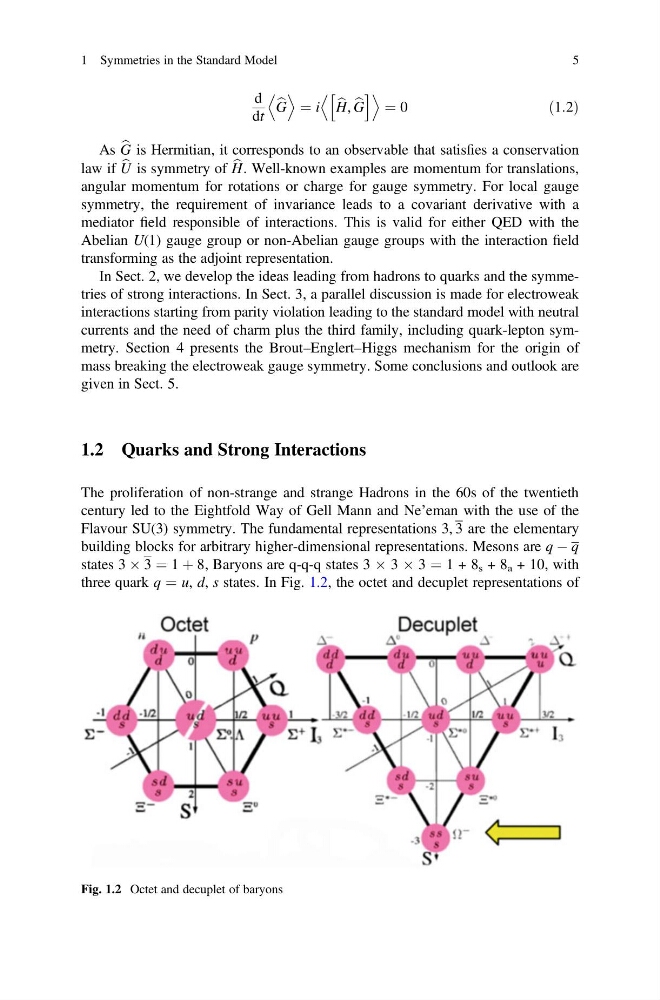
three quark q ¼ u, d, s states. In Fig. 1.2, the octet and decuplet representations of
Fig. 1.2 Octet and decuplet of baryons
1 Symmetries in the Standard Model
5
dt
b
G
D E
¼ i b
H, b
G
h
i
D
E
¼ 0
ð1:2Þ
As b
G is Hermitian, it corresponds to an observable that satisfies a conservation
law if b
U is symmetry of b
H. Well-known examples are momentum for translations,
angular momentum for rotations or charge for gauge symmetry. For local gauge
symmetry, the requirement of invariance leads to a covariant derivative with a
mediator field responsible of interactions. This is valid for either QED with the
Abelian U(1) gauge group or non-Abelian gauge groups with the interaction field
transforming as the adjoint representation.
In Sect. 2, we develop the ideas leading from hadrons to quarks and the symmetries of strong interactions. In Sect. 3, a parallel discussion is made for electroweak
interactions starting from parity violation leading to the standard model with neutral
currents and the need of charm plus the third family, including quark-lepton symmetry. Section 4 presents the Brout–Englert–Higgs mechanism for the origin of
mass breaking the electroweak gauge symmetry. Some conclusions and outlook are
given in Sect. 5.
1.2 Quarks and Strong Interactions
The proliferation of non-strange and strange Hadrons in the 60s of the twentieth
century led to the Eightfold Way of Gell Mann and Ne’eman with the use of the
Flavour SU(3) symmetry. The fundamental representations 3, 3 are the elementary
building blocks for arbitrary higher-dimensional representations. Mesons are q À q
states 3 Â 3 ¼ 1 þ 8, Baryons are q-q-q states 3 Â 3 Â 3 ¼ 1 + 8 s + 8 a + 10, with
three quark q ¼ u, d, s states. In Fig. 1.2, the octet and decuplet representations of
Fig. 1.2 Octet and decuplet of baryons
1 Symmetries in the Standard Model
5