

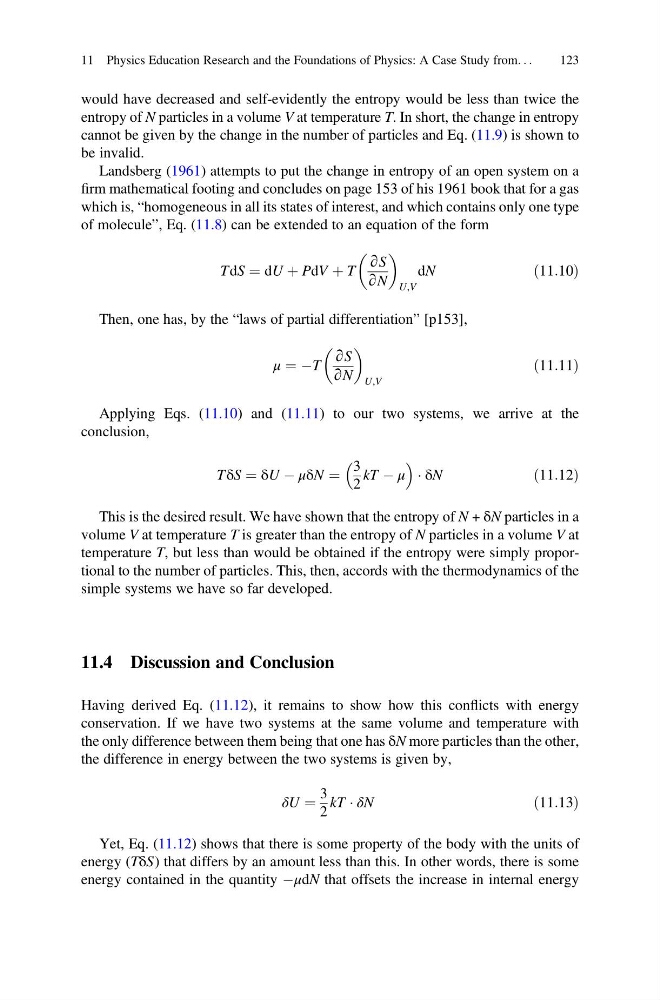
would have decreased and self-evidently the entropy would be less than twice the
entropy of N particles in a volume V at temperature T. In short, the change in entropy
cannot be given by the change in the number of particles and Eq. (11.9) is shown to
be invalid.
Landsberg (1961) attempts to put the change in entropy of an open system on a
firm mathematical footing and concludes on page 153 of his 1961 book that for a gas
which is, “homogeneous in all its states of interest, and which contains only one type
of molecule”, Eq. (11.8) can be extended to an equation of the form
TdS ¼ dU þ PdV þ T
∂S
∂N
U,V
dN
ð11:10Þ
Then, one has, by the “laws of partial differentiation” [p153],
μ ¼ ÀT
∂S
∂N
U,V
ð11:11Þ
Applying Eqs. (11.10) and (11.11) to our two systems, we arrive at the
conclusion,
TδS ¼ δU À μδN ¼
3
2
kT À μ
Á δN
ð11:12Þ
This is the desired result. We have shown that the entropy of N + δN particles in a
volume V at temperature T is greater than the entropy of N particles in a volume V at
temperature T, but less than would be obtained if the entropy were simply proportional to the number of particles. This, then, accords with the thermodynamics of the
simple systems we have so far developed.
11.4 Discussion and Conclusion
Having derived Eq. (11.12), it remains to show how this conflicts with energy
conservation. If we have two systems at the same volume and temperature with
the only difference between them being that one has δN more particles than the other,
the difference in energy between the two systems is given by,
δU ¼
3
2
kT Á δN
ð11:13Þ
Yet, Eq. (11.12) shows that there is some property of the body with the units of
energy (TδS) that differs by an amount less than this. In other words, there is some
energy contained in the quantity ÀμdN that offsets the increase in internal energy
11 Physics Education Research and the Foundations of Physics: A Case Study from. . .
123
entropy of N particles in a volume V at temperature T. In short, the change in entropy
cannot be given by the change in the number of particles and Eq. (11.9) is shown to
be invalid.
Landsberg (1961) attempts to put the change in entropy of an open system on a
firm mathematical footing and concludes on page 153 of his 1961 book that for a gas
which is, “homogeneous in all its states of interest, and which contains only one type
of molecule”, Eq. (11.8) can be extended to an equation of the form
TdS ¼ dU þ PdV þ T
∂S
∂N
U,V
dN
ð11:10Þ
Then, one has, by the “laws of partial differentiation” [p153],
μ ¼ ÀT
∂S
∂N
U,V
ð11:11Þ
Applying Eqs. (11.10) and (11.11) to our two systems, we arrive at the
conclusion,
TδS ¼ δU À μδN ¼
3
2
kT À μ
Á δN
ð11:12Þ
This is the desired result. We have shown that the entropy of N + δN particles in a
volume V at temperature T is greater than the entropy of N particles in a volume V at
temperature T, but less than would be obtained if the entropy were simply proportional to the number of particles. This, then, accords with the thermodynamics of the
simple systems we have so far developed.
11.4 Discussion and Conclusion
Having derived Eq. (11.12), it remains to show how this conflicts with energy
conservation. If we have two systems at the same volume and temperature with
the only difference between them being that one has δN more particles than the other,
the difference in energy between the two systems is given by,
δU ¼
3
2
kT Á δN
ð11:13Þ
Yet, Eq. (11.12) shows that there is some property of the body with the units of
energy (TδS) that differs by an amount less than this. In other words, there is some
energy contained in the quantity ÀμdN that offsets the increase in internal energy
11 Physics Education Research and the Foundations of Physics: A Case Study from. . .
123