

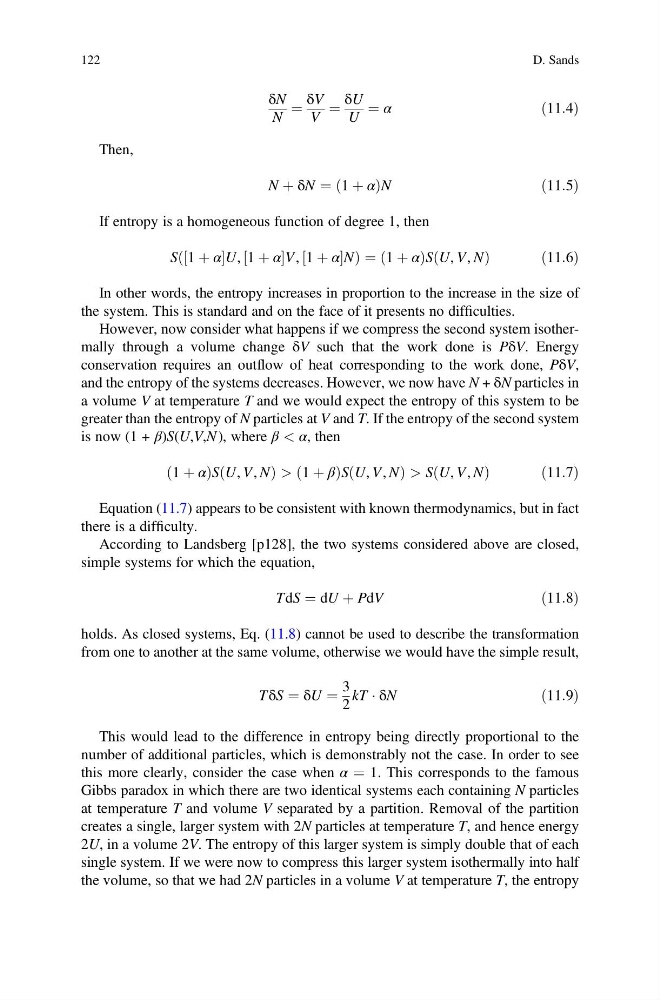
δN
N
¼
δV
V
¼
δU
U
¼ α
ð11:4Þ
Then,
N þ δN ¼ 1 þ α
ð
ÞN
ð11:5Þ
If entropy is a homogeneous function of degree 1, then
S 1 þ α
½
U, 1 þ α
½
V, 1 þ α
½
N
ð
Þ ¼ 1 þ α
ð
ÞS U, V, N
ð
Þ
ð 11:6Þ
In other words, the entropy increases in proportion to the increase in the size of
the system. This is standard and on the face of it presents no difficulties.
However, now consider what happens if we compress the second system isothermally through a volume change δV such that the work done is PδV. Energy
conservation requires an outflow of heat corresponding to the work done, PδV,
and the entropy of the systems decreases. However, we now have N + δN particles in
a volume V at temperature T and we would expect the entropy of this system to be
greater than the entropy of N particles at V and T. If the entropy of the second system
is now (1 + β)S(U,V,N ), where β < α, then
1 þ α
ð
ÞS U, V, N
ð
Þ> 1 þ β
ð
ÞS U, V, N
ð
Þ> S U, V, N
ð
Þ
ð 11:7Þ
Equation (11.7) appears to be consistent with known thermodynamics, but in fact
there is a difficulty.
According to Landsberg [p128], the two systems considered above are closed,
simple systems for which the equation,
TdS ¼ dU þ PdV
ð11:8Þ
holds. As closed systems, Eq. (11.8) cannot be used to describe the transformation
from one to another at the same volume, otherwise we would have the simple result,
TδS ¼ δU ¼
3
2
kT Á δN
ð11:9Þ
This would lead to the difference in entropy being directly proportional to the
number of additional particles, which is demonstrably not the case. In order to see
this more clearly, consider the case when α ¼ 1. This corresponds to the famous
Gibbs paradox in which there are two identical systems each containing N particles
at temperature T and volume V separated by a partition. Removal of the partition
creates a single, larger system with 2N particles at temperature T, and hence energy
2U, in a volume 2V. The entropy of this larger system is simply double that of each
single system. If we were now to compress this larger system isothermally into half
the volume, so that we had 2N particles in a volume V at temperature T, the entropy
122
D. Sands
N
¼
δV
V
¼
δU
U
¼ α
ð11:4Þ
Then,
N þ δN ¼ 1 þ α
ð
ÞN
ð11:5Þ
If entropy is a homogeneous function of degree 1, then
S 1 þ α
½
U, 1 þ α
½
V, 1 þ α
½
N
ð
Þ ¼ 1 þ α
ð
ÞS U, V, N
ð
Þ
ð 11:6Þ
In other words, the entropy increases in proportion to the increase in the size of
the system. This is standard and on the face of it presents no difficulties.
However, now consider what happens if we compress the second system isothermally through a volume change δV such that the work done is PδV. Energy
conservation requires an outflow of heat corresponding to the work done, PδV,
and the entropy of the systems decreases. However, we now have N + δN particles in
a volume V at temperature T and we would expect the entropy of this system to be
greater than the entropy of N particles at V and T. If the entropy of the second system
is now (1 + β)S(U,V,N ), where β < α, then
1 þ α
ð
ÞS U, V, N
ð
Þ> 1 þ β
ð
ÞS U, V, N
ð
Þ> S U, V, N
ð
Þ
ð 11:7Þ
Equation (11.7) appears to be consistent with known thermodynamics, but in fact
there is a difficulty.
According to Landsberg [p128], the two systems considered above are closed,
simple systems for which the equation,
TdS ¼ dU þ PdV
ð11:8Þ
holds. As closed systems, Eq. (11.8) cannot be used to describe the transformation
from one to another at the same volume, otherwise we would have the simple result,
TδS ¼ δU ¼
3
2
kT Á δN
ð11:9Þ
This would lead to the difference in entropy being directly proportional to the
number of additional particles, which is demonstrably not the case. In order to see
this more clearly, consider the case when α ¼ 1. This corresponds to the famous
Gibbs paradox in which there are two identical systems each containing N particles
at temperature T and volume V separated by a partition. Removal of the partition
creates a single, larger system with 2N particles at temperature T, and hence energy
2U, in a volume 2V. The entropy of this larger system is simply double that of each
single system. If we were now to compress this larger system isothermally into half
the volume, so that we had 2N particles in a volume V at temperature T, the entropy
122
D. Sands