

due to the increase in the number of particles. Thermodynamics gives us no clue as to
the physical meaning of μ and the physics of the ideal classical gas in the form of
kinetic theory gives no insight. Whilst the internal energy can be equated with the
average energy of particles with a range of velocities given by the Maxwellian
distribution, there is no quantity analogous to the chemical potential.
The physical meaning of μ and the validity of Eq. (11.11) can also be queried. It is
not clear to this author that Eq. (11.11) is correct for a classical ideal gas. This
equation is valid only if U and N are independent; that is, particle number N can be
changed whilst holding both U and V constant. In a classical ideal gas N can be
changed independently of V but not of U except at absolute zero, as shown by
Eq. (11.13), so the partial differential in Eq. (11.10) cannot be applied.
It should be acknowledged that entropy might not be extensive, which would
redefine the entropies of the different bodies we have discussed and alter the
relationship between them. However, it is not clear that it would solve the problem,
which fundamentally arises from the notion that a body in a particular state has a
particular entropy. This can be illustrated by the following argument. It is reasonable
to assume that entropy must in some way increase with the number of particles and
that the entropy of N + δN particles in a volume V at temperature T is greater than the
entropy of N particles in a volume V at temperature T. We would expect some
functional relationship between S and N which would permit partial differentiation,
but in a classical ideal gas N can be varied independently of only T and V or,
equivalently, P if V is allowed to vary with N. Expressing entropy as a function of
T would make it difficult in general to combine the First and Second laws, but
notwithstanding this difficulty let us suppose that we end up with something of
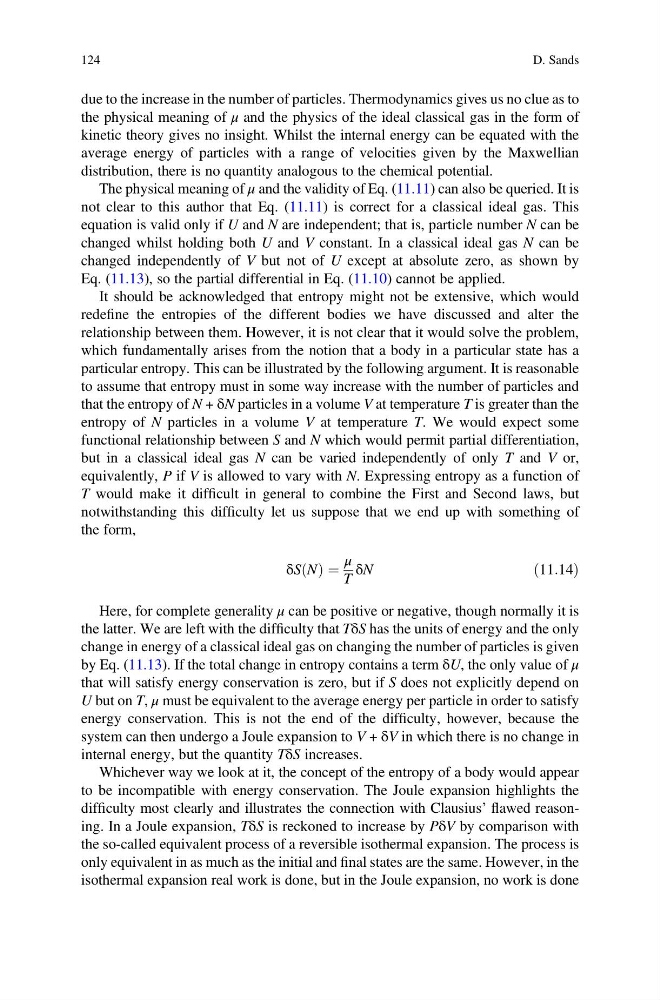
the form,
δS N
ð Þ ¼
μ
T
δN
ð11:14Þ
Here, for complete generality μ can be positive or negative, though normally it is
the latter. We are left with the difficulty that TδS has the units of energy and the only
change in energy of a classical ideal gas on changing the number of particles is given
by Eq. (11.13). If the total change in entropy contains a term δU, the only value of μ
that will satisfy energy conservation is zero, but if S does not explicitly depend on
U but on T, μ must be equivalent to the average energy per particle in order to satisfy
energy conservation. This is not the end of the difficulty, however, because the
system can then undergo a Joule expansion to V + δV in which there is no change in
internal energy, but the quantity TδS increases.
Whichever way we look at it, the concept of the entropy of a body would appear
to be incompatible with energy conservation. The Joule expansion highlights the
difficulty most clearly and illustrates the connection with Clausius’ flawed reasoning. In a Joule expansion, TδS is reckoned to increase by PδV by comparison with
the so-called equivalent process of a reversible isothermal expansion. The process is
only equivalent in as much as the initial and final states are the same. However, in the
isothermal expansion real work is done, but in the Joule expansion, no work is done
124
D. Sands
the physical meaning of μ and the physics of the ideal classical gas in the form of
kinetic theory gives no insight. Whilst the internal energy can be equated with the
average energy of particles with a range of velocities given by the Maxwellian
distribution, there is no quantity analogous to the chemical potential.
The physical meaning of μ and the validity of Eq. (11.11) can also be queried. It is
not clear to this author that Eq. (11.11) is correct for a classical ideal gas. This
equation is valid only if U and N are independent; that is, particle number N can be
changed whilst holding both U and V constant. In a classical ideal gas N can be
changed independently of V but not of U except at absolute zero, as shown by
Eq. (11.13), so the partial differential in Eq. (11.10) cannot be applied.
It should be acknowledged that entropy might not be extensive, which would
redefine the entropies of the different bodies we have discussed and alter the
relationship between them. However, it is not clear that it would solve the problem,
which fundamentally arises from the notion that a body in a particular state has a
particular entropy. This can be illustrated by the following argument. It is reasonable
to assume that entropy must in some way increase with the number of particles and
that the entropy of N + δN particles in a volume V at temperature T is greater than the
entropy of N particles in a volume V at temperature T. We would expect some
functional relationship between S and N which would permit partial differentiation,
but in a classical ideal gas N can be varied independently of only T and V or,
equivalently, P if V is allowed to vary with N. Expressing entropy as a function of
T would make it difficult in general to combine the First and Second laws, but
notwithstanding this difficulty let us suppose that we end up with something of
the form,
δS N
ð Þ ¼
μ
T
δN
ð11:14Þ
Here, for complete generality μ can be positive or negative, though normally it is
the latter. We are left with the difficulty that TδS has the units of energy and the only
change in energy of a classical ideal gas on changing the number of particles is given
by Eq. (11.13). If the total change in entropy contains a term δU, the only value of μ
that will satisfy energy conservation is zero, but if S does not explicitly depend on
U but on T, μ must be equivalent to the average energy per particle in order to satisfy
energy conservation. This is not the end of the difficulty, however, because the
system can then undergo a Joule expansion to V + δV in which there is no change in
internal energy, but the quantity TδS increases.
Whichever way we look at it, the concept of the entropy of a body would appear
to be incompatible with energy conservation. The Joule expansion highlights the
difficulty most clearly and illustrates the connection with Clausius’ flawed reasoning. In a Joule expansion, TδS is reckoned to increase by PδV by comparison with
the so-called equivalent process of a reversible isothermal expansion. The process is
only equivalent in as much as the initial and final states are the same. However, in the
isothermal expansion real work is done, but in the Joule expansion, no work is done
124
D. Sands