

26
Such a programme can best be achieved by mapping change as students, with the
support of teachers, identify questions which help them enact change. But it is perhaps overambitious to expect such approaches to be introduced quickly. Johnson
and Morris’s (2010) map of critical Citizenship Education can be a starting point for
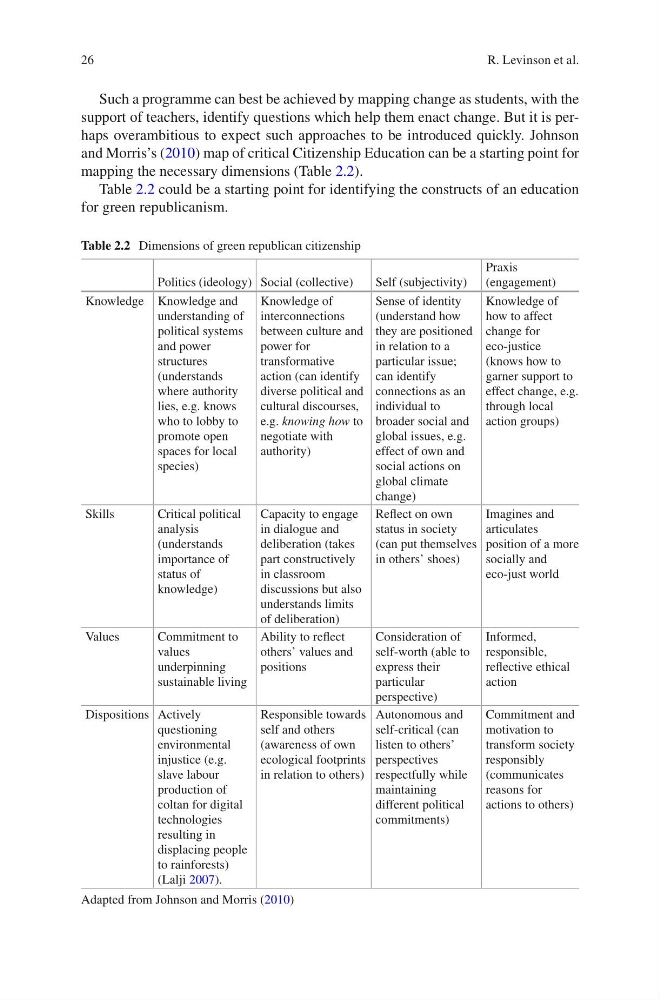
mapping the necessary dimensions (Table 2.2).
Table 2.2 could be a starting point for identifying the constructs of an education
for green republicanism.
Table 2.2 Dimensions of green republican citizenship
Politics (ideology) Social (collective)
Self (subjectivity)
Praxis
(engagement)
Knowledge Knowledge and
understanding of
political systems
and power
structures
(understands
where authority
lies, e.g. knows
who to lobby to
promote open
spaces for local
species)
Knowledge of
interconnections
between culture and
power for
transformative
action (can identify
diverse political and
cultural discourses,
e.g. knowing how to
negotiate with
authority)
Sense of identity
(understand how
they are positioned
in relation to a
particular issue;
can identify
connections as an
individual to
broader social and
global issues, e.g.
effect of own and
social actions on
global climate
change)
Knowledge of
how to affect
change for
eco-justice
(knows how to
garner support to
effect change, e.g.
through local
action groups)
Skills
Critical political
analysis
(understands
importance of
status of
knowledge)
Capacity to engage
in dialogue and
deliberation (takes
part constructively
in classroom
discussions but also
understands limits
of deliberation)
Reflect on own
status in society
(can put themselves
in others’ shoes)
Imagines and
articulates
position of a more
socially and
eco-just world
Values
Commitment to
values
underpinning
sustainable living
Ability to reflect
others’ values and
positions
Consideration of
self-worth (able to
express their
particular
perspective)
Informed,
responsible,
reflective ethical
action
Dispositions Actively
questioning
environmental
injustice (e.g.
slave labour
production of
coltan for digital
technologies
resulting in
displacing people
to rainforests)
(Lalji 2007).
Responsible towards
self and others
(awareness of own
ecological footprints
in relation to others)
Autonomous and
self-critical (can
listen to others’
perspectives
respectfully while
maintaining
different political
commitments)
Commitment and
motivation to
transform society
responsibly
(communicates
reasons for
actions to others)
Adapted from Johnson and Morris (2010)
R. Levinson et al.
Such a programme can best be achieved by mapping change as students, with the
support of teachers, identify questions which help them enact change. But it is perhaps overambitious to expect such approaches to be introduced quickly. Johnson
and Morris’s (2010) map of critical Citizenship Education can be a starting point for
mapping the necessary dimensions (Table 2.2).
Table 2.2 could be a starting point for identifying the constructs of an education
for green republicanism.
Table 2.2 Dimensions of green republican citizenship
Politics (ideology) Social (collective)
Self (subjectivity)
Praxis
(engagement)
Knowledge Knowledge and
understanding of
political systems
and power
structures
(understands
where authority
lies, e.g. knows
who to lobby to
promote open
spaces for local
species)
Knowledge of
interconnections
between culture and
power for
transformative
action (can identify
diverse political and
cultural discourses,
e.g. knowing how to
negotiate with
authority)
Sense of identity
(understand how
they are positioned
in relation to a
particular issue;
can identify
connections as an
individual to
broader social and
global issues, e.g.
effect of own and
social actions on
global climate
change)
Knowledge of
how to affect
change for
eco-justice
(knows how to
garner support to
effect change, e.g.
through local
action groups)
Skills
Critical political
analysis
(understands
importance of
status of
knowledge)
Capacity to engage
in dialogue and
deliberation (takes
part constructively
in classroom
discussions but also
understands limits
of deliberation)
Reflect on own
status in society
(can put themselves
in others’ shoes)
Imagines and
articulates
position of a more
socially and
eco-just world
Values
Commitment to
values
underpinning
sustainable living
Ability to reflect
others’ values and
positions
Consideration of
self-worth (able to
express their
particular
perspective)
Informed,
responsible,
reflective ethical
action
Dispositions Actively
questioning
environmental
injustice (e.g.
slave labour
production of
coltan for digital
technologies
resulting in
displacing people
to rainforests)
(Lalji 2007).
Responsible towards
self and others
(awareness of own
ecological footprints
in relation to others)
Autonomous and
self-critical (can
listen to others’
perspectives
respectfully while
maintaining
different political
commitments)
Commitment and
motivation to
transform society
responsibly
(communicates
reasons for
actions to others)
Adapted from Johnson and Morris (2010)
R. Levinson et al.