

25
need to respect and listen to young people’s ideas, what Levinson (2018) has termed
knowledgeability and non-presumptiveness, in other words the practice of democracy within the classroom.
Within a sustainable society, young people also need to understand that they
could and should have a political role beyond the legal frameworks of representative
democracies; as young people, they are also citizens rather than ‘future citizens’.
They need to understand those political structures which can be transformed through
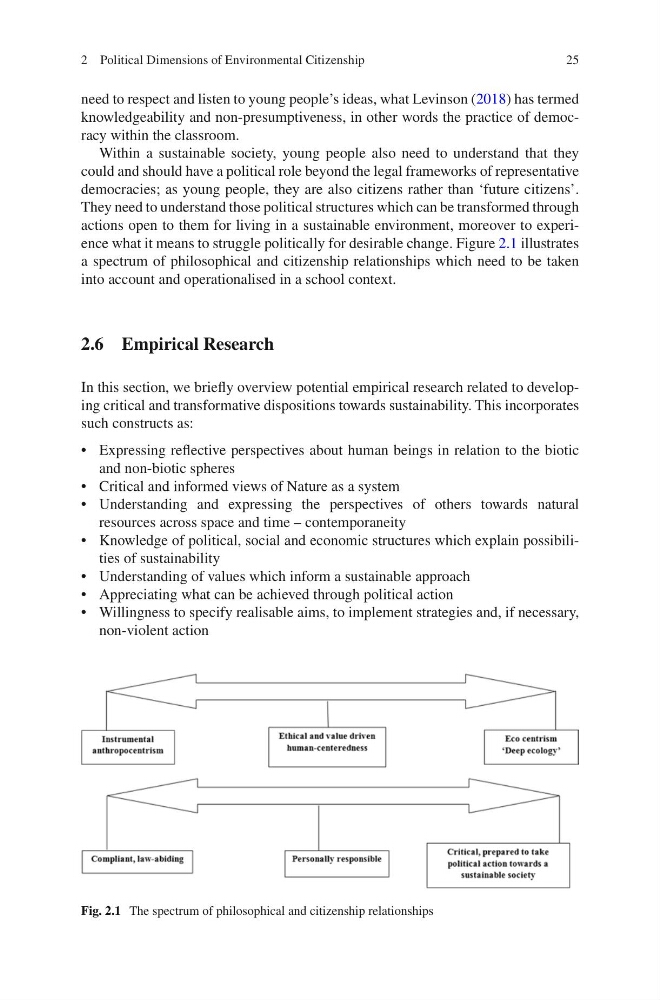
actions open to them for living in a sustainable environment, moreover to experience what it means to struggle politically for desirable change. Figure 2.1 illustrates
a spectrum of philosophical and citizenship relationships which need to be taken
into account and operationalised in a school context.
2.6 Empirical Research
In this section, we briefly overview potential empirical research related to developing critical and transformative dispositions towards sustainability. This incorporates
such constructs as:
• Expressing reflective perspectives about human beings in relation to the biotic
and non-biotic spheres
• Critical and informed views of Nature as a system
• Understanding and expressing the perspectives of others towards natural
resources across space and time – contemporaneity
• Knowledge of political, social and economic structures which explain possibilities of sustainability
• Understanding of values which inform a sustainable approach
• Appreciating what can be achieved through political action
• Willingness to specify realisable aims, to implement strategies and, if necessary,
non-violent action
Fig. 2.1 The spectrum of philosophical and citizenship relationships
2 Political Dimensions of Environmental Citizenship
need to respect and listen to young people’s ideas, what Levinson (2018) has termed
knowledgeability and non-presumptiveness, in other words the practice of democracy within the classroom.
Within a sustainable society, young people also need to understand that they
could and should have a political role beyond the legal frameworks of representative
democracies; as young people, they are also citizens rather than ‘future citizens’.
They need to understand those political structures which can be transformed through
actions open to them for living in a sustainable environment, moreover to experience what it means to struggle politically for desirable change. Figure 2.1 illustrates
a spectrum of philosophical and citizenship relationships which need to be taken
into account and operationalised in a school context.
2.6 Empirical Research
In this section, we briefly overview potential empirical research related to developing critical and transformative dispositions towards sustainability. This incorporates
such constructs as:
• Expressing reflective perspectives about human beings in relation to the biotic
and non-biotic spheres
• Critical and informed views of Nature as a system
• Understanding and expressing the perspectives of others towards natural
resources across space and time – contemporaneity
• Knowledge of political, social and economic structures which explain possibilities of sustainability
• Understanding of values which inform a sustainable approach
• Appreciating what can be achieved through political action
• Willingness to specify realisable aims, to implement strategies and, if necessary,
non-violent action
Fig. 2.1 The spectrum of philosophical and citizenship relationships
2 Political Dimensions of Environmental Citizenship