

214
Scholars (Eshach 2007; Falk 2006) assert that the distinction should take into
account not only the physical environment in which learning takes place but other
aspects, especially the underlying motivation and interest of the learner to learn, the
social contexts and socially-constructed nature of learning as well as the organisation of the learning and assessment. According to Eshach, informal learning refers
to learning that may happen in spontaneous situations that happen in people’s lives
and other unstructured activities. Thus, the learning is open, intrinsically motivated
(i.e. individual’s choice) and is usually individually lead (control over learning).
Informal learning is often referred to as ‘free-choice’ learning (NAAEE 2009;
Ballantyne and Packer 2005).
Conversely, non-formal learning occurs in a planned but highly adaptable manner in institutions, organisations and situations beyond the spheres of formal or
informal education (Eshach 2007; Silberman-Keller 2003). While it is mediated, the
motivation for learning may arise from the learner. An additional distinction relevant
to the nature of learning is based on the frequency at which the places where learning occurs are visited. Accordingly, informal learning will happen in places where
people’s daily lives take place, e.g. homes, neighbourhoods and local playgrounds
or school grounds during breaks. Spontaneous informal learning may, in principle,
be experienced in places associated with free choice learning, such as zoos, museums and other such settings. As such visits can be infrequent, they are often organised and may include structured activities (especially when visited as part of a school
programme), thus the type of learning that often occurs is non- formal (Esach 2007).
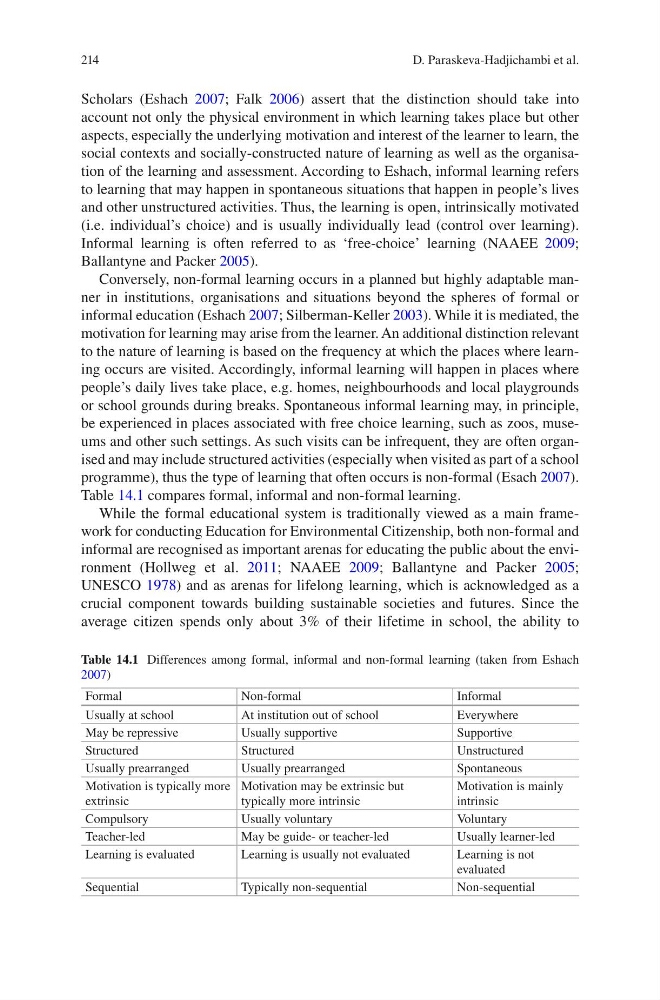
Table 14.1 compares formal, informal and non-formal learning.
While the formal educational system is traditionally viewed as a main framework for conducting Education for Environmental Citizenship, both non-formal and
informal are recognised as important arenas for educating the public about the environment (Hollweg et al. 2011; NAAEE 2009; Ballantyne and Packer 2005;
UNESCO 1978) and as arenas for lifelong learning, which is acknowledged as a
crucial component towards building sustainable societies and futures. Since the
average citizen spends only about 3% of their lifetime in school, the ability to
Table 14.1 Differences among formal, informal and non-formal learning (taken from Eshach
2007)
Formal
Non-formal
Informal
Usually at school
At institution out of school
Everywhere
May be repressive
Usually supportive
Supportive
Structured
Structured
Unstructured
Usually prearranged
Usually prearranged
Spontaneous
Motivation is typically more
extrinsic
Motivation may be extrinsic but
typically more intrinsic
Motivation is mainly
intrinsic
Compulsory
Usually voluntary
Voluntary
Teacher-led
May be guide- or teacher-led
Usually learner-led
Learning is evaluated
Learning is usually not evaluated
Learning is not
evaluated
Sequential
Typically non-sequential
Non-sequential
D. Paraskeva-Hadjichambi et al.
Scholars (Eshach 2007; Falk 2006) assert that the distinction should take into
account not only the physical environment in which learning takes place but other
aspects, especially the underlying motivation and interest of the learner to learn, the
social contexts and socially-constructed nature of learning as well as the organisation of the learning and assessment. According to Eshach, informal learning refers
to learning that may happen in spontaneous situations that happen in people’s lives
and other unstructured activities. Thus, the learning is open, intrinsically motivated
(i.e. individual’s choice) and is usually individually lead (control over learning).
Informal learning is often referred to as ‘free-choice’ learning (NAAEE 2009;
Ballantyne and Packer 2005).
Conversely, non-formal learning occurs in a planned but highly adaptable manner in institutions, organisations and situations beyond the spheres of formal or
informal education (Eshach 2007; Silberman-Keller 2003). While it is mediated, the
motivation for learning may arise from the learner. An additional distinction relevant
to the nature of learning is based on the frequency at which the places where learning occurs are visited. Accordingly, informal learning will happen in places where
people’s daily lives take place, e.g. homes, neighbourhoods and local playgrounds
or school grounds during breaks. Spontaneous informal learning may, in principle,
be experienced in places associated with free choice learning, such as zoos, museums and other such settings. As such visits can be infrequent, they are often organised and may include structured activities (especially when visited as part of a school
programme), thus the type of learning that often occurs is non- formal (Esach 2007).
Table 14.1 compares formal, informal and non-formal learning.
While the formal educational system is traditionally viewed as a main framework for conducting Education for Environmental Citizenship, both non-formal and
informal are recognised as important arenas for educating the public about the environment (Hollweg et al. 2011; NAAEE 2009; Ballantyne and Packer 2005;
UNESCO 1978) and as arenas for lifelong learning, which is acknowledged as a
crucial component towards building sustainable societies and futures. Since the
average citizen spends only about 3% of their lifetime in school, the ability to
Table 14.1 Differences among formal, informal and non-formal learning (taken from Eshach
2007)
Formal
Non-formal
Informal
Usually at school
At institution out of school
Everywhere
May be repressive
Usually supportive
Supportive
Structured
Structured
Unstructured
Usually prearranged
Usually prearranged
Spontaneous
Motivation is typically more
extrinsic
Motivation may be extrinsic but
typically more intrinsic
Motivation is mainly
intrinsic
Compulsory
Usually voluntary
Voluntary
Teacher-led
May be guide- or teacher-led
Usually learner-led
Learning is evaluated
Learning is usually not evaluated
Learning is not
evaluated
Sequential
Typically non-sequential
Non-sequential
D. Paraskeva-Hadjichambi et al.