

215
access, critically evaluate and utilise information must continue throughout people’s
lives. Non-formal and informal settings offer the opportunity for such lifelong
learning. Additionally, these frameworks can support students’ learning in formal
education and this is increasingly acknowledged and utilised (for example, Bell
et al. 2009). Since most learning is attained outside of schools, which is especially
true for environmental learning, there is increasing recognition of the significant
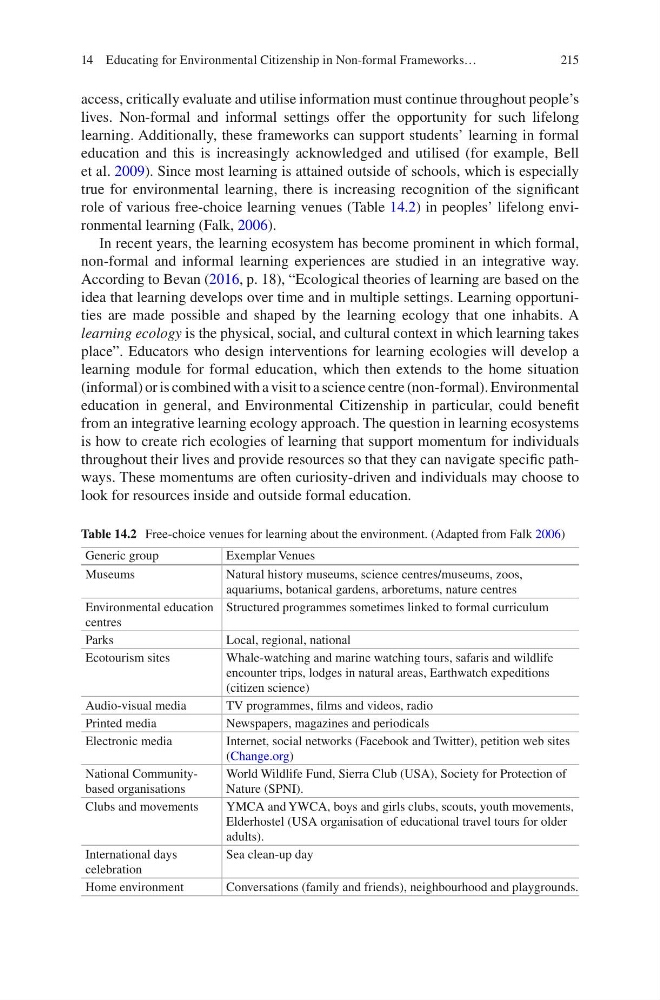
role of various free-choice learning venues (Table 14.2) in peoples’ lifelong environmental learning (Falk, 2006).
In recent years, the learning ecosystem has become prominent in which formal,
non-formal and informal learning experiences are studied in an integrative way.
According to Bevan (2016, p. 18), “Ecological theories of learning are based on the
idea that learning develops over time and in multiple settings. Learning opportunities are made possible and shaped by the learning ecology that one inhabits. A
learning ecology is the physical, social, and cultural context in which learning takes
place”. Educators who design interventions for learning ecologies will develop a
learning module for formal education, which then extends to the home situation
(informal) or is combined with a visit to a science centre (non-formal). Environmental
education in general, and Environmental Citizenship in particular, could benefit
from an integrative learning ecology approach. The question in learning ecosystems
is how to create rich ecologies of learning that support momentum for individuals
throughout their lives and provide resources so that they can navigate specific pathways. These momentums are often curiosity-driven and individuals may choose to
look for resources inside and outside formal education.
Table 14.2 Free-choice venues for learning about the environment. (Adapted from Falk 2006)
Generic group
Exemplar Venues
Museums
Natural history museums, science centres/museums, zoos,
aquariums, botanical gardens, arboretums, nature centres
Environmental education
centres
Structured programmes sometimes linked to formal curriculum
Parks
Local, regional, national
Ecotourism sites
Whale-watching and marine watching tours, safaris and wildlife
encounter trips, lodges in natural areas, Earthwatch expeditions
(citizen science)
Audio-visual media
TV programmes, films and videos, radio
Printed media
Newspapers, magazines and periodicals
Electronic media
Internet, social networks (Facebook and Twitter), petition web sites
(Change.org)
National Communitybased organisations
World Wildlife Fund, Sierra Club (USA), Society for Protection of
Nature (SPNI).
Clubs and movements
YMCA and YWCA, boys and girls clubs, scouts, youth movements,
Elderhostel (USA organisation of educational travel tours for older
adults).
International days
celebration
Sea clean-up day
Home environment
Conversations (family and friends), neighbourhood and playgrounds.
14 Educating for Environmental Citizenship in Non-formal Frameworks…
access, critically evaluate and utilise information must continue throughout people’s
lives. Non-formal and informal settings offer the opportunity for such lifelong
learning. Additionally, these frameworks can support students’ learning in formal
education and this is increasingly acknowledged and utilised (for example, Bell
et al. 2009). Since most learning is attained outside of schools, which is especially
true for environmental learning, there is increasing recognition of the significant
role of various free-choice learning venues (Table 14.2) in peoples’ lifelong environmental learning (Falk, 2006).
In recent years, the learning ecosystem has become prominent in which formal,
non-formal and informal learning experiences are studied in an integrative way.
According to Bevan (2016, p. 18), “Ecological theories of learning are based on the
idea that learning develops over time and in multiple settings. Learning opportunities are made possible and shaped by the learning ecology that one inhabits. A
learning ecology is the physical, social, and cultural context in which learning takes
place”. Educators who design interventions for learning ecologies will develop a
learning module for formal education, which then extends to the home situation
(informal) or is combined with a visit to a science centre (non-formal). Environmental
education in general, and Environmental Citizenship in particular, could benefit
from an integrative learning ecology approach. The question in learning ecosystems
is how to create rich ecologies of learning that support momentum for individuals
throughout their lives and provide resources so that they can navigate specific pathways. These momentums are often curiosity-driven and individuals may choose to
look for resources inside and outside formal education.
Table 14.2 Free-choice venues for learning about the environment. (Adapted from Falk 2006)
Generic group
Exemplar Venues
Museums
Natural history museums, science centres/museums, zoos,
aquariums, botanical gardens, arboretums, nature centres
Environmental education
centres
Structured programmes sometimes linked to formal curriculum
Parks
Local, regional, national
Ecotourism sites
Whale-watching and marine watching tours, safaris and wildlife
encounter trips, lodges in natural areas, Earthwatch expeditions
(citizen science)
Audio-visual media
TV programmes, films and videos, radio
Printed media
Newspapers, magazines and periodicals
Electronic media
Internet, social networks (Facebook and Twitter), petition web sites
(Change.org)
National Communitybased organisations
World Wildlife Fund, Sierra Club (USA), Society for Protection of
Nature (SPNI).
Clubs and movements
YMCA and YWCA, boys and girls clubs, scouts, youth movements,
Elderhostel (USA organisation of educational travel tours for older
adults).
International days
celebration
Sea clean-up day
Home environment
Conversations (family and friends), neighbourhood and playgrounds.
14 Educating for Environmental Citizenship in Non-formal Frameworks…