

127
of additional influential factors, this model includes the component of ‘external/
situational’ factors (see Fig. 8.8). Situational, environmental and social constraints
are crucial aspects when taking a systemic view of reciprocal determination of
human action and social and environmental systems, for example, in the frame of
socioecological systems.
When Hines et al. (1987) constructed the Model of REB based on the metaanalysis of environmental behaviour studies, only a few of these studies reported on
the quantitative relationships between variables. Twenty years later, a meta-analysis
of psychosocial determinants of pro-environmental behaviour was repeated with the
aim of quantifying the strength of the relationships between these psychosocial
variables (Bamberg and Mðser 2007). The latter meta-analysis confirms that behavioural intention mediates the influence of all the other psychosocial variables on
behaviour. Independent predictors of pro-environmental behavioural intention are
attitudes, behavioural control and personal moral norms; the latter influenced by an
interplay of cognitive (awareness of and knowledge about environmental problems),
emotional (guilt) and social factors. Thus, awareness and knowledge about environmental issues is an important but indirect determinant of pro-environmental
behaviour.
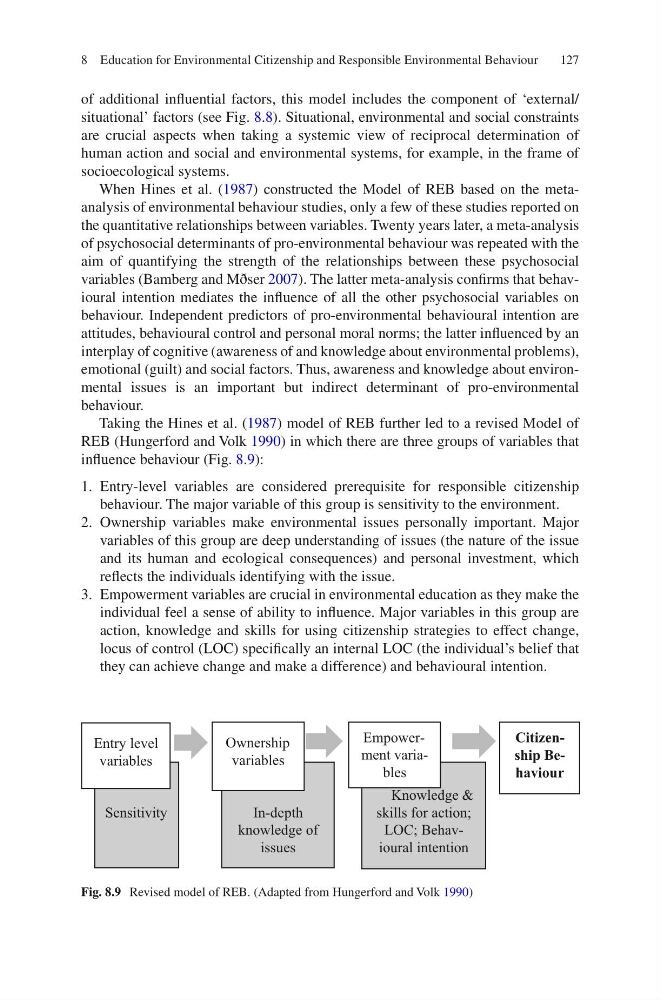
Taking the Hines et al. (1987) model of REB further led to a revised Model of
REB (Hungerford and Volk 1990) in which there are three groups of variables that
influence behaviour (Fig. 8.9):
1. Entry-level variables are considered prerequisite for responsible citizenship
behaviour. The major variable of this group is sensitivity to the environment.
2. Ownership variables make environmental issues personally important. Major
variables of this group are deep understanding of issues (the nature of the issue
and its human and ecological consequences) and personal investment, which
reflects the individuals identifying with the issue.
3. Empowerment variables are crucial in environmental education as they make the
individual feel a sense of ability to influence. Major variables in this group are
action, knowledge and skills for using citizenship strategies to effect change,
locus of control (LOC) specifically an internal LOC (the individual’s belief that
they can achieve change and make a difference) and behavioural intention.
Sensitivity
In-depth
knowledge of
issues
Knowledge &
skills for action;
LOC; Behavioural intention
Entry level
variables
Ownership
variables
Empowerment variables
Citizenship Behaviour
Fig. 8.9 Revised model of REB. (Adapted from Hungerford and Volk 1990)
8 Education for Environmental Citizenship and Responsible Environmental Behaviour
of additional influential factors, this model includes the component of ‘external/
situational’ factors (see Fig. 8.8). Situational, environmental and social constraints
are crucial aspects when taking a systemic view of reciprocal determination of
human action and social and environmental systems, for example, in the frame of
socioecological systems.
When Hines et al. (1987) constructed the Model of REB based on the metaanalysis of environmental behaviour studies, only a few of these studies reported on
the quantitative relationships between variables. Twenty years later, a meta-analysis
of psychosocial determinants of pro-environmental behaviour was repeated with the
aim of quantifying the strength of the relationships between these psychosocial
variables (Bamberg and Mðser 2007). The latter meta-analysis confirms that behavioural intention mediates the influence of all the other psychosocial variables on
behaviour. Independent predictors of pro-environmental behavioural intention are
attitudes, behavioural control and personal moral norms; the latter influenced by an
interplay of cognitive (awareness of and knowledge about environmental problems),
emotional (guilt) and social factors. Thus, awareness and knowledge about environmental issues is an important but indirect determinant of pro-environmental
behaviour.
Taking the Hines et al. (1987) model of REB further led to a revised Model of
REB (Hungerford and Volk 1990) in which there are three groups of variables that
influence behaviour (Fig. 8.9):
1. Entry-level variables are considered prerequisite for responsible citizenship
behaviour. The major variable of this group is sensitivity to the environment.
2. Ownership variables make environmental issues personally important. Major
variables of this group are deep understanding of issues (the nature of the issue
and its human and ecological consequences) and personal investment, which
reflects the individuals identifying with the issue.
3. Empowerment variables are crucial in environmental education as they make the
individual feel a sense of ability to influence. Major variables in this group are
action, knowledge and skills for using citizenship strategies to effect change,
locus of control (LOC) specifically an internal LOC (the individual’s belief that
they can achieve change and make a difference) and behavioural intention.
Sensitivity
In-depth
knowledge of
issues
Knowledge &
skills for action;
LOC; Behavioural intention
Entry level
variables
Ownership
variables
Empowerment variables
Citizenship Behaviour
Fig. 8.9 Revised model of REB. (Adapted from Hungerford and Volk 1990)
8 Education for Environmental Citizenship and Responsible Environmental Behaviour