

126
variables leading to behaviour. In this causal chain of factors that influence
behavioural decisions, basic personal values are the fundamental determinant.
A further, well-acknowledged, contemporary model is the Theory of Interpersonal
Behaviour by Triandis (1977), which considers attitudes, social factors (roles,
norms), self-identity, affective factors (emotions) and facilitating (vs. inhibiting)
factors together with habits.
8.3.3 Skills, Self-Efficacy and Situational Factors
While the VBN model covers various social and individual moral- and valueoriented motivational aspects, cognitive factors such as knowledge and skills and
situational constraints are not considered in depth by this model. Some early and
more recent models attempt to incorporate these variables.
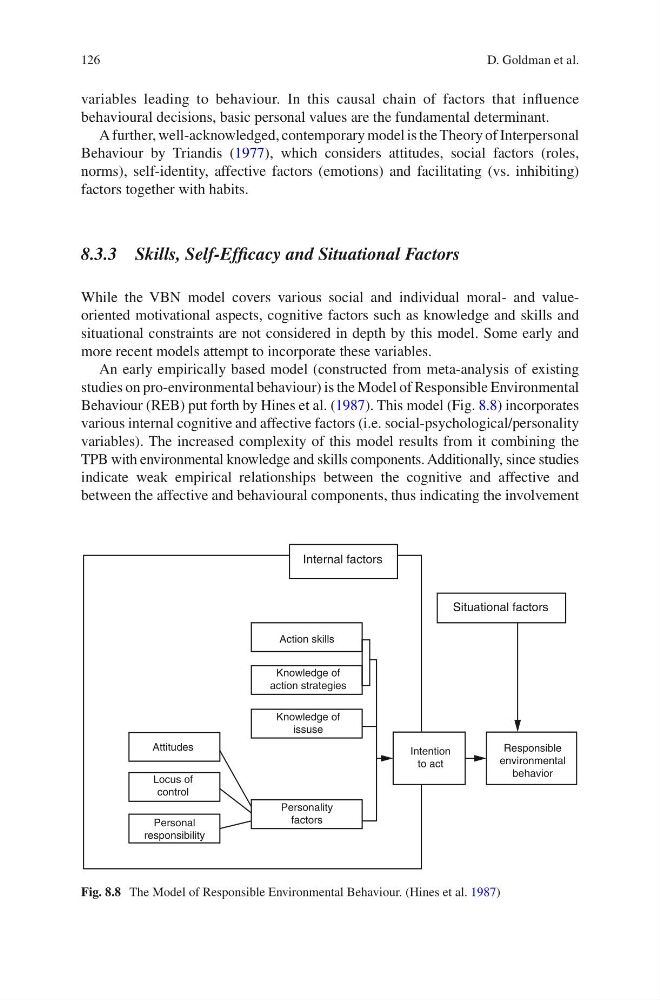
An early empirically based model (constructed from meta-analysis of existing
studies on pro-environmental behaviour) is the Model of Responsible Environmental
Behaviour (REB) put forth by Hines et al. (1987). This model (Fig. 8.8) incorporates
various internal cognitive and affective factors (i.e. social-psychological/personality
variables). The increased complexity of this model results from it combining the
TPB with environmental knowledge and skills components. Additionally, since studies
indicate weak empirical relationships between the cognitive and affective and
between the affective and behavioural components, thus indicating the involvement
Internal factors
Situational factors
Action skills
Knowledge of
action strategies
Knowledge of
issuse
Attitudes
Locus of
control
Personal
responsibility
Personality
factors
Intention
to act
Responsible
environmental
behavior
Fig. 8.8 The Model of Responsible Environmental Behaviour. (Hines et al. 1987)
D. Goldman et al.
variables leading to behaviour. In this causal chain of factors that influence
behavioural decisions, basic personal values are the fundamental determinant.
A further, well-acknowledged, contemporary model is the Theory of Interpersonal
Behaviour by Triandis (1977), which considers attitudes, social factors (roles,
norms), self-identity, affective factors (emotions) and facilitating (vs. inhibiting)
factors together with habits.
8.3.3 Skills, Self-Efficacy and Situational Factors
While the VBN model covers various social and individual moral- and valueoriented motivational aspects, cognitive factors such as knowledge and skills and
situational constraints are not considered in depth by this model. Some early and
more recent models attempt to incorporate these variables.
An early empirically based model (constructed from meta-analysis of existing
studies on pro-environmental behaviour) is the Model of Responsible Environmental
Behaviour (REB) put forth by Hines et al. (1987). This model (Fig. 8.8) incorporates
various internal cognitive and affective factors (i.e. social-psychological/personality
variables). The increased complexity of this model results from it combining the
TPB with environmental knowledge and skills components. Additionally, since studies
indicate weak empirical relationships between the cognitive and affective and
between the affective and behavioural components, thus indicating the involvement
Internal factors
Situational factors
Action skills
Knowledge of
action strategies
Knowledge of
issuse
Attitudes
Locus of
control
Personal
responsibility
Personality
factors
Intention
to act
Responsible
environmental
behavior
Fig. 8.8 The Model of Responsible Environmental Behaviour. (Hines et al. 1987)
D. Goldman et al.