

119
4.8
8.0
12.3
12.8
12.9
55.4
19.0
26.3
28.3
27.4
32.0
22.3
38.2
41.0
35.9
31.5
33.2
13.7
37.9
24.7
23.4
28.3
21.8
8.6
0.0
2 0.0
4 0.0
6 0.0
8 0.0
1 00.0
Q20c Cut back on driving a car for environmental reasons
Q20f Avoid buying certain products for environmental reasons
Q20b Effort: to buy fruit and vegetables without pesticides or
chemicals
Q20e Save or re-use water for environmental reasons
Q20d Reduce the energy or fuel at home for environmental
reasons
Q20a Effort: Sort glass for recycling
Types of personal environmental behaviour
Always
Often
Sometimes
Never
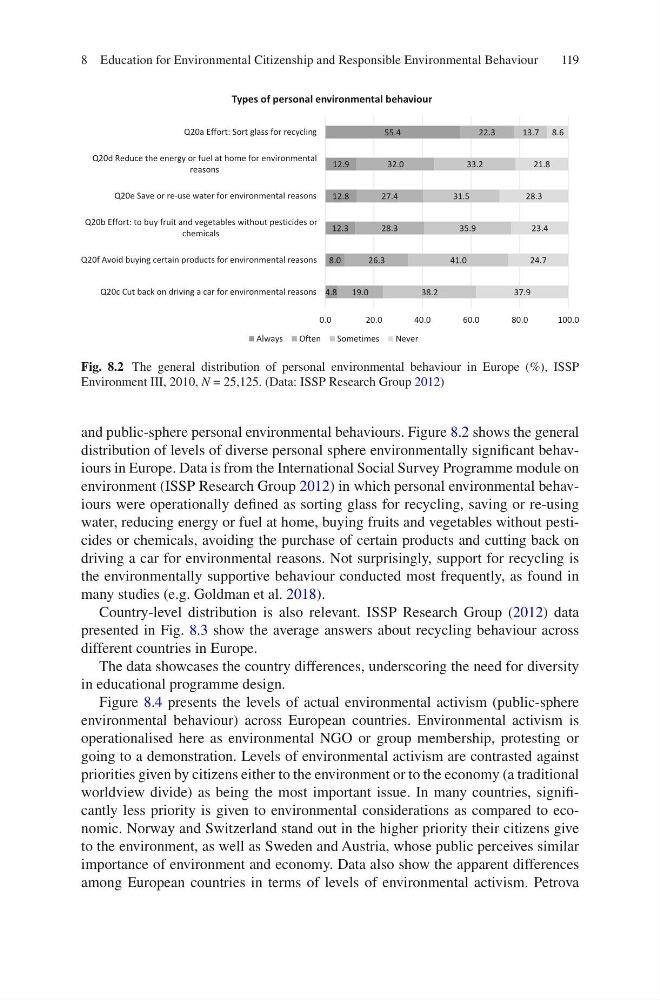
Fig. 8.2 The general distribution of personal environmental behaviour in Europe (%), ISSP
Environment III, 2010, N = 25,125. (Data: ISSP Research Group 2012)
and public-sphere personal environmental behaviours. Figure 8.2 shows the general
distribution of levels of diverse personal sphere environmentally significant behaviours in Europe. Data is from the International Social Survey Programme module on
environment (ISSP Research Group 2012) in which personal environmental behaviours were operationally defined as sorting glass for recycling, saving or re-using
water, reducing energy or fuel at home, buying fruits and vegetables without pesticides or chemicals, avoiding the purchase of certain products and cutting back on
driving a car for environmental reasons. Not surprisingly, support for recycling is
the environmentally supportive behaviour conducted most frequently, as found in
many studies (e.g. Goldman et al. 2018).
Country-level distribution is also relevant. ISSP Research Group (2012) data
presented in Fig. 8.3 show the average answers about recycling behaviour across
different countries in Europe.
The data showcases the country differences, underscoring the need for diversity
in educational programme design.
Figure 8.4 presents the levels of actual environmental activism (public-sphere
environmental behaviour) across European countries. Environmental activism is
operationalised here as environmental NGO or group membership, protesting or
going to a demonstration. Levels of environmental activism are contrasted against
priorities given by citizens either to the environment or to the economy (a traditional
worldview divide) as being the most important issue. In many countries, significantly less priority is given to environmental considerations as compared to economic. Norway and Switzerland stand out in the higher priority their citizens give
to the environment, as well as Sweden and Austria, whose public perceives similar
importance of environment and economy. Data also show the apparent differences
among European countries in terms of levels of environmental activism. Petrova
8 Education for Environmental Citizenship and Responsible Environmental Behaviour
4.8
8.0
12.3
12.8
12.9
55.4
19.0
26.3
28.3
27.4
32.0
22.3
38.2
41.0
35.9
31.5
33.2
13.7
37.9
24.7
23.4
28.3
21.8
8.6
0.0
2 0.0
4 0.0
6 0.0
8 0.0
1 00.0
Q20c Cut back on driving a car for environmental reasons
Q20f Avoid buying certain products for environmental reasons
Q20b Effort: to buy fruit and vegetables without pesticides or
chemicals
Q20e Save or re-use water for environmental reasons
Q20d Reduce the energy or fuel at home for environmental
reasons
Q20a Effort: Sort glass for recycling
Types of personal environmental behaviour
Always
Often
Sometimes
Never
Fig. 8.2 The general distribution of personal environmental behaviour in Europe (%), ISSP
Environment III, 2010, N = 25,125. (Data: ISSP Research Group 2012)
and public-sphere personal environmental behaviours. Figure 8.2 shows the general
distribution of levels of diverse personal sphere environmentally significant behaviours in Europe. Data is from the International Social Survey Programme module on
environment (ISSP Research Group 2012) in which personal environmental behaviours were operationally defined as sorting glass for recycling, saving or re-using
water, reducing energy or fuel at home, buying fruits and vegetables without pesticides or chemicals, avoiding the purchase of certain products and cutting back on
driving a car for environmental reasons. Not surprisingly, support for recycling is
the environmentally supportive behaviour conducted most frequently, as found in
many studies (e.g. Goldman et al. 2018).
Country-level distribution is also relevant. ISSP Research Group (2012) data
presented in Fig. 8.3 show the average answers about recycling behaviour across
different countries in Europe.
The data showcases the country differences, underscoring the need for diversity
in educational programme design.
Figure 8.4 presents the levels of actual environmental activism (public-sphere
environmental behaviour) across European countries. Environmental activism is
operationalised here as environmental NGO or group membership, protesting or
going to a demonstration. Levels of environmental activism are contrasted against
priorities given by citizens either to the environment or to the economy (a traditional
worldview divide) as being the most important issue. In many countries, significantly less priority is given to environmental considerations as compared to economic. Norway and Switzerland stand out in the higher priority their citizens give
to the environment, as well as Sweden and Austria, whose public perceives similar
importance of environment and economy. Data also show the apparent differences
among European countries in terms of levels of environmental activism. Petrova
8 Education for Environmental Citizenship and Responsible Environmental Behaviour