

formula. If we want to obtain a predissociation rate constant, k pr , this can be easily
done using the Fermi Golden Rule (see [11], p. 535): if for a given vibrational level
the matrix element of the interaction of states 1 and 2 (or i and j) is known,
k pr ¼ 1=s pr ¼ hV
2
1;2 s
À1
ð3:6:16Þ
One can calculate the V
2
1;2 value if the overlap integralhv
0
i jv
0
i i, and the A el value
are known (3.6.8). How it is interesting: a nonadiabatic transition rate constant is
actually calculated in the adiabatic approximation, separating the electron and
vibrational motion in the molecule. A little later we will return to this formula.
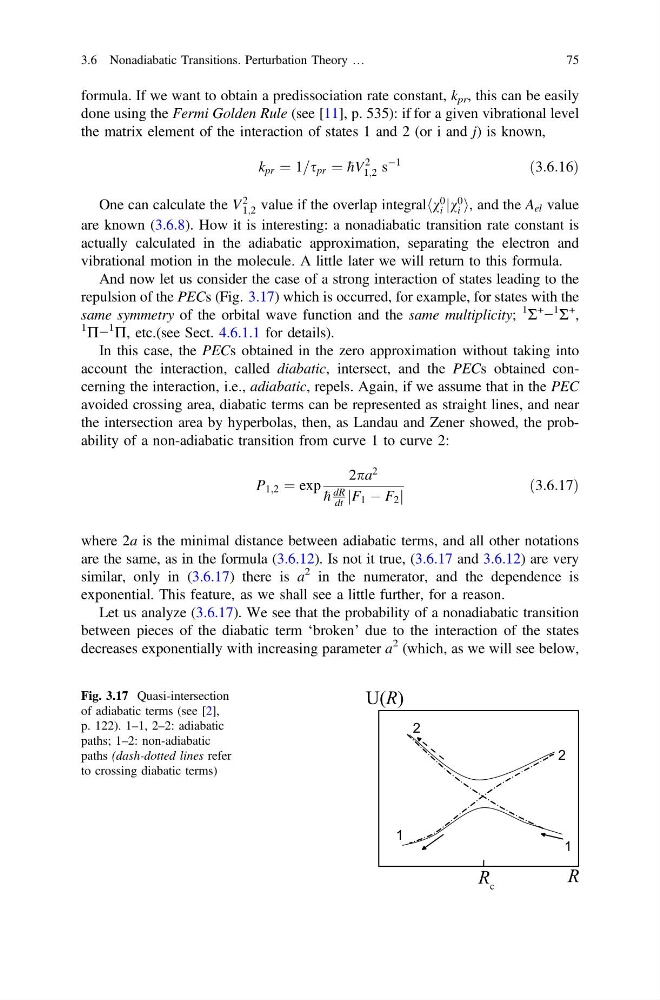
And now let us consider the case of a strong interaction of states leading to the
repulsion of the PECs (Fig. 3.17) which is occurred, for example, for states with the
same symmetry of the orbital wave function and the same multiplicity;
1 R
+
−
1 R
+
,
1 P−
1 P, etc.(see Sect. 4.6.1.1 for details).
In this case, the PECs obtained in the zero approximation without taking into
account the interaction, called diabatic, intersect, and the PECs obtained concerning the interaction, i.e., adiabatic, repels. Again, if we assume that in the PEC
avoided crossing area, diabatic terms can be represented as straight lines, and near
the intersection area by hyperbolas, then, as Landau and Zener showed, the probability of a non-adiabatic transition from curve 1 to curve 2:
P 1;2 ¼ exp
2pa
2
h
dR
dt F 1 À F 2
j
j
ð3:6:17Þ
where 2a is the minimal distance between adiabatic terms, and all other notations
are the same, as in the formula (3.6.12). Is not it true, (3.6.17 and 3.6.12) are very
similar, only in (3.6.17) there is a
2 in the numerator, and the dependence is
exponential. This feature, as we shall see a little further, for a reason.
Let us analyze (3.6.17). We see that the probability of a nonadiabatic transition
between pieces of the diabatic term ‘broken’ due to the interaction of the states
decreases exponentially with increasing parameter a
2 (which, as we will see below,
Fig. 3.17 Quasi-intersection
of adiabatic terms (see [2],
p. 122). 1–1, 2–2: adiabatic
paths; 1–2: non-adiabatic
paths (dash-dotted lines refer
to crossing diabatic terms)
3.6 Nonadiabatic Transitions. Perturbation Theory …
75
done using the Fermi Golden Rule (see [11], p. 535): if for a given vibrational level
the matrix element of the interaction of states 1 and 2 (or i and j) is known,
k pr ¼ 1=s pr ¼ hV
2
1;2 s
À1
ð3:6:16Þ
One can calculate the V
2
1;2 value if the overlap integralhv
0
i jv
0
i i, and the A el value
are known (3.6.8). How it is interesting: a nonadiabatic transition rate constant is
actually calculated in the adiabatic approximation, separating the electron and
vibrational motion in the molecule. A little later we will return to this formula.
And now let us consider the case of a strong interaction of states leading to the
repulsion of the PECs (Fig. 3.17) which is occurred, for example, for states with the
same symmetry of the orbital wave function and the same multiplicity;
1 R
+
−
1 R
+
,
1 P−
1 P, etc.(see Sect. 4.6.1.1 for details).
In this case, the PECs obtained in the zero approximation without taking into
account the interaction, called diabatic, intersect, and the PECs obtained concerning the interaction, i.e., adiabatic, repels. Again, if we assume that in the PEC
avoided crossing area, diabatic terms can be represented as straight lines, and near
the intersection area by hyperbolas, then, as Landau and Zener showed, the probability of a non-adiabatic transition from curve 1 to curve 2:
P 1;2 ¼ exp
2pa
2
h
dR
dt F 1 À F 2
j
j
ð3:6:17Þ
where 2a is the minimal distance between adiabatic terms, and all other notations
are the same, as in the formula (3.6.12). Is not it true, (3.6.17 and 3.6.12) are very
similar, only in (3.6.17) there is a
2 in the numerator, and the dependence is
exponential. This feature, as we shall see a little further, for a reason.
Let us analyze (3.6.17). We see that the probability of a nonadiabatic transition
between pieces of the diabatic term ‘broken’ due to the interaction of the states
decreases exponentially with increasing parameter a
2 (which, as we will see below,
Fig. 3.17 Quasi-intersection
of adiabatic terms (see [2],
p. 122). 1–1, 2–2: adiabatic
paths; 1–2: non-adiabatic
paths (dash-dotted lines refer
to crossing diabatic terms)
3.6 Nonadiabatic Transitions. Perturbation Theory …
75