

magnitude depends on the type of interaction, i.e., the type of the operator, the
electronic part of the matrix element, and the overlap integral of vibrational wave
functions can be considered as constant. The terms U 1 and U 2 of these states in this
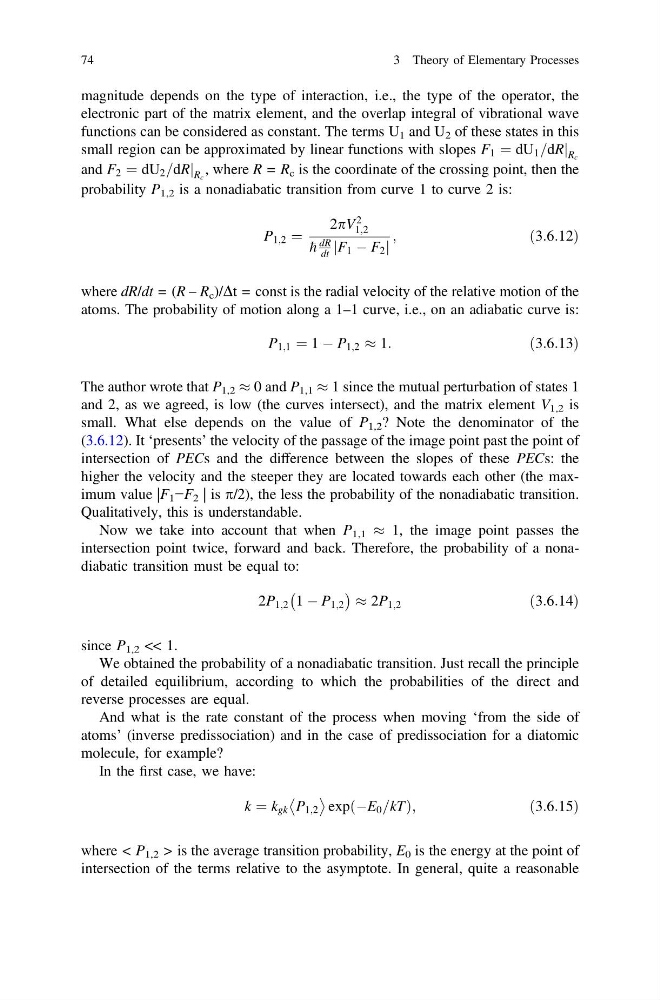
small region can be approximated by linear functions with slopes F 1 ¼ dU 1 =dRj R c
and F 2 ¼ dU 2 =dRj R c , where R = R c is the coordinate of the crossing point, then the
probability P 1,2 is a nonadiabatic transition from curve 1 to curve 2 is:
P 1;2 ¼
2pV
2
1;2
h
dR
dt F 1 À F 2
j
j
;
ð3:6:12Þ
where dR/dt = (R – R c )/Dt = const is the radial velocity of the relative motion of the
atoms. The probability of motion along a 1–1 curve, i.e., on an adiabatic curve is:
P 1;1 ¼ 1 À P 1;2 % 1:
ð3:6:13Þ
The author wrote that P 1,2 % 0 and P 1,1 % 1 since the mutual perturbation of states 1
and 2, as we agreed, is low (the curves intersect), and the matrix element V 1,2 is
small. What else depends on the value of P 1,2 ? Note the denominator of the
(3.6.12). It ‘presents’ the velocity of the passage of the image point past the point of
intersection of PECs and the difference between the slopes of these PECs: the
higher the velocity and the steeper they are located towards each other (the maximum value |F 1 −F 2 | is p/2), the less the probability of the nonadiabatic transition.
Qualitatively, this is understandable.
Now we take into account that when P 1,1 % 1, the image point passes the
intersection point twice, forward and back. Therefore, the probability of a nonadiabatic transition must be equal to:
2P 1;2 1 À P 1;2
À
Á % 2P 1;2
ð3:6:14Þ
since P 1,2 << 1.
We obtained the probability of a nonadiabatic transition. Just recall the principle
of detailed equilibrium, according to which the probabilities of the direct and
reverse processes are equal.
And what is the rate constant of the process when moving ‘from the side of
atoms’ (inverse predissociation) and in the case of predissociation for a diatomic
molecule, for example?
In the first case, we have:
k ¼ k gk P 1;2
exp ÀE 0 =kT
ð
Þ ;
ð3:6:15Þ
where < P 1,2 > is the average transition probability, E 0 is the energy at the point of
intersection of the terms relative to the asymptote. In general, quite a reasonable
74
3 Theory of Elementary Processes
electronic part of the matrix element, and the overlap integral of vibrational wave
functions can be considered as constant. The terms U 1 and U 2 of these states in this
small region can be approximated by linear functions with slopes F 1 ¼ dU 1 =dRj R c
and F 2 ¼ dU 2 =dRj R c , where R = R c is the coordinate of the crossing point, then the
probability P 1,2 is a nonadiabatic transition from curve 1 to curve 2 is:
P 1;2 ¼
2pV
2
1;2
h
dR
dt F 1 À F 2
j
j
;
ð3:6:12Þ
where dR/dt = (R – R c )/Dt = const is the radial velocity of the relative motion of the
atoms. The probability of motion along a 1–1 curve, i.e., on an adiabatic curve is:
P 1;1 ¼ 1 À P 1;2 % 1:
ð3:6:13Þ
The author wrote that P 1,2 % 0 and P 1,1 % 1 since the mutual perturbation of states 1
and 2, as we agreed, is low (the curves intersect), and the matrix element V 1,2 is
small. What else depends on the value of P 1,2 ? Note the denominator of the
(3.6.12). It ‘presents’ the velocity of the passage of the image point past the point of
intersection of PECs and the difference between the slopes of these PECs: the
higher the velocity and the steeper they are located towards each other (the maximum value |F 1 −F 2 | is p/2), the less the probability of the nonadiabatic transition.
Qualitatively, this is understandable.
Now we take into account that when P 1,1 % 1, the image point passes the
intersection point twice, forward and back. Therefore, the probability of a nonadiabatic transition must be equal to:
2P 1;2 1 À P 1;2
À
Á % 2P 1;2
ð3:6:14Þ
since P 1,2 << 1.
We obtained the probability of a nonadiabatic transition. Just recall the principle
of detailed equilibrium, according to which the probabilities of the direct and
reverse processes are equal.
And what is the rate constant of the process when moving ‘from the side of
atoms’ (inverse predissociation) and in the case of predissociation for a diatomic
molecule, for example?
In the first case, we have:
k ¼ k gk P 1;2
exp ÀE 0 =kT
ð
Þ ;
ð3:6:15Þ
where < P 1,2 > is the average transition probability, E 0 is the energy at the point of
intersection of the terms relative to the asymptote. In general, quite a reasonable
74
3 Theory of Elementary Processes