

is valid. Since the expression under the root is the sum of two squares, (3.6.9) is
valid only if, for the same values of internuclear distances
E
0
i À E
0
j þ V ii À V jj ¼ 0 and V ij ¼ 0
ð3:6:11Þ
For a diatomic molecule, this is possible if V ij = 0, since both values under the
root are functions of only one coordinate and cannot be equal to zero at the same
time. Therefore, the PECs of states i and j intersect if these states have different
types of symmetry of electronic wave functions (the exception is electrostatic
interaction). Otherwise, these states are ‘repelled’. In polyatomic molecules,
(3.6.10) is always valid, but not for all coordinates (conical intersection), i.e., PESs
of these molecules intersect even if the symmetry types of their wave functions
coincide.
So, we see that if the Massey parameter for PEC, PES, obtained in the zero
approximation, i.e., without taking into account the perturbations is small, and these
PEC, PES approach or even intersect, then the adiabatic approximation is again not
applicable in the zero approximation. In these cases, we must take into account that
a jump from surface to surface, so-called nonadiabatic transition, can occur with
some probability. As we will see later, the probability of these transitions depends
on the degree of interaction of these states obtained in the zero approximation; the
energy gap between the PECs, PESs of the states obtained already taking into
account the disturbances, i.e., ‘corrected’ Massey parameter.
We now consider the question of the factors on which the probabilities of
nonadiabatic transitions depend in more detail. For simplicity, consider first the
PECs, i.e., cases of predissociation of a diatomic molecule, reversed predissociation, and transitions between their bound states. First, we consider the general laws
and then will illustrate them with examples.
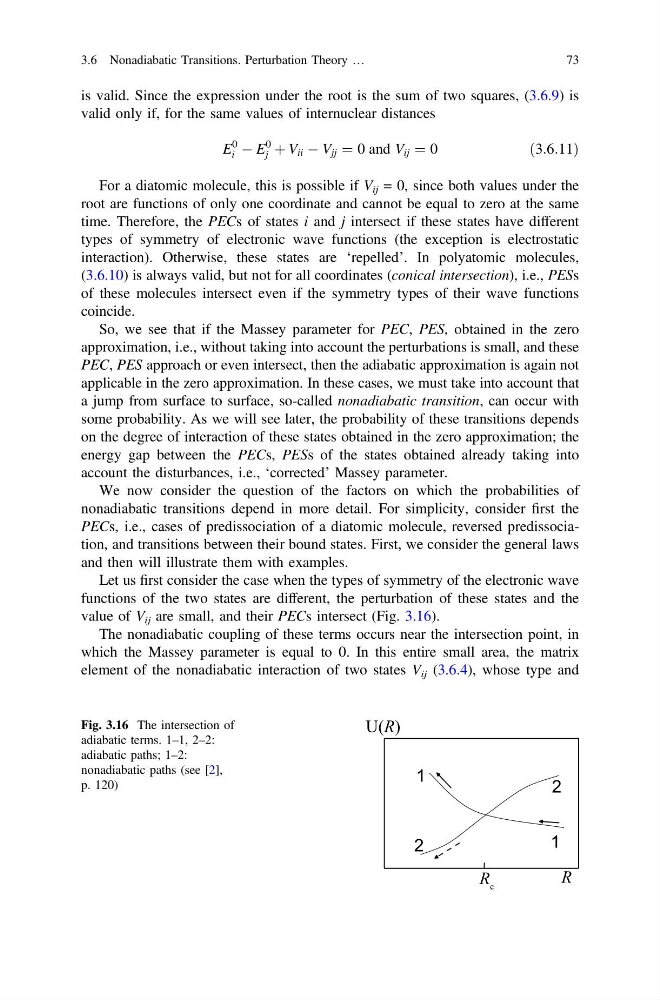
Let us first consider the case when the types of symmetry of the electronic wave
functions of the two states are different, the perturbation of these states and the
value of V ij are small, and their PECs intersect (Fig. 3.16).
The nonadiabatic coupling of these terms occurs near the intersection point, in
which the Massey parameter is equal to 0. In this entire small area, the matrix
element of the nonadiabatic interaction of two states V ij (3.6.4), whose type and
Fig. 3.16 The intersection of
adiabatic terms. 1–1, 2–2:
adiabatic paths; 1–2:
nonadiabatic paths (see [2],
p. 120)
3.6 Nonadiabatic Transitions. Perturbation Theory …
73
valid only if, for the same values of internuclear distances
E
0
i À E
0
j þ V ii À V jj ¼ 0 and V ij ¼ 0
ð3:6:11Þ
For a diatomic molecule, this is possible if V ij = 0, since both values under the
root are functions of only one coordinate and cannot be equal to zero at the same
time. Therefore, the PECs of states i and j intersect if these states have different
types of symmetry of electronic wave functions (the exception is electrostatic
interaction). Otherwise, these states are ‘repelled’. In polyatomic molecules,
(3.6.10) is always valid, but not for all coordinates (conical intersection), i.e., PESs
of these molecules intersect even if the symmetry types of their wave functions
coincide.
So, we see that if the Massey parameter for PEC, PES, obtained in the zero
approximation, i.e., without taking into account the perturbations is small, and these
PEC, PES approach or even intersect, then the adiabatic approximation is again not
applicable in the zero approximation. In these cases, we must take into account that
a jump from surface to surface, so-called nonadiabatic transition, can occur with
some probability. As we will see later, the probability of these transitions depends
on the degree of interaction of these states obtained in the zero approximation; the
energy gap between the PECs, PESs of the states obtained already taking into
account the disturbances, i.e., ‘corrected’ Massey parameter.
We now consider the question of the factors on which the probabilities of
nonadiabatic transitions depend in more detail. For simplicity, consider first the
PECs, i.e., cases of predissociation of a diatomic molecule, reversed predissociation, and transitions between their bound states. First, we consider the general laws
and then will illustrate them with examples.
Let us first consider the case when the types of symmetry of the electronic wave
functions of the two states are different, the perturbation of these states and the
value of V ij are small, and their PECs intersect (Fig. 3.16).
The nonadiabatic coupling of these terms occurs near the intersection point, in
which the Massey parameter is equal to 0. In this entire small area, the matrix
element of the nonadiabatic interaction of two states V ij (3.6.4), whose type and
Fig. 3.16 The intersection of
adiabatic terms. 1–1, 2–2:
adiabatic paths; 1–2:
nonadiabatic paths (see [2],
p. 120)
3.6 Nonadiabatic Transitions. Perturbation Theory …
73