

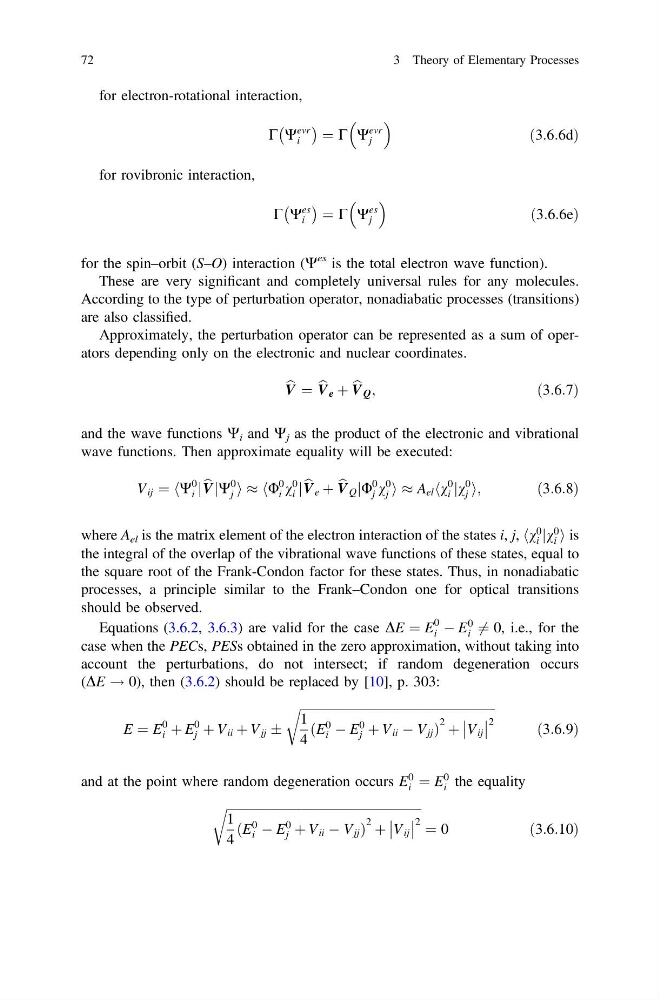
for electron-rotational interaction,
C W
evr
i
À
Á ¼ C W
evr
j
ð3:6:6dÞ
for rovibronic interaction,
C W
es
i
À Á ¼ C W
es
j
ð3:6:6eÞ
for the spin–orbit (S–O) interaction (W
es is the total electron wave function).
These are very significant and completely universal rules for any molecules.
According to the type of perturbation operator, nonadiabatic processes (transitions)
are also classified.
Approximately, the perturbation operator can be represented as a sum of operators depending only on the electronic and nuclear coordinates.
b
V ¼ b
V e þ b
V Q ;
ð3:6:7Þ
and the wave functions W i and W j as the product of the electronic and vibrational
wave functions. Then approximate equality will be executed:
V ij ¼ hW
0
i j b
V jW
0
j i % hU
0
i v
0
i j b
V e þ b
V Q jU
0
j v
0
j i % A el hv
0
i jv
0
j i;
ð3:6:8Þ
where A el is the matrix element of the electron interaction of the states i, j, hv
0
i jv
0
i i is
the integral of the overlap of the vibrational wave functions of these states, equal to
the square root of the Frank-Condon factor for these states. Thus, in nonadiabatic
processes, a principle similar to the Frank–Condon one for optical transitions
should be observed.
Equations (3.6.2, 3.6.3) are valid for the case DE ¼ E
0
i À E
0
i 6 ¼ 0, i.e., for the
case when the PECs, PESs obtained in the zero approximation, without taking into
account the perturbations, do not intersect; if random degeneration occurs
(DE ! 0), then (3.6.2) should be replaced by [10], p. 303:
E ¼ E
0
i þ E
0
j þ V ii þ V jj Æ
ffiffiffiffiffiffiffiffiffiffiffiffiffiffiffiffiffiffiffiffiffiffiffiffiffiffiffiffiffiffiffiffiffiffiffiffiffiffiffiffiffiffiffiffiffiffiffiffiffiffiffiffiffiffiffiffiffiffiffiffiffiffi ffi
1
4
ðE
0
i À E
0
j þ V ii À V jj Þ
2 þ V ij
2
r
ð3:6:9Þ
and at the point where random degeneration occurs E
0
i ¼ E
0
i the equality
ffiffiffiffiffiffiffiffiffiffiffiffiffiffiffiffiffiffiffiffiffiffiffiffiffiffiffiffiffiffiffiffiffiffiffiffiffiffiffiffiffiffiffiffiffiffiffiffiffiffiffiffiffiffiffiffiffiffiffiffiffiffi ffi
1
4
ðE
0
i À E
0
j þ V ii À V jj Þ
2 þ V ij
2
r
¼ 0
ð3:6:10Þ
72
3 Theory of Elementary Processes
C W
evr
i
À
Á ¼ C W
evr
j
ð3:6:6dÞ
for rovibronic interaction,
C W
es
i
À Á ¼ C W
es
j
ð3:6:6eÞ
for the spin–orbit (S–O) interaction (W
es is the total electron wave function).
These are very significant and completely universal rules for any molecules.
According to the type of perturbation operator, nonadiabatic processes (transitions)
are also classified.
Approximately, the perturbation operator can be represented as a sum of operators depending only on the electronic and nuclear coordinates.
b
V ¼ b
V e þ b
V Q ;
ð3:6:7Þ
and the wave functions W i and W j as the product of the electronic and vibrational
wave functions. Then approximate equality will be executed:
V ij ¼ hW
0
i j b
V jW
0
j i % hU
0
i v
0
i j b
V e þ b
V Q jU
0
j v
0
j i % A el hv
0
i jv
0
j i;
ð3:6:8Þ
where A el is the matrix element of the electron interaction of the states i, j, hv
0
i jv
0
i i is
the integral of the overlap of the vibrational wave functions of these states, equal to
the square root of the Frank-Condon factor for these states. Thus, in nonadiabatic
processes, a principle similar to the Frank–Condon one for optical transitions
should be observed.
Equations (3.6.2, 3.6.3) are valid for the case DE ¼ E
0
i À E
0
i 6 ¼ 0, i.e., for the
case when the PECs, PESs obtained in the zero approximation, without taking into
account the perturbations, do not intersect; if random degeneration occurs
(DE ! 0), then (3.6.2) should be replaced by [10], p. 303:
E ¼ E
0
i þ E
0
j þ V ii þ V jj Æ
ffiffiffiffiffiffiffiffiffiffiffiffiffiffiffiffiffiffiffiffiffiffiffiffiffiffiffiffiffiffiffiffiffiffiffiffiffiffiffiffiffiffiffiffiffiffiffiffiffiffiffiffiffiffiffiffiffiffiffiffiffiffi ffi
1
4
ðE
0
i À E
0
j þ V ii À V jj Þ
2 þ V ij
2
r
ð3:6:9Þ
and at the point where random degeneration occurs E
0
i ¼ E
0
i the equality
ffiffiffiffiffiffiffiffiffiffiffiffiffiffiffiffiffiffiffiffiffiffiffiffiffiffiffiffiffiffiffiffiffiffiffiffiffiffiffiffiffiffiffiffiffiffiffiffiffiffiffiffiffiffiffiffiffiffiffiffiffiffi ffi
1
4
ðE
0
i À E
0
j þ V ii À V jj Þ
2 þ V ij
2
r
¼ 0
ð3:6:10Þ
72
3 Theory of Elementary Processes