

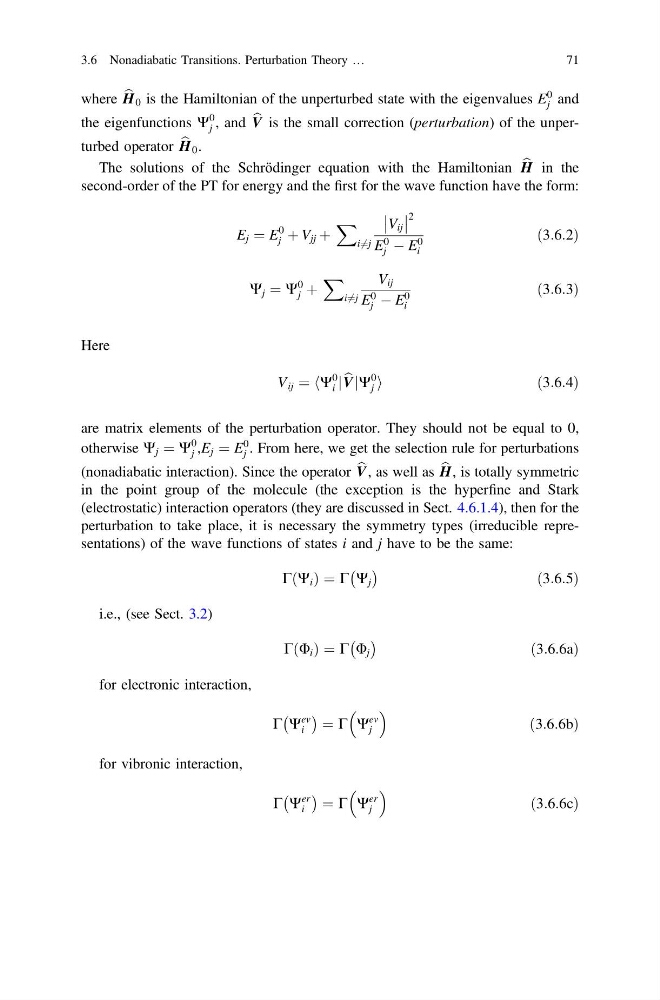
where b
H 0 is the Hamiltonian of the unperturbed state with the eigenvalues E
0
j and
the eigenfunctions W
0
j , and b
V is the small correction (perturbation) of the unperturbed operator b
H 0 .
The solutions of the Schrödinger equation with the Hamiltonian b
H in the
second-order of the PT for energy and the first for the wave function have the form:
E j ¼ E
0
j þ V jj þ
X
i6 ¼j
V ij
2
E
0
j À E
0
i
ð3:6:2Þ
W j ¼ W
0
j þ
X
i6 ¼j
V ij
E
0
j À E
0
i
ð3:6:3Þ
Here
V ij ¼ hW
0
i j b
V jW
0
j i
ð 3:6:4Þ
are matrix elements of the perturbation operator. They should not be equal to 0,
otherwise W j ¼ W
0
j ,E j ¼ E
0
j . From here, we get the selection rule for perturbations
(nonadiabatic interaction). Since the operator b
V , as well as b
H, is totally symmetric
in the point group of the molecule (the exception is the hyperfine and Stark
(electrostatic) interaction operators (they are discussed in Sect. 4.6.1.4), then for the
perturbation to take place, it is necessary the symmetry types (irreducible representations) of the wave functions of states i and j have to be the same:
C W i
ð Þ ¼ C W j
À Á
ð3:6:5Þ
i.e., (see Sect. 3.2)
C U i
ð Þ ¼ C U j
À Á
ð3:6:6aÞ
for electronic interaction,
C W
ev
i
À Á ¼ C W
ev
j
ð3:6:6bÞ
for vibronic interaction,
C W
er
i
À Á ¼ C W
er
j
ð3:6:6cÞ
3.6 Nonadiabatic Transitions. Perturbation Theory …
71
H 0 is the Hamiltonian of the unperturbed state with the eigenvalues E
0
j and
the eigenfunctions W
0
j , and b
V is the small correction (perturbation) of the unperturbed operator b
H 0 .
The solutions of the Schrödinger equation with the Hamiltonian b
H in the
second-order of the PT for energy and the first for the wave function have the form:
E j ¼ E
0
j þ V jj þ
X
i6 ¼j
V ij
2
E
0
j À E
0
i
ð3:6:2Þ
W j ¼ W
0
j þ
X
i6 ¼j
V ij
E
0
j À E
0
i
ð3:6:3Þ
Here
V ij ¼ hW
0
i j b
V jW
0
j i
ð 3:6:4Þ
are matrix elements of the perturbation operator. They should not be equal to 0,
otherwise W j ¼ W
0
j ,E j ¼ E
0
j . From here, we get the selection rule for perturbations
(nonadiabatic interaction). Since the operator b
V , as well as b
H, is totally symmetric
in the point group of the molecule (the exception is the hyperfine and Stark
(electrostatic) interaction operators (they are discussed in Sect. 4.6.1.4), then for the
perturbation to take place, it is necessary the symmetry types (irreducible representations) of the wave functions of states i and j have to be the same:
C W i
ð Þ ¼ C W j
À Á
ð3:6:5Þ
i.e., (see Sect. 3.2)
C U i
ð Þ ¼ C U j
À Á
ð3:6:6aÞ
for electronic interaction,
C W
ev
i
À Á ¼ C W
ev
j
ð3:6:6bÞ
for vibronic interaction,
C W
er
i
À Á ¼ C W
er
j
ð3:6:6cÞ
3.6 Nonadiabatic Transitions. Perturbation Theory …
71