

intersection point of the PESs of the zero approximation. The magnitude of the
understatement depends on the matrix element of the interaction of the states W A,BC
and W AB,C
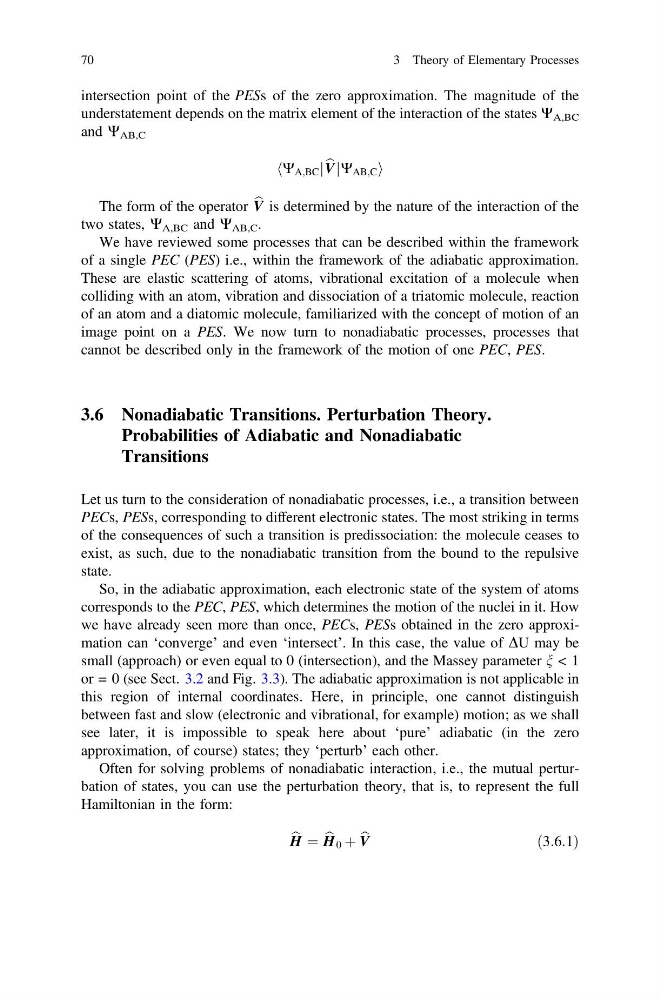
hW A;BC j b
V jW AB;C i
The form of the operator b
V is determined by the nature of the interaction of the
two states, W A,BC and W AB,C .
We have reviewed some processes that can be described within the framework
of a single PEC (PES) i.e., within the framework of the adiabatic approximation.
These are elastic scattering of atoms, vibrational excitation of a molecule when
colliding with an atom, vibration and dissociation of a triatomic molecule, reaction
of an atom and a diatomic molecule, familiarized with the concept of motion of an
image point on a PES. We now turn to nonadiabatic processes, processes that
cannot be described only in the framework of the motion of one PEC, PES.
3.6 Nonadiabatic Transitions. Perturbation Theory.
Probabilities of Adiabatic and Nonadiabatic
Transitions
Let us turn to the consideration of nonadiabatic processes, i.e., a transition between
PECs, PESs, corresponding to different electronic states. The most striking in terms
of the consequences of such a transition is predissociation: the molecule ceases to
exist, as such, due to the nonadiabatic transition from the bound to the repulsive
state.
So, in the adiabatic approximation, each electronic state of the system of atoms
corresponds to the PEC, PES, which determines the motion of the nuclei in it. How
we have already seen more than once, PECs, PESs obtained in the zero approximation can ‘converge’ and even ‘intersect’. In this case, the value of DU may be
small (approach) or even equal to 0 (intersection), and the Massey parameter n < 1
or = 0 (see Sect. 3.2 and Fig. 3.3). The adiabatic approximation is not applicable in
this region of internal coordinates. Here, in principle, one cannot distinguish
between fast and slow (electronic and vibrational, for example) motion; as we shall
see later, it is impossible to speak here about ‘pure’ adiabatic (in the zero
approximation, of course) states; they ‘perturb’ each other.
Often for solving problems of nonadiabatic interaction, i.e., the mutual perturbation of states, you can use the perturbation theory, that is, to represent the full
Hamiltonian in the form:
b
H ¼ b
H 0 þ b
V
ð3:6:1Þ
70
3 Theory of Elementary Processes
understatement depends on the matrix element of the interaction of the states W A,BC
and W AB,C
hW A;BC j b
V jW AB;C i
The form of the operator b
V is determined by the nature of the interaction of the
two states, W A,BC and W AB,C .
We have reviewed some processes that can be described within the framework
of a single PEC (PES) i.e., within the framework of the adiabatic approximation.
These are elastic scattering of atoms, vibrational excitation of a molecule when
colliding with an atom, vibration and dissociation of a triatomic molecule, reaction
of an atom and a diatomic molecule, familiarized with the concept of motion of an
image point on a PES. We now turn to nonadiabatic processes, processes that
cannot be described only in the framework of the motion of one PEC, PES.
3.6 Nonadiabatic Transitions. Perturbation Theory.
Probabilities of Adiabatic and Nonadiabatic
Transitions
Let us turn to the consideration of nonadiabatic processes, i.e., a transition between
PECs, PESs, corresponding to different electronic states. The most striking in terms
of the consequences of such a transition is predissociation: the molecule ceases to
exist, as such, due to the nonadiabatic transition from the bound to the repulsive
state.
So, in the adiabatic approximation, each electronic state of the system of atoms
corresponds to the PEC, PES, which determines the motion of the nuclei in it. How
we have already seen more than once, PECs, PESs obtained in the zero approximation can ‘converge’ and even ‘intersect’. In this case, the value of DU may be
small (approach) or even equal to 0 (intersection), and the Massey parameter n < 1
or = 0 (see Sect. 3.2 and Fig. 3.3). The adiabatic approximation is not applicable in
this region of internal coordinates. Here, in principle, one cannot distinguish
between fast and slow (electronic and vibrational, for example) motion; as we shall
see later, it is impossible to speak here about ‘pure’ adiabatic (in the zero
approximation, of course) states; they ‘perturb’ each other.
Often for solving problems of nonadiabatic interaction, i.e., the mutual perturbation of states, you can use the perturbation theory, that is, to represent the full
Hamiltonian in the form:
b
H ¼ b
H 0 þ b
V
ð3:6:1Þ
70
3 Theory of Elementary Processes