

The restructuring of the electronic structure of the system during the
A þ BC ! AB þ C
reaction can be very qualitatively described by the superposition of two wave
functions W A,BC and W AB,C , the first of which corresponds to the system consisting
of the atom A and the molecule BC, and the second atom C and molecules AB
(Fig. 3.15):
W ¼ a W A;BC þ c W AB;C :
ð3:5:6Þ
The coefficients a and c vary along the reaction path in accordance with the
continuous transition from state A + BC to state AB + C. Far from the region
corresponding to the activated complex of system A + BC, H + Cl 2 , O + N 2 , a
PES can be represented as that of corresponding to the interaction of the inert gas
atom with the molecule, i.e., pure repulsive potential. If we confine ourselves to
exchange reactions, then the potential of AB + C away from the activated complex
is the same (see, for example, HCl + Cl). If there is no reaction, then at smaller
distances AB À C; HCl À Cl, etc. the potential should be repulsive. In the area near
the activated complex, i.e., for identical values of the internal coordinates and the
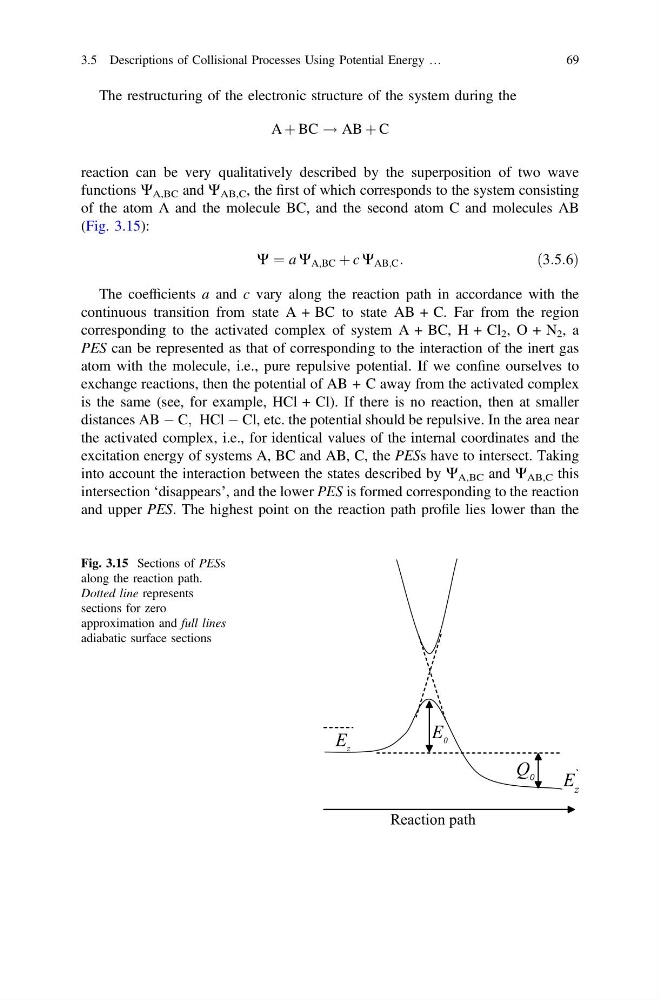
excitation energy of systems A, BC and AB, C, the PESs have to intersect. Taking
into account the interaction between the states described by W A,BC and W AB,C this
intersection ‘disappears’, and the lower PES is formed corresponding to the reaction
and upper PES. The highest point on the reaction path profile lies lower than the
Fig. 3.15 Sections of PESs
along the reaction path.
Dotted line represents
sections for zero
approximation and full lines
adiabatic surface sections
3.5 Descriptions of Collisional Processes Using Potential Energy …
69
A þ BC ! AB þ C
reaction can be very qualitatively described by the superposition of two wave
functions W A,BC and W AB,C , the first of which corresponds to the system consisting
of the atom A and the molecule BC, and the second atom C and molecules AB
(Fig. 3.15):
W ¼ a W A;BC þ c W AB;C :
ð3:5:6Þ
The coefficients a and c vary along the reaction path in accordance with the
continuous transition from state A + BC to state AB + C. Far from the region
corresponding to the activated complex of system A + BC, H + Cl 2 , O + N 2 , a
PES can be represented as that of corresponding to the interaction of the inert gas
atom with the molecule, i.e., pure repulsive potential. If we confine ourselves to
exchange reactions, then the potential of AB + C away from the activated complex
is the same (see, for example, HCl + Cl). If there is no reaction, then at smaller
distances AB À C; HCl À Cl, etc. the potential should be repulsive. In the area near
the activated complex, i.e., for identical values of the internal coordinates and the
excitation energy of systems A, BC and AB, C, the PESs have to intersect. Taking
into account the interaction between the states described by W A,BC and W AB,C this
intersection ‘disappears’, and the lower PES is formed corresponding to the reaction
and upper PES. The highest point on the reaction path profile lies lower than the
Fig. 3.15 Sections of PESs
along the reaction path.
Dotted line represents
sections for zero
approximation and full lines
adiabatic surface sections
3.5 Descriptions of Collisional Processes Using Potential Energy …
69