

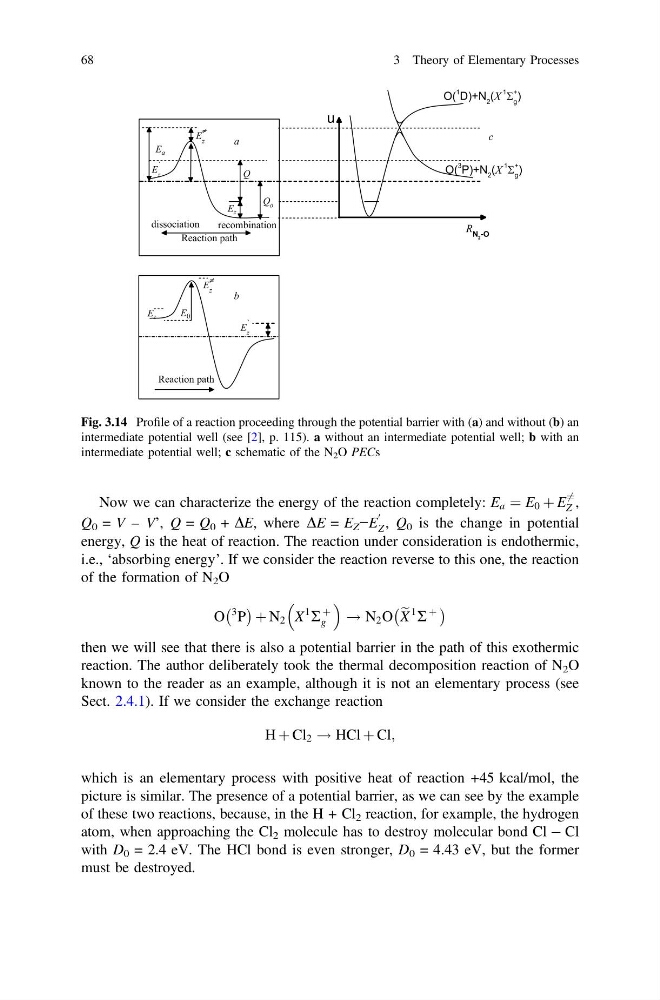
Now we can characterize the energy of the reaction completely: E a ¼ E 0 þ E
6 ¼
Z ,
Q 0 = V – V’, Q = Q 0 + DE, where DE = E Z −E
0
Z , Q 0 is the change in potential
energy, Q is the heat of reaction. The reaction under consideration is endothermic,
i.e., ‘absorbing energy’. If we consider the reaction reverse to this one, the reaction
of the formation of N 2 O
O
3 P
À Á þ N 2 X
1 R
þ
g
! N 2 O e
X
1 R
þ
À
Á
then we will see that there is also a potential barrier in the path of this exothermic
reaction. The author deliberately took the thermal decomposition reaction of N 2 O
known to the reader as an example, although it is not an elementary process (see
Sect. 2.4.1). If we consider the exchange reaction
H þ Cl 2 ! HCl þ Cl;
which is an elementary process with positive heat of reaction +45 kcal/mol, the
picture is similar. The presence of a potential barrier, as we can see by the example
of these two reactions, because, in the H + Cl 2 reaction, for example, the hydrogen
atom, when approaching the Cl 2 molecule has to destroy molecular bond Cl À Cl
with D 0 = 2.4 eV. The HCl bond is even stronger, D 0 = 4.43 eV, but the former
must be destroyed.
Fig. 3.14 Profile of a reaction proceeding through the potential barrier with (a) and without (b) an
intermediate potential well (see [2], p. 115). a without an intermediate potential well; b with an
intermediate potential well; c schematic of the N 2 O PECs
68
3 Theory of Elementary Processes
6 ¼
Z ,
Q 0 = V – V’, Q = Q 0 + DE, where DE = E Z −E
0
Z , Q 0 is the change in potential
energy, Q is the heat of reaction. The reaction under consideration is endothermic,
i.e., ‘absorbing energy’. If we consider the reaction reverse to this one, the reaction
of the formation of N 2 O
O
3 P
À Á þ N 2 X
1 R
þ
g
! N 2 O e
X
1 R
þ
À
Á
then we will see that there is also a potential barrier in the path of this exothermic
reaction. The author deliberately took the thermal decomposition reaction of N 2 O
known to the reader as an example, although it is not an elementary process (see
Sect. 2.4.1). If we consider the exchange reaction
H þ Cl 2 ! HCl þ Cl;
which is an elementary process with positive heat of reaction +45 kcal/mol, the
picture is similar. The presence of a potential barrier, as we can see by the example
of these two reactions, because, in the H + Cl 2 reaction, for example, the hydrogen
atom, when approaching the Cl 2 molecule has to destroy molecular bond Cl À Cl
with D 0 = 2.4 eV. The HCl bond is even stronger, D 0 = 4.43 eV, but the former
must be destroyed.
Fig. 3.14 Profile of a reaction proceeding through the potential barrier with (a) and without (b) an
intermediate potential well (see [2], p. 115). a without an intermediate potential well; b with an
intermediate potential well; c schematic of the N 2 O PECs
68
3 Theory of Elementary Processes