

still happen if during the lifetime of this complex it does not collide with another
species. It is also evident that if the C
16 O 2 (X,v) molecule is vibrationally excited, or
the kinetic energy of the relative motion of O and CO is not equal to 0, the lifetime
of the complex has to be less. What is the probability of ‘dropping out’ of an image
point in a given valley at given energies? The answer to this question can be given
by solving the problem of the motion of an image point on a given surface and with
given initial conditions.
The author has been describing quite a bit about how the oxygen atom in the CO
molecule is replaced when it collides with the O(
1 D) atom and how the problem of
the vibrational excitation of the CO 2 molecule formed can be solved and the
probability of the exchange of oxygen atoms. The same process can be described
more simply and is done using the theory of an activated complex.
The author will not dwell on the description of this theory and mention how to
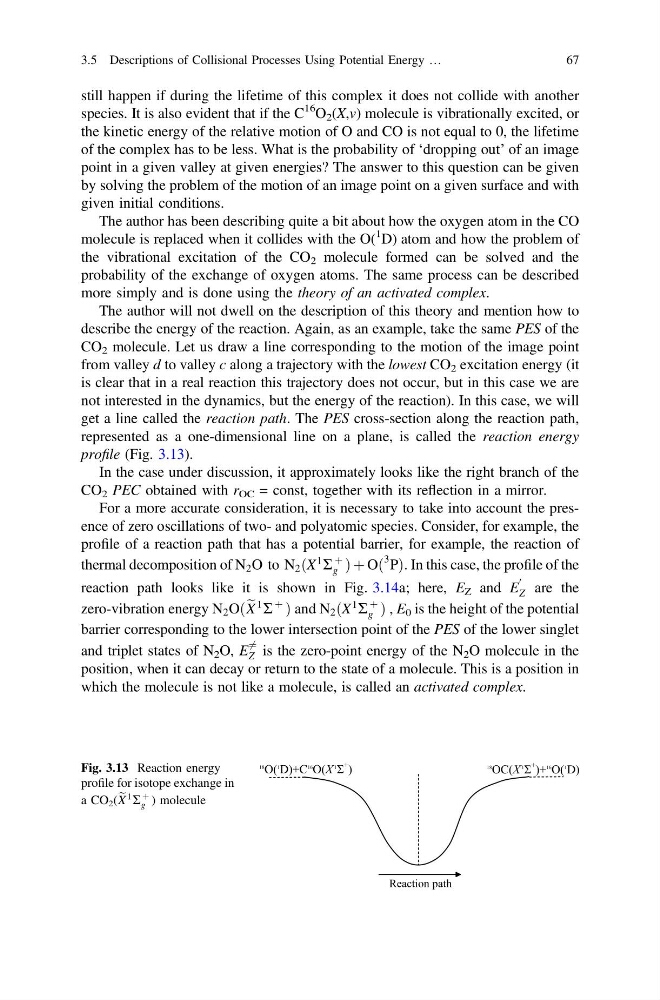
describe the energy of the reaction. Again, as an example, take the same PES of the
CO 2 molecule. Let us draw a line corresponding to the motion of the image point
from valley d to valley c along a trajectory with the lowest CO 2 excitation energy (it
is clear that in a real reaction this trajectory does not occur, but in this case we are
not interested in the dynamics, but the energy of the reaction). In this case, we will
get a line called the reaction path. The PES cross-section along the reaction path,
represented as a one-dimensional line on a plane, is called the reaction energy
profile (Fig. 3.13).
In the case under discussion, it approximately looks like the right branch of the
CO 2 PEC obtained with r OC = const, together with its reflection in a mirror.
For a more accurate consideration, it is necessary to take into account the presence of zero oscillations of two- and polyatomic species. Consider, for example, the
profile of a reaction path that has a potential barrier, for example, the reaction of
thermal decomposition of N 2 O to N 2 ðX
1 R
þ
g Þ þ Oð
3 PÞ. In this case, the profile of the
reaction path looks like it is shown in Fig. 3.14a; here, E Z and E
0
Z are the
zero-vibration energy N 2 Oð e
X
1 R
þ
Þ and N 2 ðX
1 R
þ
g Þ , E 0 is the height of the potential
barrier corresponding to the lower intersection point of the PES of the lower singlet
and triplet states of N 2 O, E
6 ¼
Z is the zero-point energy of the N 2 O molecule in the
position, when it can decay or return to the state of a molecule. This is a position in
which the molecule is not like a molecule, is called an activated complex.
Fig. 3.13 Reaction energy
profile for isotope exchange in
a CO 2 ( e
X
1 R
þ
g ) molecule
3.5 Descriptions of Collisional Processes Using Potential Energy …
67
species. It is also evident that if the C
16 O 2 (X,v) molecule is vibrationally excited, or
the kinetic energy of the relative motion of O and CO is not equal to 0, the lifetime
of the complex has to be less. What is the probability of ‘dropping out’ of an image
point in a given valley at given energies? The answer to this question can be given
by solving the problem of the motion of an image point on a given surface and with
given initial conditions.
The author has been describing quite a bit about how the oxygen atom in the CO
molecule is replaced when it collides with the O(
1 D) atom and how the problem of
the vibrational excitation of the CO 2 molecule formed can be solved and the
probability of the exchange of oxygen atoms. The same process can be described
more simply and is done using the theory of an activated complex.
The author will not dwell on the description of this theory and mention how to
describe the energy of the reaction. Again, as an example, take the same PES of the
CO 2 molecule. Let us draw a line corresponding to the motion of the image point
from valley d to valley c along a trajectory with the lowest CO 2 excitation energy (it
is clear that in a real reaction this trajectory does not occur, but in this case we are
not interested in the dynamics, but the energy of the reaction). In this case, we will
get a line called the reaction path. The PES cross-section along the reaction path,
represented as a one-dimensional line on a plane, is called the reaction energy
profile (Fig. 3.13).
In the case under discussion, it approximately looks like the right branch of the
CO 2 PEC obtained with r OC = const, together with its reflection in a mirror.
For a more accurate consideration, it is necessary to take into account the presence of zero oscillations of two- and polyatomic species. Consider, for example, the
profile of a reaction path that has a potential barrier, for example, the reaction of
thermal decomposition of N 2 O to N 2 ðX
1 R
þ
g Þ þ Oð
3 PÞ. In this case, the profile of the
reaction path looks like it is shown in Fig. 3.14a; here, E Z and E
0
Z are the
zero-vibration energy N 2 Oð e
X
1 R
þ
Þ and N 2 ðX
1 R
þ
g Þ , E 0 is the height of the potential
barrier corresponding to the lower intersection point of the PES of the lower singlet
and triplet states of N 2 O, E
6 ¼
Z is the zero-point energy of the N 2 O molecule in the
position, when it can decay or return to the state of a molecule. This is a position in
which the molecule is not like a molecule, is called an activated complex.
Fig. 3.13 Reaction energy
profile for isotope exchange in
a CO 2 ( e
X
1 R
þ
g ) molecule
3.5 Descriptions of Collisional Processes Using Potential Energy …
67