

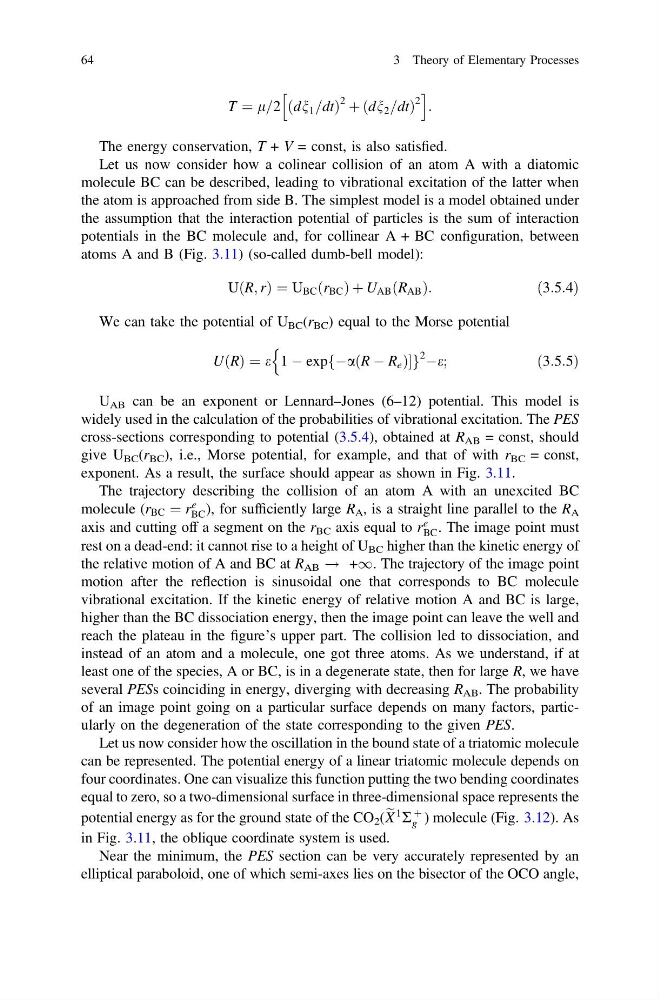
T ¼ l=2 dn 1 =dt
ð
Þ
2 þ dn 2 =dt
ð
Þ
2
h
i
:
The energy conservation, T + V = const, is also satisfied.
Let us now consider how a colinear collision of an atom A with a diatomic
molecule BC can be described, leading to vibrational excitation of the latter when
the atom is approached from side B. The simplest model is a model obtained under
the assumption that the interaction potential of particles is the sum of interaction
potentials in the BC molecule and, for collinear A + BC configuration, between
atoms A and B (Fig. 3.11) (so-called dumb-bell model):
UðR; rÞ ¼ U BC r BC
ð ÞþU AB R AB
ð
Þ:
ð3:5:4Þ
We can take the potential of U BC (r BC ) equal to the Morse potential
UðRÞ ¼ e 1 À exp Àa R À R e
ð
Þ
f
g
2 Àe
n
;
ð3:5:5Þ
U AB can be an exponent or Lennard–Jones (6–12) potential. This model is
widely used in the calculation of the probabilities of vibrational excitation. The PES
cross-sections corresponding to potential (3.5.4), obtained at R AB = const, should
give U BC (r BC ), i.e., Morse potential, for example, and that of with r BC = const,
exponent. As a result, the surface should appear as shown in Fig. 3.11.
The trajectory describing the collision of an atom A with an unexcited BC
molecule (r BC ¼ r
e
BC ), for sufficiently large R A , is a straight line parallel to the R A
axis and cutting off a segment on the r BC axis equal to r
e
BC . The image point must
rest on a dead-end: it cannot rise to a height of U BC higher than the kinetic energy of
the relative motion of A and BC at R AB ! +1. The trajectory of the image point
motion after the reflection is sinusoidal one that corresponds to BC molecule
vibrational excitation. If the kinetic energy of relative motion A and BC is large,
higher than the BC dissociation energy, then the image point can leave the well and
reach the plateau in the figure’s upper part. The collision led to dissociation, and
instead of an atom and a molecule, one got three atoms. As we understand, if at
least one of the species, A or BC, is in a degenerate state, then for large R, we have
several PESs coinciding in energy, diverging with decreasing R AB . The probability
of an image point going on a particular surface depends on many factors, particularly on the degeneration of the state corresponding to the given PES.
Let us now consider how the oscillation in the bound state of a triatomic molecule
can be represented. The potential energy of a linear triatomic molecule depends on
four coordinates. One can visualize this function putting the two bending coordinates
equal to zero, so a two-dimensional surface in three-dimensional space represents the
potential energy as for the ground state of the CO 2 ( e
X
1 R
þ
g ) molecule (Fig. 3.12). As
in Fig. 3.11, the oblique coordinate system is used.
Near the minimum, the PES section can be very accurately represented by an
elliptical paraboloid, one of which semi-axes lies on the bisector of the OCO angle,
64
3 Theory of Elementary Processes
ð
Þ
2 þ dn 2 =dt
ð
Þ
2
h
i
:
The energy conservation, T + V = const, is also satisfied.
Let us now consider how a colinear collision of an atom A with a diatomic
molecule BC can be described, leading to vibrational excitation of the latter when
the atom is approached from side B. The simplest model is a model obtained under
the assumption that the interaction potential of particles is the sum of interaction
potentials in the BC molecule and, for collinear A + BC configuration, between
atoms A and B (Fig. 3.11) (so-called dumb-bell model):
UðR; rÞ ¼ U BC r BC
ð ÞþU AB R AB
ð
Þ:
ð3:5:4Þ
We can take the potential of U BC (r BC ) equal to the Morse potential
UðRÞ ¼ e 1 À exp Àa R À R e
ð
Þ
f
g
2 Àe
n
;
ð3:5:5Þ
U AB can be an exponent or Lennard–Jones (6–12) potential. This model is
widely used in the calculation of the probabilities of vibrational excitation. The PES
cross-sections corresponding to potential (3.5.4), obtained at R AB = const, should
give U BC (r BC ), i.e., Morse potential, for example, and that of with r BC = const,
exponent. As a result, the surface should appear as shown in Fig. 3.11.
The trajectory describing the collision of an atom A with an unexcited BC
molecule (r BC ¼ r
e
BC ), for sufficiently large R A , is a straight line parallel to the R A
axis and cutting off a segment on the r BC axis equal to r
e
BC . The image point must
rest on a dead-end: it cannot rise to a height of U BC higher than the kinetic energy of
the relative motion of A and BC at R AB ! +1. The trajectory of the image point
motion after the reflection is sinusoidal one that corresponds to BC molecule
vibrational excitation. If the kinetic energy of relative motion A and BC is large,
higher than the BC dissociation energy, then the image point can leave the well and
reach the plateau in the figure’s upper part. The collision led to dissociation, and
instead of an atom and a molecule, one got three atoms. As we understand, if at
least one of the species, A or BC, is in a degenerate state, then for large R, we have
several PESs coinciding in energy, diverging with decreasing R AB . The probability
of an image point going on a particular surface depends on many factors, particularly on the degeneration of the state corresponding to the given PES.
Let us now consider how the oscillation in the bound state of a triatomic molecule
can be represented. The potential energy of a linear triatomic molecule depends on
four coordinates. One can visualize this function putting the two bending coordinates
equal to zero, so a two-dimensional surface in three-dimensional space represents the
potential energy as for the ground state of the CO 2 ( e
X
1 R
þ
g ) molecule (Fig. 3.12). As
in Fig. 3.11, the oblique coordinate system is used.
Near the minimum, the PES section can be very accurately represented by an
elliptical paraboloid, one of which semi-axes lies on the bisector of the OCO angle,
64
3 Theory of Elementary Processes