

and the other, of course, is perpendicular to it. The harmonic approximation
describes well the potential energy in this surface region. The study of the dynamics
of the motion of such a system shows that it can be described by such a set of
variables in which the total vibrational Hamiltonian is represented as a sum of
Hamiltonians, each of which depends on this variable and its derivative on time.
The total energy of the system in this approximation is represented as the sum of
time-independent energies. These coordinates are called normal, and the approximation is suitable as long as the PES differs little from an elliptic paraboloid. As the
amplitude of the oscillations increases, the higher terms of the coordinates, which
consider the anharmonicity, appear in the decomposition of the kinetic and potential
energies, and an elliptical paraboloid cannot describe the PES.
Now let us consider vibrations of the linear triatomic molecule CO 2 ( e
X
1 R
þ
g ). It is
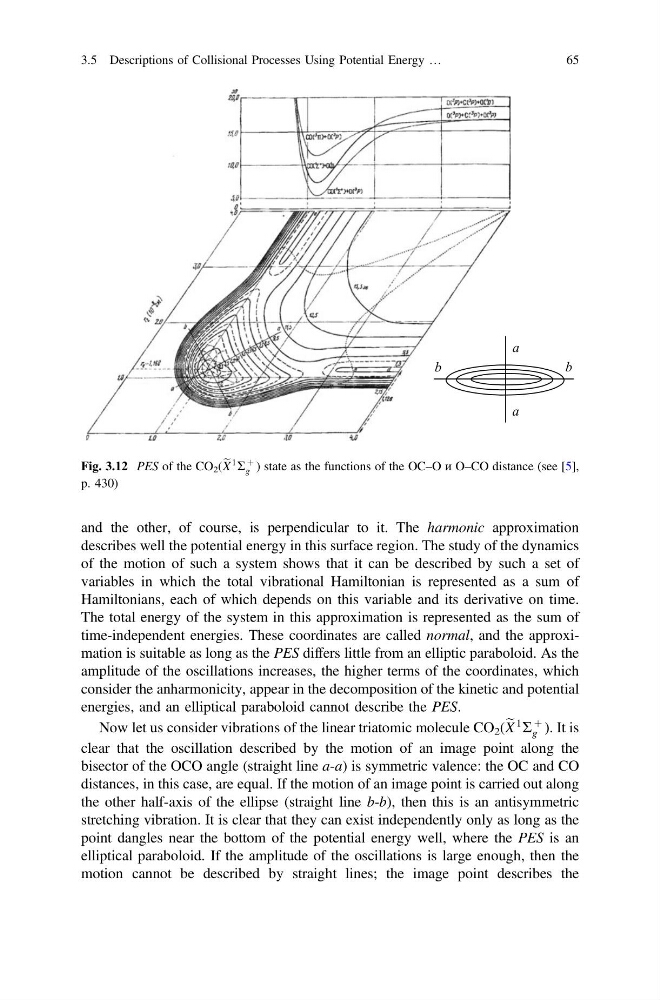
clear that the oscillation described by the motion of an image point along the
bisector of the OCO angle (straight line a-a) is symmetric valence: the OC and CO
distances, in this case, are equal. If the motion of an image point is carried out along
the other half-axis of the ellipse (straight line b-b), then this is an antisymmetric
stretching vibration. It is clear that they can exist independently only as long as the
point dangles near the bottom of the potential energy well, where the PES is an
elliptical paraboloid. If the amplitude of the oscillations is large enough, then the
motion cannot be described by straight lines; the image point describes the
Fig. 3.12 PES of the CO 2 ( e
X
1 R
þ
g ) state as the functions of the OC–O и O–CO distance (see [5],
p. 430)
3.5 Descriptions of Collisional Processes Using Potential Energy …
65
describes well the potential energy in this surface region. The study of the dynamics
of the motion of such a system shows that it can be described by such a set of
variables in which the total vibrational Hamiltonian is represented as a sum of
Hamiltonians, each of which depends on this variable and its derivative on time.
The total energy of the system in this approximation is represented as the sum of
time-independent energies. These coordinates are called normal, and the approximation is suitable as long as the PES differs little from an elliptic paraboloid. As the
amplitude of the oscillations increases, the higher terms of the coordinates, which
consider the anharmonicity, appear in the decomposition of the kinetic and potential
energies, and an elliptical paraboloid cannot describe the PES.
Now let us consider vibrations of the linear triatomic molecule CO 2 ( e
X
1 R
þ
g ). It is
clear that the oscillation described by the motion of an image point along the
bisector of the OCO angle (straight line a-a) is symmetric valence: the OC and CO
distances, in this case, are equal. If the motion of an image point is carried out along
the other half-axis of the ellipse (straight line b-b), then this is an antisymmetric
stretching vibration. It is clear that they can exist independently only as long as the
point dangles near the bottom of the potential energy well, where the PES is an
elliptical paraboloid. If the amplitude of the oscillations is large enough, then the
motion cannot be described by straight lines; the image point describes the
Fig. 3.12 PES of the CO 2 ( e
X
1 R
þ
g ) state as the functions of the OC–O и O–CO distance (see [5],
p. 430)
3.5 Descriptions of Collisional Processes Using Potential Energy …
65