

in Fig. 3.8), then the image point does not fall over the barrier. It reflects from it,
i.e., species moves past each other, not coming closer. If one fixes the value of the
relative angular momentum M ¼ l AB Á u Á b and increases the total energy E, so
E > E 2 , the image point ‘overruns’ through the barrier (i.e., the species approaches
to the distance R < R m , Fig. 3.8). Then the image point reaches the point on the
repulsive part of the barrier, which is isoenergetic with the energy of the potential at
the point R m , reflects, and goes back. This motion of the image point corresponds to
the fact that the trajectory of motion in Fig. 3.9 corresponds to a spiral, which first
twists and then spins (the point jumped out of the potential well). This feature is
called orbiting. If one of the species A, B is a di- or polyatomic molecule, then the
image point will ‘dangle’ for some time in this potential well.
One can show that the total cross-section of a process that corresponds to
orbiting, called the capture cross-section is:
r c ðEÞ ¼ pb
2
c ðEÞ;
b c is the impact parameter corresponding to the orbiting.
It can also be shown that orbiting takes place if
r c ðEÞ ¼ pR
2
0 ;
much more than gas-kinetic cross-section. It is also clear that if the collision energy
is high (E 1 , Fig. 3.8), then orbiting does not take place: the image point reaches the
repulsive potential, reflects and quickly fall out of the well.
Potential energy surfaces. Let us consider the PES of systems of three atoms,
using which one can describe the processes of energy exchange, bimolecular
reactions, and spontaneous decay.
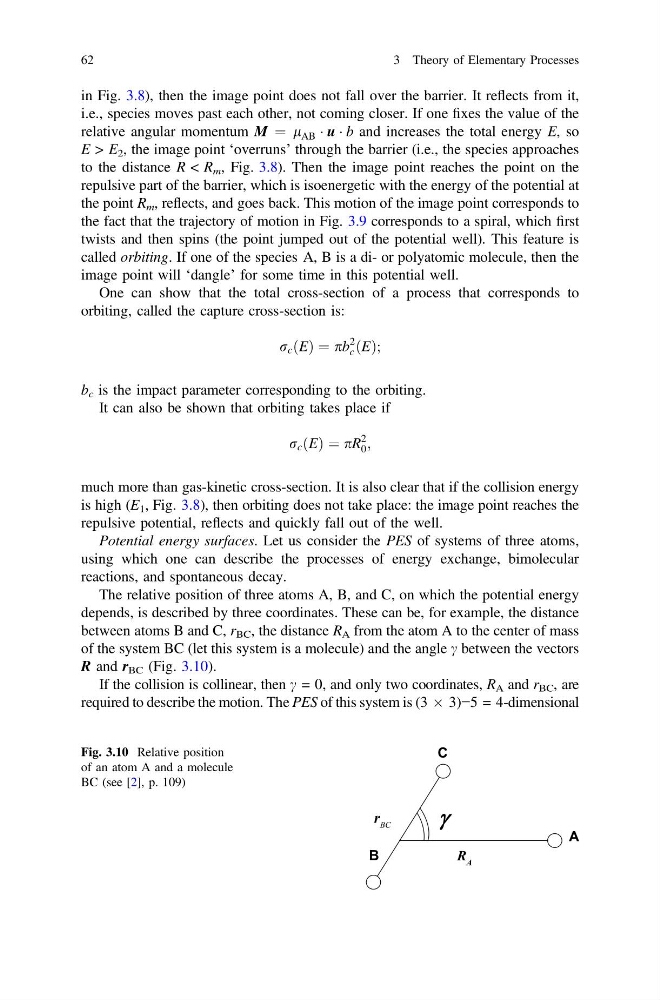
The relative position of three atoms A, B, and C, on which the potential energy
depends, is described by three coordinates. These can be, for example, the distance
between atoms B and C, r BC , the distance R A from the atom A to the center of mass
of the system BC (let this system is a molecule) and the angle c between the vectors
R and r BC (Fig. 3.10).
If the collision is collinear, then c = 0, and only two coordinates, R A and r BC , are
required to describe the motion. The PES of this system is (3 Â 3)−5 = 4-dimensional
Fig. 3.10 Relative position
of an atom A and a molecule
BC (see [2], p. 109)
62
3 Theory of Elementary Processes
i.e., species moves past each other, not coming closer. If one fixes the value of the
relative angular momentum M ¼ l AB Á u Á b and increases the total energy E, so
E > E 2 , the image point ‘overruns’ through the barrier (i.e., the species approaches
to the distance R < R m , Fig. 3.8). Then the image point reaches the point on the
repulsive part of the barrier, which is isoenergetic with the energy of the potential at
the point R m , reflects, and goes back. This motion of the image point corresponds to
the fact that the trajectory of motion in Fig. 3.9 corresponds to a spiral, which first
twists and then spins (the point jumped out of the potential well). This feature is
called orbiting. If one of the species A, B is a di- or polyatomic molecule, then the
image point will ‘dangle’ for some time in this potential well.
One can show that the total cross-section of a process that corresponds to
orbiting, called the capture cross-section is:
r c ðEÞ ¼ pb
2
c ðEÞ;
b c is the impact parameter corresponding to the orbiting.
It can also be shown that orbiting takes place if
r c ðEÞ ¼ pR
2
0 ;
much more than gas-kinetic cross-section. It is also clear that if the collision energy
is high (E 1 , Fig. 3.8), then orbiting does not take place: the image point reaches the
repulsive potential, reflects and quickly fall out of the well.
Potential energy surfaces. Let us consider the PES of systems of three atoms,
using which one can describe the processes of energy exchange, bimolecular
reactions, and spontaneous decay.
The relative position of three atoms A, B, and C, on which the potential energy
depends, is described by three coordinates. These can be, for example, the distance
between atoms B and C, r BC , the distance R A from the atom A to the center of mass
of the system BC (let this system is a molecule) and the angle c between the vectors
R and r BC (Fig. 3.10).
If the collision is collinear, then c = 0, and only two coordinates, R A and r BC , are
required to describe the motion. The PES of this system is (3 Â 3)−5 = 4-dimensional
Fig. 3.10 Relative position
of an atom A and a molecule
BC (see [2], p. 109)
62
3 Theory of Elementary Processes