

Lennard–Jones potentials are used to describe the interaction potentials of species that can form only a vdW complex with a well depth e. A classical motion in
the elastic collision of two atoms A, B is equivalent to the problem of the motion of
a material point with a mass equal to the reduced mass in the field of the effective
potential (Fig. 3.9):
U eff R
ð Þ ¼ U LÀJ R
ð Þ þ
M
2
2l AB R
2
ð3:5:1Þ
where M ¼ l AB Á u Á b is the angular momentum vector. A feature of U eff R
ð Þ is the
presence of a potential centrifugal barrier for potentials U(R), decreasing faster than
1/R
2 . The magnitude of this barrier is larger, the larger u and impact parameter b. It
is somewhat similar to the rotational centrifugal barrier of diatomic molecules.
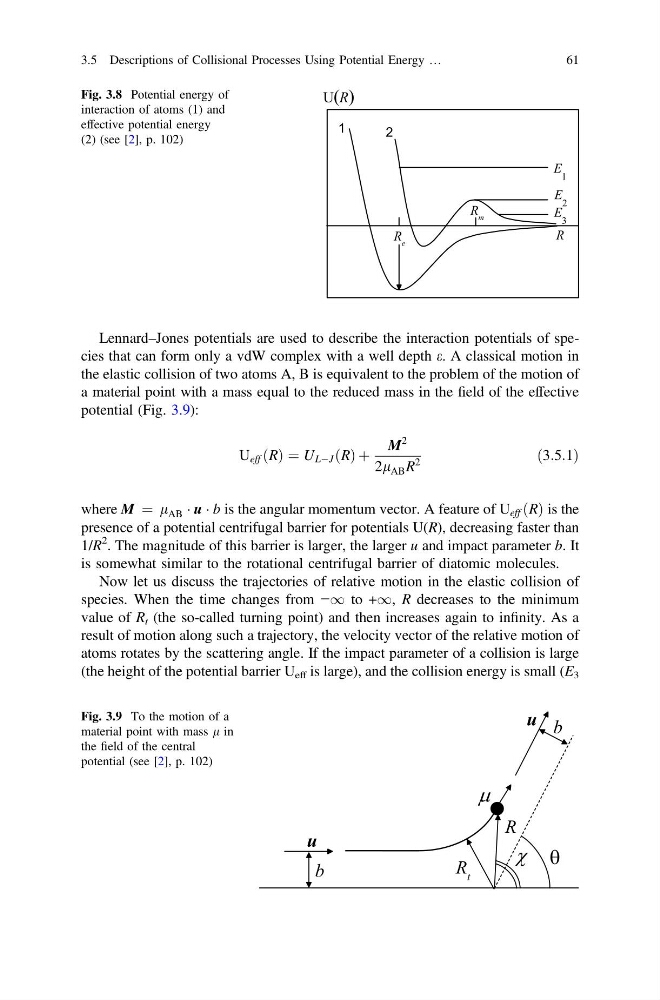
Now let us discuss the trajectories of relative motion in the elastic collision of
species. When the time changes from −1 to +1, R decreases to the minimum
value of R t (the so-called turning point) and then increases again to infinity. As a
result of motion along such a trajectory, the velocity vector of the relative motion of
atoms rotates by the scattering angle. If the impact parameter of a collision is large
(the height of the potential barrier U eff is large), and the collision energy is small (E 3
Fig. 3.8 Potential energy of
interaction of atoms (1) and
effective potential energy
(2) (see [2], p. 102)
Fig. 3.9 To the motion of a
material point with mass l in
the field of the central
potential (see [2], p. 102)
3.5 Descriptions of Collisional Processes Using Potential Energy …
61
the elastic collision of two atoms A, B is equivalent to the problem of the motion of
a material point with a mass equal to the reduced mass in the field of the effective
potential (Fig. 3.9):
U eff R
ð Þ ¼ U LÀJ R
ð Þ þ
M
2
2l AB R
2
ð3:5:1Þ
where M ¼ l AB Á u Á b is the angular momentum vector. A feature of U eff R
ð Þ is the
presence of a potential centrifugal barrier for potentials U(R), decreasing faster than
1/R
2 . The magnitude of this barrier is larger, the larger u and impact parameter b. It
is somewhat similar to the rotational centrifugal barrier of diatomic molecules.
Now let us discuss the trajectories of relative motion in the elastic collision of
species. When the time changes from −1 to +1, R decreases to the minimum
value of R t (the so-called turning point) and then increases again to infinity. As a
result of motion along such a trajectory, the velocity vector of the relative motion of
atoms rotates by the scattering angle. If the impact parameter of a collision is large
(the height of the potential barrier U eff is large), and the collision energy is small (E 3
Fig. 3.8 Potential energy of
interaction of atoms (1) and
effective potential energy
(2) (see [2], p. 102)
Fig. 3.9 To the motion of a
material point with mass l in
the field of the central
potential (see [2], p. 102)
3.5 Descriptions of Collisional Processes Using Potential Energy …
61