

curves or surfaces. As for the PECs, i.e., the problems of dissociation, predissociation of a diatomic molecule, or the collision of two atoms, very often, we can get
much of the information about the PECs from an experiment. For PESs, this
happens less often, and usually only after solving the quantum chemical problem of
calculating PES using some ab initio or semi-empirical method(s), one can begin to
solve the dynamic problem of describing the motion of an image point on this PES.
Let us now understand how elastic collisions, energy exchange processes during
them, and chemical reactions can be described using PECs and PESs.
Elastic collisions. In collisions (3.1.1) as we now know, for each pair of species
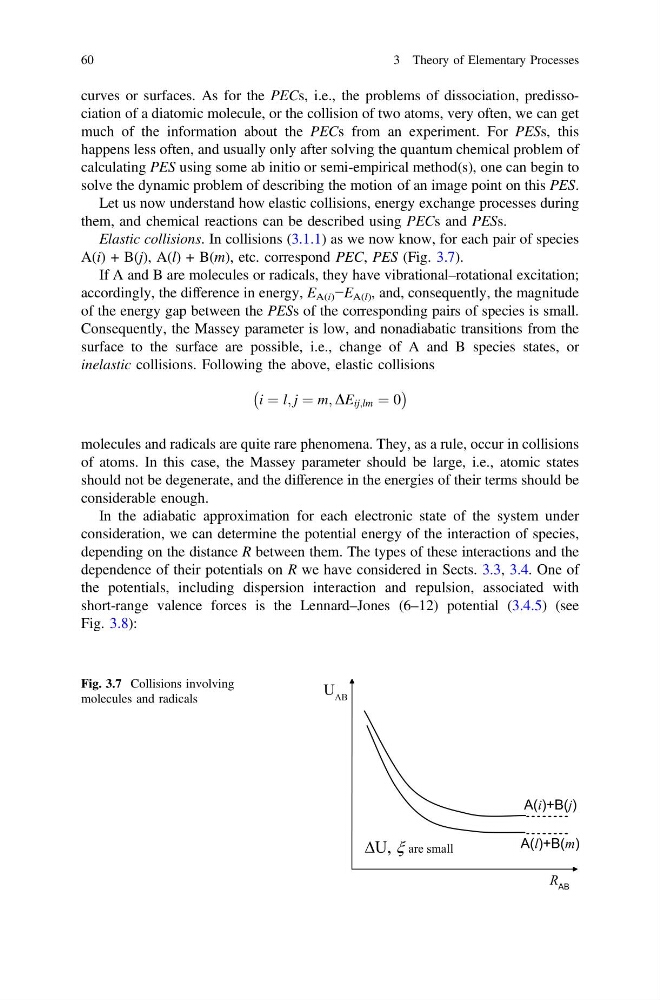
A(i) + B(j), A(l) + B(m), etc. correspond PEC, PES (Fig. 3.7).
If A and B are molecules or radicals, they have vibrational–rotational excitation;
accordingly, the difference in energy, E A(i) −E A(l) , and, consequently, the magnitude
of the energy gap between the PESs of the corresponding pairs of species is small.
Consequently, the Massey parameter is low, and nonadiabatic transitions from the
surface to the surface are possible, i.e., change of A and B species states, or
inelastic collisions. Following the above, elastic collisions
i ¼ l; j ¼ m; DE ij;lm ¼ 0
À
Á
molecules and radicals are quite rare phenomena. They, as a rule, occur in collisions
of atoms. In this case, the Massey parameter should be large, i.e., atomic states
should not be degenerate, and the difference in the energies of their terms should be
considerable enough.
In the adiabatic approximation for each electronic state of the system under
consideration, we can determine the potential energy of the interaction of species,
depending on the distance R between them. The types of these interactions and the
dependence of their potentials on R we have considered in Sects. 3.3, 3.4. One of
the potentials, including dispersion interaction and repulsion, associated with
short-range valence forces is the Lennard–Jones (6–12) potential (3.4.5) (see
Fig. 3.8):
Fig. 3.7 Collisions involving
molecules and radicals
60
3 Theory of Elementary Processes
much of the information about the PECs from an experiment. For PESs, this
happens less often, and usually only after solving the quantum chemical problem of
calculating PES using some ab initio or semi-empirical method(s), one can begin to
solve the dynamic problem of describing the motion of an image point on this PES.
Let us now understand how elastic collisions, energy exchange processes during
them, and chemical reactions can be described using PECs and PESs.
Elastic collisions. In collisions (3.1.1) as we now know, for each pair of species
A(i) + B(j), A(l) + B(m), etc. correspond PEC, PES (Fig. 3.7).
If A and B are molecules or radicals, they have vibrational–rotational excitation;
accordingly, the difference in energy, E A(i) −E A(l) , and, consequently, the magnitude
of the energy gap between the PESs of the corresponding pairs of species is small.
Consequently, the Massey parameter is low, and nonadiabatic transitions from the
surface to the surface are possible, i.e., change of A and B species states, or
inelastic collisions. Following the above, elastic collisions
i ¼ l; j ¼ m; DE ij;lm ¼ 0
À
Á
molecules and radicals are quite rare phenomena. They, as a rule, occur in collisions
of atoms. In this case, the Massey parameter should be large, i.e., atomic states
should not be degenerate, and the difference in the energies of their terms should be
considerable enough.
In the adiabatic approximation for each electronic state of the system under
consideration, we can determine the potential energy of the interaction of species,
depending on the distance R between them. The types of these interactions and the
dependence of their potentials on R we have considered in Sects. 3.3, 3.4. One of
the potentials, including dispersion interaction and repulsion, associated with
short-range valence forces is the Lennard–Jones (6–12) potential (3.4.5) (see
Fig. 3.8):
Fig. 3.7 Collisions involving
molecules and radicals
60
3 Theory of Elementary Processes