

the dipole–dipole interaction, decreasing as 1/R
3 , since the interaction energy is
obtained in the first order of perturbation theory. Thus, the resonant interaction is
more long-range than the polarization, decreasing as 1/R
6 .
The state described by the wave function (3.3.8) is non-stationary, and as a result
of the resonant interaction, the species exchange an excitation with a frequency
proportional to the resonant integral. If species scatter, or species B energy dissipates in any way (dissociation, predissociation, photon radiation), then, as a result
of resonance detuning, one-sided energy transfer takes place
A
Ã
þ B ! A þ B
Ã
:
A more detailed description of intermolecular interactions can be found, for
example, in the book by I.G. Kaplan [4]. We will also consider such interactions
when analyzing collision-induced nonadiabatic transitions (Sect. 5.5.3).
3.4 Semiempirical Model Potentials for Intermolecular
Interactions
Model potentials with simple analytical representations, which parameters are
determined experimentally, are widely used for describing of intermolecular
interactions. They are discussed in detail in [4, 8], for example.
Below, some model potentials that have been extensively used are discussed
briefly.
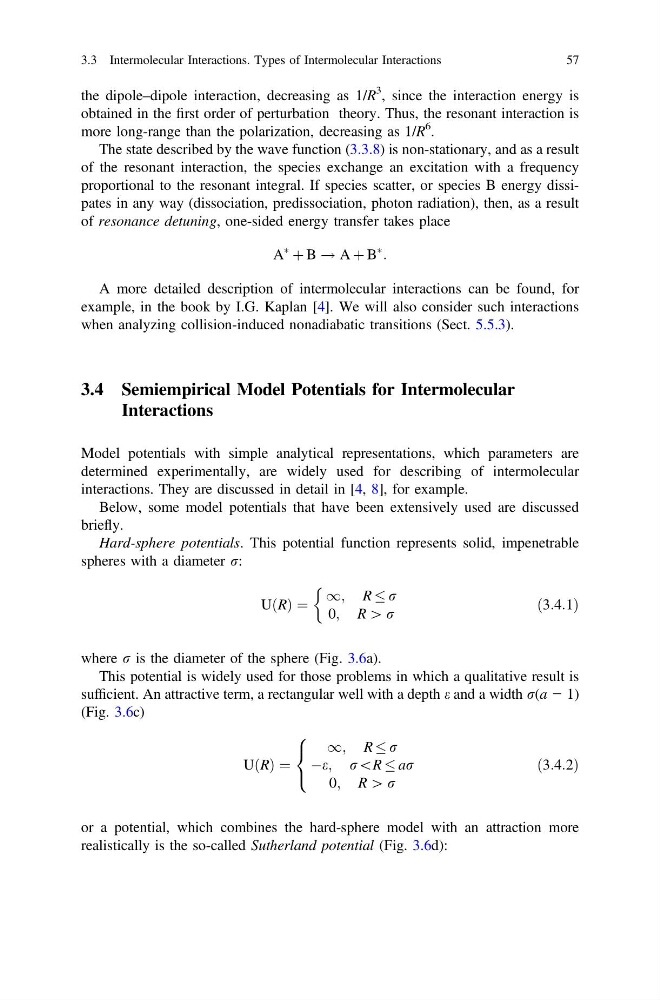
Hard-sphere potentials. This potential function represents solid, impenetrable
spheres with a diameter r:
UðRÞ ¼
1; R r
0; R [ r
&
ð3:4:1Þ
where r is the diameter of the sphere (Fig. 3.6a).
This potential is widely used for those problems in which a qualitative result is
sufficient. An attractive term, a rectangular well with a depth e and a width r(a − 1)
(Fig. 3.6c)
UðRÞ ¼
1; R r
Àe; r\R ar
0; R [ r
8
<
:
ð3:4:2Þ
or a potential, which combines the hard-sphere model with an attraction more
realistically is the so-called Sutherland potential (Fig. 3.6d):
3.3 Intermolecular Interactions. Types of Intermolecular Interactions
57
3 , since the interaction energy is
obtained in the first order of perturbation theory. Thus, the resonant interaction is
more long-range than the polarization, decreasing as 1/R
6 .
The state described by the wave function (3.3.8) is non-stationary, and as a result
of the resonant interaction, the species exchange an excitation with a frequency
proportional to the resonant integral. If species scatter, or species B energy dissipates in any way (dissociation, predissociation, photon radiation), then, as a result
of resonance detuning, one-sided energy transfer takes place
A
Ã
þ B ! A þ B
Ã
:
A more detailed description of intermolecular interactions can be found, for
example, in the book by I.G. Kaplan [4]. We will also consider such interactions
when analyzing collision-induced nonadiabatic transitions (Sect. 5.5.3).
3.4 Semiempirical Model Potentials for Intermolecular
Interactions
Model potentials with simple analytical representations, which parameters are
determined experimentally, are widely used for describing of intermolecular
interactions. They are discussed in detail in [4, 8], for example.
Below, some model potentials that have been extensively used are discussed
briefly.
Hard-sphere potentials. This potential function represents solid, impenetrable
spheres with a diameter r:
UðRÞ ¼
1; R r
0; R [ r
&
ð3:4:1Þ
where r is the diameter of the sphere (Fig. 3.6a).
This potential is widely used for those problems in which a qualitative result is
sufficient. An attractive term, a rectangular well with a depth e and a width r(a − 1)
(Fig. 3.6c)
UðRÞ ¼
1; R r
Àe; r\R ar
0; R [ r
8
<
:
ð3:4:2Þ
or a potential, which combines the hard-sphere model with an attraction more
realistically is the so-called Sutherland potential (Fig. 3.6d):
3.3 Intermolecular Interactions. Types of Intermolecular Interactions
57