

UðRÞ ¼
1; R r
Àuðr=RÞ
6 ; R [ r
&
ð3:4:3Þ
is sometimes added to the hard-sphere potential [4] p. 184.
Lennard–Jones potential. The general form of this potential proposed by Jones
[9] is:
U R
ð Þ ¼
k n
R
n þ
k m
R
m
ð3:4:4Þ
Below, the so-called Lennard–Jones (6–12) potential:
U LÀJ R
ð Þ ¼ 4e½
R 0
R
12
À
R 0
R
6
;
ð3:4:5Þ
where e is the depth of the potential well with the minimum at R e ¼ R 0
ffiffi ffi
2
6
p
and R 0 is
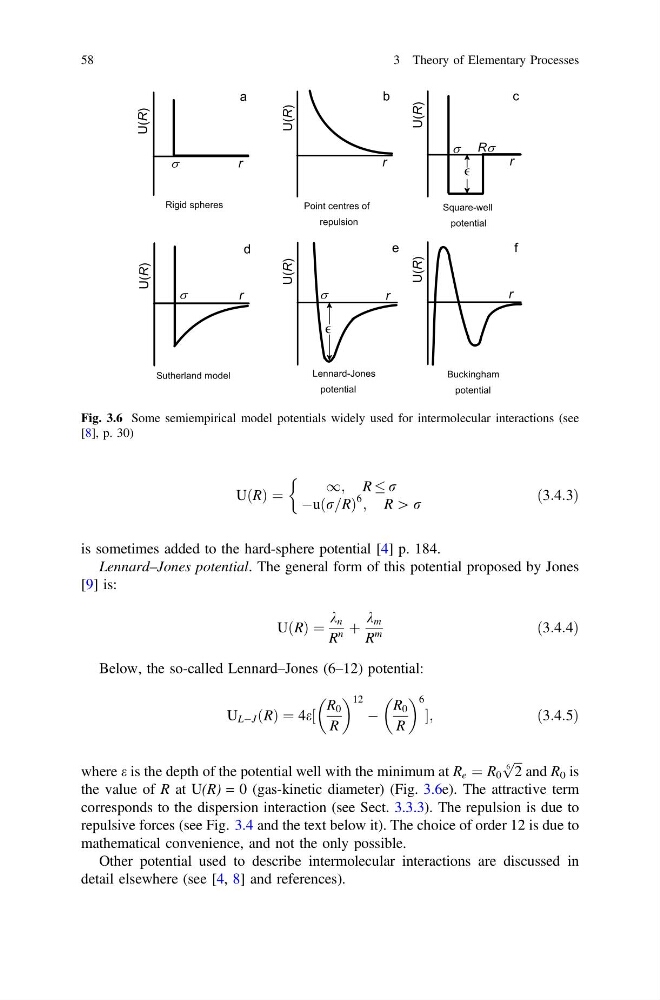
the value of R at U(R) = 0 (gas-kinetic diameter) (Fig. 3.6e). The attractive term
corresponds to the dispersion interaction (see Sect. 3.3.3). The repulsion is due to
repulsive forces (see Fig. 3.4 and the text below it). The choice of order 12 is due to
mathematical convenience, and not the only possible.
Other potential used to describe intermolecular interactions are discussed in
detail elsewhere (see [4, 8] and references).
Fig. 3.6 Some semiempirical model potentials widely used for intermolecular interactions (see
[8], p. 30)
58
3 Theory of Elementary Processes
1; R r
Àuðr=RÞ
6 ; R [ r
&
ð3:4:3Þ
is sometimes added to the hard-sphere potential [4] p. 184.
Lennard–Jones potential. The general form of this potential proposed by Jones
[9] is:
U R
ð Þ ¼
k n
R
n þ
k m
R
m
ð3:4:4Þ
Below, the so-called Lennard–Jones (6–12) potential:
U LÀJ R
ð Þ ¼ 4e½
R 0
R
12
À
R 0
R
6
;
ð3:4:5Þ
where e is the depth of the potential well with the minimum at R e ¼ R 0
ffiffi ffi
2
6
p
and R 0 is
the value of R at U(R) = 0 (gas-kinetic diameter) (Fig. 3.6e). The attractive term
corresponds to the dispersion interaction (see Sect. 3.3.3). The repulsion is due to
repulsive forces (see Fig. 3.4 and the text below it). The choice of order 12 is due to
mathematical convenience, and not the only possible.
Other potential used to describe intermolecular interactions are discussed in
detail elsewhere (see [4, 8] and references).
Fig. 3.6 Some semiempirical model potentials widely used for intermolecular interactions (see
[8], p. 30)
58
3 Theory of Elementary Processes