

If at least one of the interacting species is in an electronically excited state, the
coefficient C 6 can increase by orders of magnitude. Let species A is in the excited
state n, the density of states i to which a transition can occur is large, and the
transition itself has a large probability. In this case, the transition frequency is small,
and the polarizability
a A ¼
2
3
X
n6 ¼i
l ni
j j
2
E n À E i
j
j
may be orders of magnitude higher than the polarizability of the samespecies in the
ground state. It is this case that takes place in the ion-pair states of halogens, which
will be discussed in Sect. 5.5.3.
3.3.4 Resonance Interactions
These interactions occur if one of the colliding species is in ground and the other in
excited states, and the transition energies to the excited states of both species are the
same (in particular, if the same molecules collide).
Let one of the species (A) be in the excited state, and the other (B) in the ground
one. In the absence of interaction, the state of such a system is described by the
wave function W
A
n W
B
0 . The same energy corresponds to the state W
A
0 W
B
m (resonance!). There is a degeneration, and the wave function of the system is described
as symmetric and antisymmetric linear combinations of the initial functions of
zero-order:
W g;u ¼
1
2
ðW
A
n W
B
0 Æ W
A
0 W
B
m Þ
ð 3:3:8Þ
The interaction energy in the first-order PT is
E
1
ð Þ
g;u ¼
1
2
W g;u b
V
W g;u
D
E
¼ W
A
n W
B
0
b
V
W
A
n W
B
0
D
E
þ W
A
0 W
B
m
b
V
W
A
n W
B
0
D
E
h
Æ2 W
A
n W
B
0
b
V
W
A
0 W
B
m
D
E i
ð3:3:9Þ
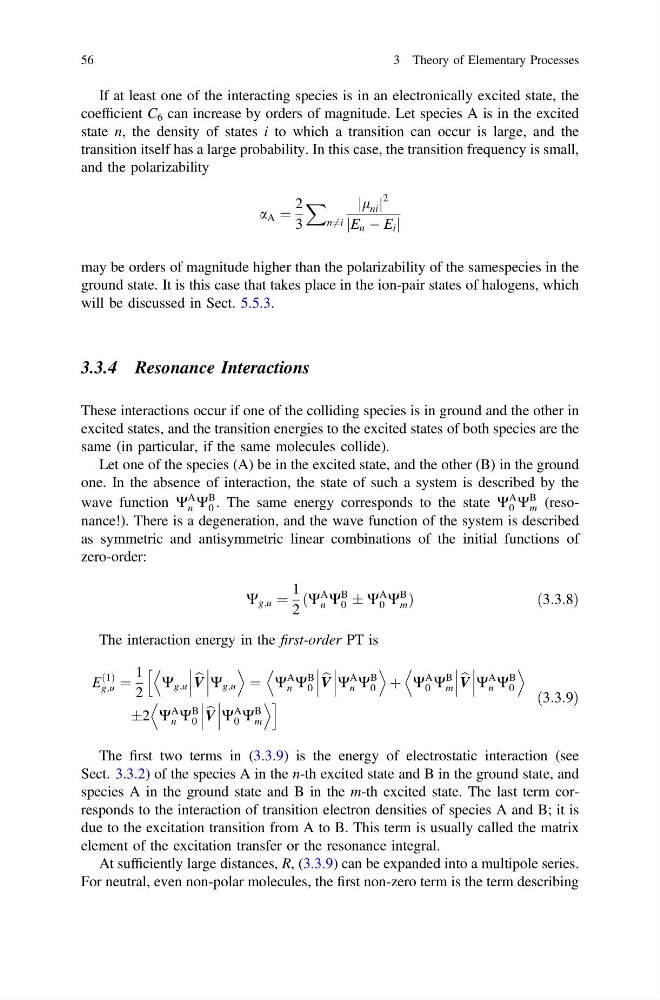
The first two terms in (3.3.9) is the energy of electrostatic interaction (see
Sect. 3.3.2) of the species A in the n-th excited state and B in the ground state, and
species A in the ground state and B in the m-th excited state. The last term corresponds to the interaction of transition electron densities of species A and B; it is
due to the excitation transition from A to B. This term is usually called the matrix
element of the excitation transfer or the resonance integral.
At sufficiently large distances, R, (3.3.9) can be expanded into a multipole series.
For neutral, even non-polar molecules, the first non-zero term is the term describing
56
3 Theory of Elementary Processes
coefficient C 6 can increase by orders of magnitude. Let species A is in the excited
state n, the density of states i to which a transition can occur is large, and the
transition itself has a large probability. In this case, the transition frequency is small,
and the polarizability
a A ¼
2
3
X
n6 ¼i
l ni
j j
2
E n À E i
j
j
may be orders of magnitude higher than the polarizability of the samespecies in the
ground state. It is this case that takes place in the ion-pair states of halogens, which
will be discussed in Sect. 5.5.3.
3.3.4 Resonance Interactions
These interactions occur if one of the colliding species is in ground and the other in
excited states, and the transition energies to the excited states of both species are the
same (in particular, if the same molecules collide).
Let one of the species (A) be in the excited state, and the other (B) in the ground
one. In the absence of interaction, the state of such a system is described by the
wave function W
A
n W
B
0 . The same energy corresponds to the state W
A
0 W
B
m (resonance!). There is a degeneration, and the wave function of the system is described
as symmetric and antisymmetric linear combinations of the initial functions of
zero-order:
W g;u ¼
1
2
ðW
A
n W
B
0 Æ W
A
0 W
B
m Þ
ð 3:3:8Þ
The interaction energy in the first-order PT is
E
1
ð Þ
g;u ¼
1
2
W g;u b
V
W g;u
D
E
¼ W
A
n W
B
0
b
V
W
A
n W
B
0
D
E
þ W
A
0 W
B
m
b
V
W
A
n W
B
0
D
E
h
Æ2 W
A
n W
B
0
b
V
W
A
0 W
B
m
D
E i
ð3:3:9Þ
The first two terms in (3.3.9) is the energy of electrostatic interaction (see
Sect. 3.3.2) of the species A in the n-th excited state and B in the ground state, and
species A in the ground state and B in the m-th excited state. The last term corresponds to the interaction of transition electron densities of species A and B; it is
due to the excitation transition from A to B. This term is usually called the matrix
element of the excitation transfer or the resonance integral.
At sufficiently large distances, R, (3.3.9) can be expanded into a multipole series.
For neutral, even non-polar molecules, the first non-zero term is the term describing
56
3 Theory of Elementary Processes