

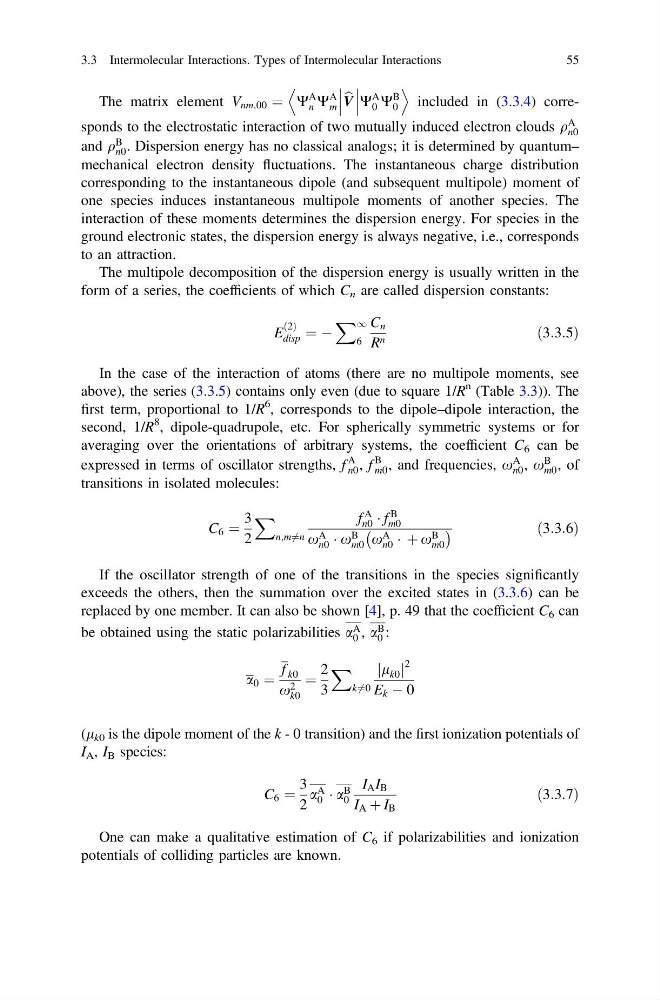
The matrix element V nm;00 ¼ W
A
n W
A
m
b
V
W
A
0 W
B
0
D
E
included in (3.3.4) corresponds to the electrostatic interaction of two mutually induced electron clouds q
A
n0
and q
B
n0 . Dispersion energy has no classical analogs; it is determined by quantum–
mechanical electron density fluctuations. The instantaneous charge distribution
corresponding to the instantaneous dipole (and subsequent multipole) moment of
one species induces instantaneous multipole moments of another species. The
interaction of these moments determines the dispersion energy. For species in the
ground electronic states, the dispersion energy is always negative, i.e., corresponds
to an attraction.
The multipole decomposition of the dispersion energy is usually written in the
form of a series, the coefficients of which C n are called dispersion constants:
E
ð2Þ
disp ¼ À
X 1
6
C n
R n
ð3:3:5Þ
In the case of the interaction of atoms (there are no multipole moments, see
above), the series (3.3.5) contains only even (due to square 1/R
n (Table 3.3)). The
first term, proportional to 1/R
6 , corresponds to the dipole–dipole interaction, the
second, 1/R
8 , dipole-quadrupole, etc. For spherically symmetric systems or for
averaging over the orientations of arbitrary systems, the coefficient C 6 can be
expressed in terms of oscillator strengths, f
A
n0 , f
B
m0 , and frequencies, x
A
n0 , x
B
m0 , of
transitions in isolated molecules:
C 6 ¼
3
2
X
n;m6 ¼n
f
A
n0 Á f
B
m0
x A
n0 Á x B
m0 x A
n0 Á þ x B
m0
À
Á
ð3:3:6Þ
If the oscillator strength of one of the transitions in the species significantly
exceeds the others, then the summation over the excited states in (3.3.6) can be
replaced by one member. It can also be shown [4], p. 49 that the coefficient C 6 can
be obtained using the static polarizabilities a A
0 , a B
0 :
a 0 ¼
f k0
x 2
k0
¼
2
3
X
k6 ¼0
l k0
j j
2
E k À 0
(l k0 is the dipole moment of the k - 0 transition) and the first ionization potentials of
I A , I B species:
C 6 ¼
3
2
a A
0 Á a B
0
I A I B
I A þ I B
ð3:3:7Þ
One can make a qualitative estimation of C 6 if polarizabilities and ionization
potentials of colliding particles are known.
3.3 Intermolecular Interactions. Types of Intermolecular Interactions
55
A
n W
A
m
b
V
W
A
0 W
B
0
D
E
included in (3.3.4) corresponds to the electrostatic interaction of two mutually induced electron clouds q
A
n0
and q
B
n0 . Dispersion energy has no classical analogs; it is determined by quantum–
mechanical electron density fluctuations. The instantaneous charge distribution
corresponding to the instantaneous dipole (and subsequent multipole) moment of
one species induces instantaneous multipole moments of another species. The
interaction of these moments determines the dispersion energy. For species in the
ground electronic states, the dispersion energy is always negative, i.e., corresponds
to an attraction.
The multipole decomposition of the dispersion energy is usually written in the
form of a series, the coefficients of which C n are called dispersion constants:
E
ð2Þ
disp ¼ À
X 1
6
C n
R n
ð3:3:5Þ
In the case of the interaction of atoms (there are no multipole moments, see
above), the series (3.3.5) contains only even (due to square 1/R
n (Table 3.3)). The
first term, proportional to 1/R
6 , corresponds to the dipole–dipole interaction, the
second, 1/R
8 , dipole-quadrupole, etc. For spherically symmetric systems or for
averaging over the orientations of arbitrary systems, the coefficient C 6 can be
expressed in terms of oscillator strengths, f
A
n0 , f
B
m0 , and frequencies, x
A
n0 , x
B
m0 , of
transitions in isolated molecules:
C 6 ¼
3
2
X
n;m6 ¼n
f
A
n0 Á f
B
m0
x A
n0 Á x B
m0 x A
n0 Á þ x B
m0
À
Á
ð3:3:6Þ
If the oscillator strength of one of the transitions in the species significantly
exceeds the others, then the summation over the excited states in (3.3.6) can be
replaced by one member. It can also be shown [4], p. 49 that the coefficient C 6 can
be obtained using the static polarizabilities a A
0 , a B
0 :
a 0 ¼
f k0
x 2
k0
¼
2
3
X
k6 ¼0
l k0
j j
2
E k À 0
(l k0 is the dipole moment of the k - 0 transition) and the first ionization potentials of
I A , I B species:
C 6 ¼
3
2
a A
0 Á a B
0
I A I B
I A þ I B
ð3:3:7Þ
One can make a qualitative estimation of C 6 if polarizabilities and ionization
potentials of colliding particles are known.
3.3 Intermolecular Interactions. Types of Intermolecular Interactions
55