

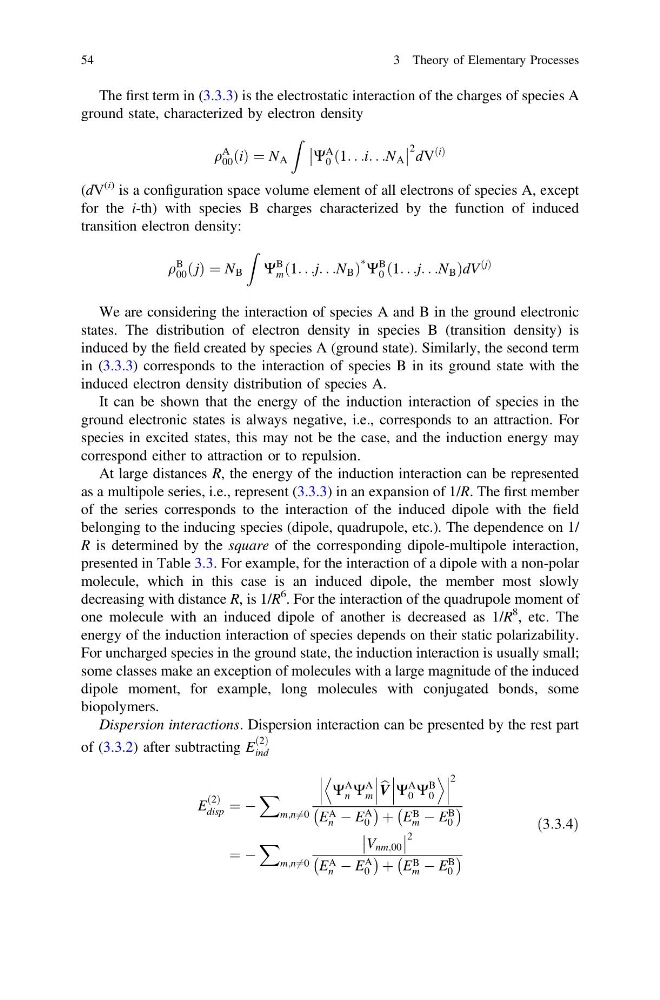
The first term in (3.3.3) is the electrostatic interaction of the charges of species A
ground state, characterized by electron density
q
A
00 i
ð Þ ¼ N A
Z
W
A
0 ð1. . .i. . .N A
2 dV
ðiÞ
(dV
(i) is a configuration space volume element of all electrons of species A, except
for the i-th) with species B charges characterized by the function of induced
transition electron density:
q
B
00 j
ð Þ ¼ N B
Z
W
B
m ð1. . .j. . .N B Þ
à W
B
0 ð1. . .j. . .N B ÞdV
ðjÞ
We are considering the interaction of species A and B in the ground electronic
states. The distribution of electron density in species B (transition density) is
induced by the field created by species A (ground state). Similarly, the second term
in (3.3.3) corresponds to the interaction of species B in its ground state with the
induced electron density distribution of species A.
It can be shown that the energy of the induction interaction of species in the
ground electronic states is always negative, i.e., corresponds to an attraction. For
species in excited states, this may not be the case, and the induction energy may
correspond either to attraction or to repulsion.
At large distances R, the energy of the induction interaction can be represented
as a multipole series, i.e., represent (3.3.3) in an expansion of 1/R. The first member
of the series corresponds to the interaction of the induced dipole with the field
belonging to the inducing species (dipole, quadrupole, etc.). The dependence on 1/
R is determined by the square of the corresponding dipole-multipole interaction,
presented in Table 3.3. For example, for the interaction of a dipole with a non-polar
molecule, which in this case is an induced dipole, the member most slowly
decreasing with distance R, is 1/R
6 . For the interaction of the quadrupole moment of
one molecule with an induced dipole of another is decreased as 1/R
8 , etc. The
energy of the induction interaction of species depends on their static polarizability.
For uncharged species in the ground state, the induction interaction is usually small;
some classes make an exception of molecules with a large magnitude of the induced
dipole moment, for example, long molecules with conjugated bonds, some
biopolymers.
Dispersion interactions. Dispersion interaction can be presented by the rest part
of (3.3.2) after subtracting E
ð2Þ
ind
E
ð2Þ
disp ¼ À
X
m;n6 ¼0
W
A
n W
A
m
b
V
W
A
0 W
B
0
D
E
2
E A
n À E A
0
À
Á þ E B
m À E B
0
À
Á
¼ À
X
m;n6 ¼0
V nm;00
2
E A
n À E A
0
À
Á þ E B
m À E B
0
À
Á
ð3:3:4Þ
54
3 Theory of Elementary Processes
ground state, characterized by electron density
q
A
00 i
ð Þ ¼ N A
Z
W
A
0 ð1. . .i. . .N A
2 dV
ðiÞ
(dV
(i) is a configuration space volume element of all electrons of species A, except
for the i-th) with species B charges characterized by the function of induced
transition electron density:
q
B
00 j
ð Þ ¼ N B
Z
W
B
m ð1. . .j. . .N B Þ
à W
B
0 ð1. . .j. . .N B ÞdV
ðjÞ
We are considering the interaction of species A and B in the ground electronic
states. The distribution of electron density in species B (transition density) is
induced by the field created by species A (ground state). Similarly, the second term
in (3.3.3) corresponds to the interaction of species B in its ground state with the
induced electron density distribution of species A.
It can be shown that the energy of the induction interaction of species in the
ground electronic states is always negative, i.e., corresponds to an attraction. For
species in excited states, this may not be the case, and the induction energy may
correspond either to attraction or to repulsion.
At large distances R, the energy of the induction interaction can be represented
as a multipole series, i.e., represent (3.3.3) in an expansion of 1/R. The first member
of the series corresponds to the interaction of the induced dipole with the field
belonging to the inducing species (dipole, quadrupole, etc.). The dependence on 1/
R is determined by the square of the corresponding dipole-multipole interaction,
presented in Table 3.3. For example, for the interaction of a dipole with a non-polar
molecule, which in this case is an induced dipole, the member most slowly
decreasing with distance R, is 1/R
6 . For the interaction of the quadrupole moment of
one molecule with an induced dipole of another is decreased as 1/R
8 , etc. The
energy of the induction interaction of species depends on their static polarizability.
For uncharged species in the ground state, the induction interaction is usually small;
some classes make an exception of molecules with a large magnitude of the induced
dipole moment, for example, long molecules with conjugated bonds, some
biopolymers.
Dispersion interactions. Dispersion interaction can be presented by the rest part
of (3.3.2) after subtracting E
ð2Þ
ind
E
ð2Þ
disp ¼ À
X
m;n6 ¼0
W
A
n W
A
m
b
V
W
A
0 W
B
0
D
E
2
E A
n À E A
0
À
Á þ E B
m À E B
0
À
Á
¼ À
X
m;n6 ¼0
V nm;00
2
E A
n À E A
0
À
Á þ E B
m À E B
0
À
Á
ð3:3:4Þ
54
3 Theory of Elementary Processes