

It can be seen from Tables 3.1 and 3.2, that the dipole moment of a molecule in
the ground electronic state equal to 0, if it possesses more than one axis of symmetry, either a mirror-turning axis or a center of symmetry. For excited states of
molecules, this statement is false. If the species has spherical symmetry (K h group,
atoms), all multipole moments are equal to 0.
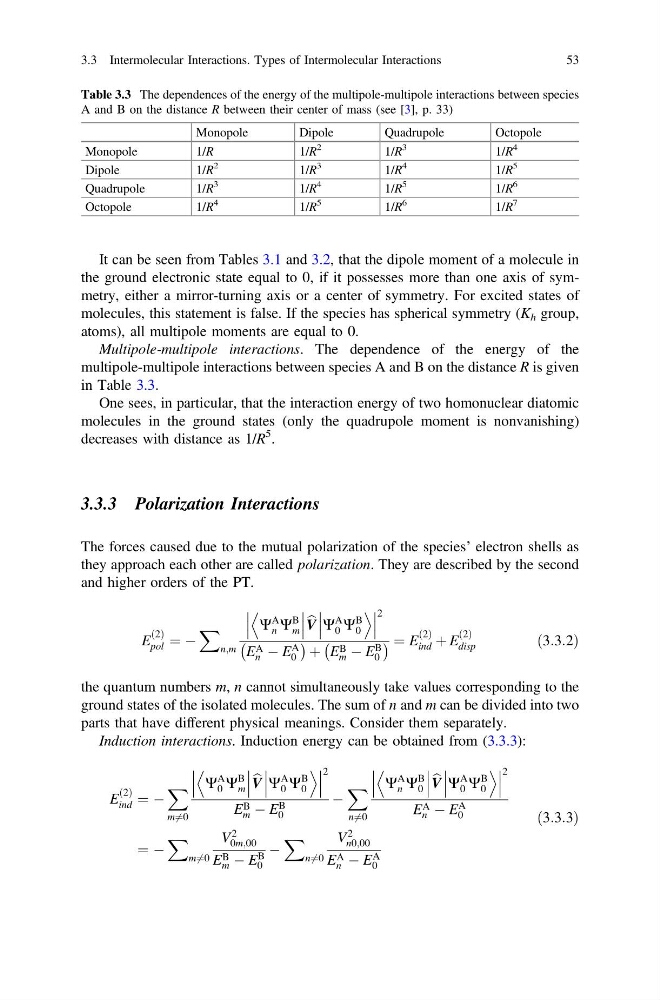
Multipole-multipole interactions. The dependence of the energy of the
multipole-multipole interactions between species A and B on the distance R is given
in Table 3.3.
One sees, in particular, that the interaction energy of two homonuclear diatomic
molecules in the ground states (only the quadrupole moment is nonvanishing)
decreases with distance as 1/R
5 .
3.3.3 Polarization Interactions
The forces caused due to the mutual polarization of the species’ electron shells as
they approach each other are called polarization. They are described by the second
and higher orders of the PT.
E
ð2Þ
pol ¼ À
X
n;m
W
A
n W
B
m
b
V
W
A
0 W
B
0
D
E
2
E A
n À E A
0
À
Á þ E B
m À E B
0
À
Á¼ E
ð2Þ
ind þ E
ð2Þ
disp
ð3:3:2Þ
the quantum numbers m, n cannot simultaneously take values corresponding to the
ground states of the isolated molecules. The sum of n and m can be divided into two
parts that have different physical meanings. Consider them separately.
Induction interactions. Induction energy can be obtained from (3.3.3):
E
2
ð Þ
ind ¼ À
X
m6 ¼0
W
A
0 W
B
m
b
V
W
A
0 W
B
0
D
E
2
E B
m À E B
0
À
X
n6 ¼0
W
A
n W
B
0
b
V
W
A
0 W
B
0
D
E
2
E A
n À E A
0
¼ À
X
m6 ¼0
V
2
0m;00
E B
m À E B
0
À
X
n6 ¼0
V
2
n0;00
E A
n À E A
0
ð3:3:3Þ
Table 3.3 The dependences of the energy of the multipole-multipole interactions between species
A and B on the distance R between their center of mass (see [3], p. 33)
Monopole
Dipole
Quadrupole
Octopole
Monopole
1/R
1/R
2
1/R
3
1/R
4
Dipole
1/R
2
1/R
3
1/R
4
1/R
5
Quadrupole
1/R
3
1/R
4
1/R
5
1/R
6
Octopole
1/R
4
1/R
5
1/R
6
1/R
7
3.3 Intermolecular Interactions. Types of Intermolecular Interactions
53
the ground electronic state equal to 0, if it possesses more than one axis of symmetry, either a mirror-turning axis or a center of symmetry. For excited states of
molecules, this statement is false. If the species has spherical symmetry (K h group,
atoms), all multipole moments are equal to 0.
Multipole-multipole interactions. The dependence of the energy of the
multipole-multipole interactions between species A and B on the distance R is given
in Table 3.3.
One sees, in particular, that the interaction energy of two homonuclear diatomic
molecules in the ground states (only the quadrupole moment is nonvanishing)
decreases with distance as 1/R
5 .
3.3.3 Polarization Interactions
The forces caused due to the mutual polarization of the species’ electron shells as
they approach each other are called polarization. They are described by the second
and higher orders of the PT.
E
ð2Þ
pol ¼ À
X
n;m
W
A
n W
B
m
b
V
W
A
0 W
B
0
D
E
2
E A
n À E A
0
À
Á þ E B
m À E B
0
À
Á¼ E
ð2Þ
ind þ E
ð2Þ
disp
ð3:3:2Þ
the quantum numbers m, n cannot simultaneously take values corresponding to the
ground states of the isolated molecules. The sum of n and m can be divided into two
parts that have different physical meanings. Consider them separately.
Induction interactions. Induction energy can be obtained from (3.3.3):
E
2
ð Þ
ind ¼ À
X
m6 ¼0
W
A
0 W
B
m
b
V
W
A
0 W
B
0
D
E
2
E B
m À E B
0
À
X
n6 ¼0
W
A
n W
B
0
b
V
W
A
0 W
B
0
D
E
2
E A
n À E A
0
¼ À
X
m6 ¼0
V
2
0m;00
E B
m À E B
0
À
X
n6 ¼0
V
2
n0;00
E A
n À E A
0
ð3:3:3Þ
Table 3.3 The dependences of the energy of the multipole-multipole interactions between species
A and B on the distance R between their center of mass (see [3], p. 33)
Monopole
Dipole
Quadrupole
Octopole
Monopole
1/R
1/R
2
1/R
3
1/R
4
Dipole
1/R
2
1/R
3
1/R
4
1/R
5
Quadrupole
1/R
3
1/R
4
1/R
5
1/R
6
Octopole
1/R
4
1/R
5
1/R
6
1/R
7
3.3 Intermolecular Interactions. Types of Intermolecular Interactions
53