

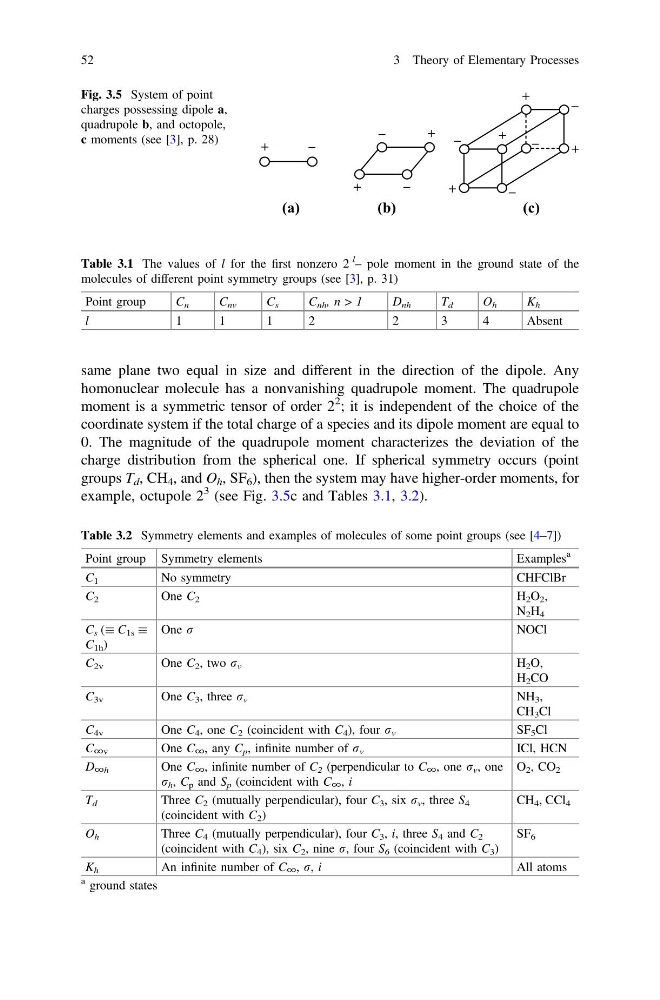
same plane two equal in size and different in the direction of the dipole. Any
homonuclear molecule has a nonvanishing quadrupole moment. The quadrupole
moment is a symmetric tensor of order 2
2 ; it is independent of the choice of the
coordinate system if the total charge of a species and its dipole moment are equal to
0. The magnitude of the quadrupole moment characterizes the deviation of the
charge distribution from the spherical one. If spherical symmetry occurs (point
groups T d , CH 4 , and O h , SF 6 ), then the system may have higher-order moments, for
example, octupole 2
3 (see Fig. 3.5c and Tables 3.1, 3.2).
Table 3.1 The values of l for the first nonzero 2
l – pole moment in the ground state of the
molecules of different point symmetry groups (see [3], p. 31)
Point group
C n
C nv
C s
C nh , n > 1
D nh
T d
O h
K h
l
1
1
1
2
2
3
4
Absent
(c)
_
_
_
_
+
+
+
+
(b)
_
_
+
+
_
+
(a)
Fig. 3.5 System of point
charges possessing dipole a,
quadrupole b, and octopole,
c moments (see [3], p. 28)
Table 3.2 Symmetry elements and examples of molecules of some point groups (see [4–7])
Point group Symmetry elements
Examples
a
C 1
No symmetry
CHFClBr
C 2
One C 2
H 2 O 2 ,
N 2 H 4
C s ( C 1s
C 1h )
One r
NOCl
C 2v
One C 2 , two r v
H 2 O,
H 2 CO
C 3v
One C 3 , three r v
NH 3 ,
CH 3 Cl
C 4v
One C 4 , one C 2 (coincident with C 4 ), four r v
SF 5 Cl
C ∞v
One C ∞ , any C p , infinite number of r v
ICl, HCN
D ∞h
One C ∞ , infinite number of C 2 (perpendicular to C ∞ , one r v , one
r h , C p and S p (coincident with C ∞ , i
O 2 , CO 2
T d
Three C 2 (mutually perpendicular), four C 3 , six r v , three S 4
(coincident with C 2 )
CH 4 , CCl 4
O h
Three C 4 (mutually perpendicular), four C 3 , i, three S 4 and C 2
(coincident with C 4 ), six C 2 , nine r, four S 6 (coincident with C 3 )
SF 6
K h
An infinite number of C ∞ , r, i
All atoms
a ground states
52
3 Theory of Elementary Processes
homonuclear molecule has a nonvanishing quadrupole moment. The quadrupole
moment is a symmetric tensor of order 2
2 ; it is independent of the choice of the
coordinate system if the total charge of a species and its dipole moment are equal to
0. The magnitude of the quadrupole moment characterizes the deviation of the
charge distribution from the spherical one. If spherical symmetry occurs (point
groups T d , CH 4 , and O h , SF 6 ), then the system may have higher-order moments, for
example, octupole 2
3 (see Fig. 3.5c and Tables 3.1, 3.2).
Table 3.1 The values of l for the first nonzero 2
l – pole moment in the ground state of the
molecules of different point symmetry groups (see [3], p. 31)
Point group
C n
C nv
C s
C nh , n > 1
D nh
T d
O h
K h
l
1
1
1
2
2
3
4
Absent
(c)
_
_
_
_
+
+
+
+
(b)
_
_
+
+
_
+
(a)
Fig. 3.5 System of point
charges possessing dipole a,
quadrupole b, and octopole,
c moments (see [3], p. 28)
Table 3.2 Symmetry elements and examples of molecules of some point groups (see [4–7])
Point group Symmetry elements
Examples
a
C 1
No symmetry
CHFClBr
C 2
One C 2
H 2 O 2 ,
N 2 H 4
C s ( C 1s
C 1h )
One r
NOCl
C 2v
One C 2 , two r v
H 2 O,
H 2 CO
C 3v
One C 3 , three r v
NH 3 ,
CH 3 Cl
C 4v
One C 4 , one C 2 (coincident with C 4 ), four r v
SF 5 Cl
C ∞v
One C ∞ , any C p , infinite number of r v
ICl, HCN
D ∞h
One C ∞ , infinite number of C 2 (perpendicular to C ∞ , one r v , one
r h , C p and S p (coincident with C ∞ , i
O 2 , CO 2
T d
Three C 2 (mutually perpendicular), four C 3 , six r v , three S 4
(coincident with C 2 )
CH 4 , CCl 4
O h
Three C 4 (mutually perpendicular), four C 3 , i, three S 4 and C 2
(coincident with C 4 ), six C 2 , nine r, four S 6 (coincident with C 3 )
SF 6
K h
An infinite number of C ∞ , r, i
All atoms
a ground states
52
3 Theory of Elementary Processes