

3.3.2 Direct Electrostatic Interactions
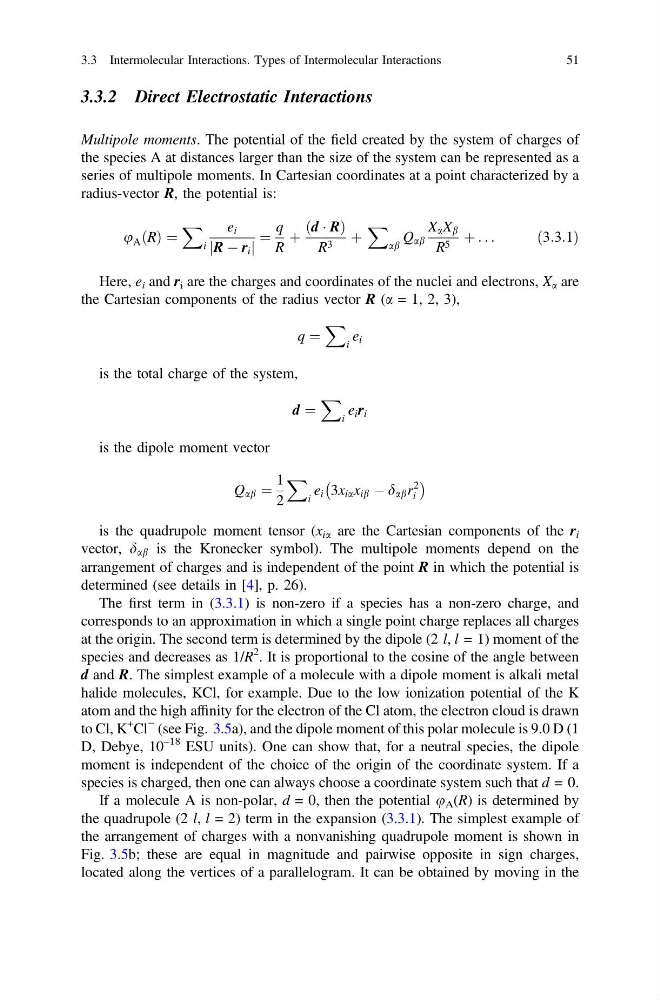
Multipole moments. The potential of the field created by the system of charges of
the species A at distances larger than the size of the system can be represented as a
series of multipole moments. In Cartesian coordinates at a point characterized by a
radius-vector R, the potential is:
u A ðRÞ ¼
X
i
e i
R À r i
j
j
¼
q
R
þ
ðd Á RÞ
R 3 þ
X
ab
Q ab
X a X b
R 5 þ . . .
ð3:3:1Þ
Here, e i and r i are the charges and coordinates of the nuclei and electrons, X a are
the Cartesian components of the radius vector R (a = 1, 2, 3),
q ¼
X
i
e i
is the total charge of the system,
d ¼
X
i
e i r i
is the dipole moment vector
Q ab ¼
1
2
X
i
e i 3x ia x ib À d ab r
2
i
À
Á
is the quadrupole moment tensor (x ia are the Cartesian components of the r i
vector, d ab is the Kronecker symbol). The multipole moments depend on the
arrangement of charges and is independent of the point R in which the potential is
determined (see details in [4], p. 26).
The first term in (3.3.1) is non-zero if a species has a non-zero charge, and
corresponds to an approximation in which a single point charge replaces all charges
at the origin. The second term is determined by the dipole (2 l, l = 1) moment of the
species and decreases as 1/R
2 . It is proportional to the cosine of the angle between
d and R. The simplest example of a molecule with a dipole moment is alkali metal
halide molecules, KCl, for example. Due to the low ionization potential of the K
atom and the high affinity for the electron of the Cl atom, the electron cloud is drawn
to Cl, K
+
Cl
− (see Fig. 3.5a), and the dipole moment of this polar molecule is 9.0 D (1
D, Debye, 10
–18 ESU units). One can show that, for a neutral species, the dipole
moment is independent of the choice of the origin of the coordinate system. If a
species is charged, then one can always choose a coordinate system such that d = 0.
If a molecule A is non-polar, d = 0, then the potential u A (R) is determined by
the quadrupole (2 l, l = 2) term in the expansion (3.3.1). The simplest example of
the arrangement of charges with a nonvanishing quadrupole moment is shown in
Fig. 3.5b; these are equal in magnitude and pairwise opposite in sign charges,
located along the vertices of a parallelogram. It can be obtained by moving in the
3.3 Intermolecular Interactions. Types of Intermolecular Interactions
51
Multipole moments. The potential of the field created by the system of charges of
the species A at distances larger than the size of the system can be represented as a
series of multipole moments. In Cartesian coordinates at a point characterized by a
radius-vector R, the potential is:
u A ðRÞ ¼
X
i
e i
R À r i
j
j
¼
q
R
þ
ðd Á RÞ
R 3 þ
X
ab
Q ab
X a X b
R 5 þ . . .
ð3:3:1Þ
Here, e i and r i are the charges and coordinates of the nuclei and electrons, X a are
the Cartesian components of the radius vector R (a = 1, 2, 3),
q ¼
X
i
e i
is the total charge of the system,
d ¼
X
i
e i r i
is the dipole moment vector
Q ab ¼
1
2
X
i
e i 3x ia x ib À d ab r
2
i
À
Á
is the quadrupole moment tensor (x ia are the Cartesian components of the r i
vector, d ab is the Kronecker symbol). The multipole moments depend on the
arrangement of charges and is independent of the point R in which the potential is
determined (see details in [4], p. 26).
The first term in (3.3.1) is non-zero if a species has a non-zero charge, and
corresponds to an approximation in which a single point charge replaces all charges
at the origin. The second term is determined by the dipole (2 l, l = 1) moment of the
species and decreases as 1/R
2 . It is proportional to the cosine of the angle between
d and R. The simplest example of a molecule with a dipole moment is alkali metal
halide molecules, KCl, for example. Due to the low ionization potential of the K
atom and the high affinity for the electron of the Cl atom, the electron cloud is drawn
to Cl, K
+
Cl
− (see Fig. 3.5a), and the dipole moment of this polar molecule is 9.0 D (1
D, Debye, 10
–18 ESU units). One can show that, for a neutral species, the dipole
moment is independent of the choice of the origin of the coordinate system. If a
species is charged, then one can always choose a coordinate system such that d = 0.
If a molecule A is non-polar, d = 0, then the potential u A (R) is determined by
the quadrupole (2 l, l = 2) term in the expansion (3.3.1). The simplest example of
the arrangement of charges with a nonvanishing quadrupole moment is shown in
Fig. 3.5b; these are equal in magnitude and pairwise opposite in sign charges,
located along the vertices of a parallelogram. It can be obtained by moving in the
3.3 Intermolecular Interactions. Types of Intermolecular Interactions
51