

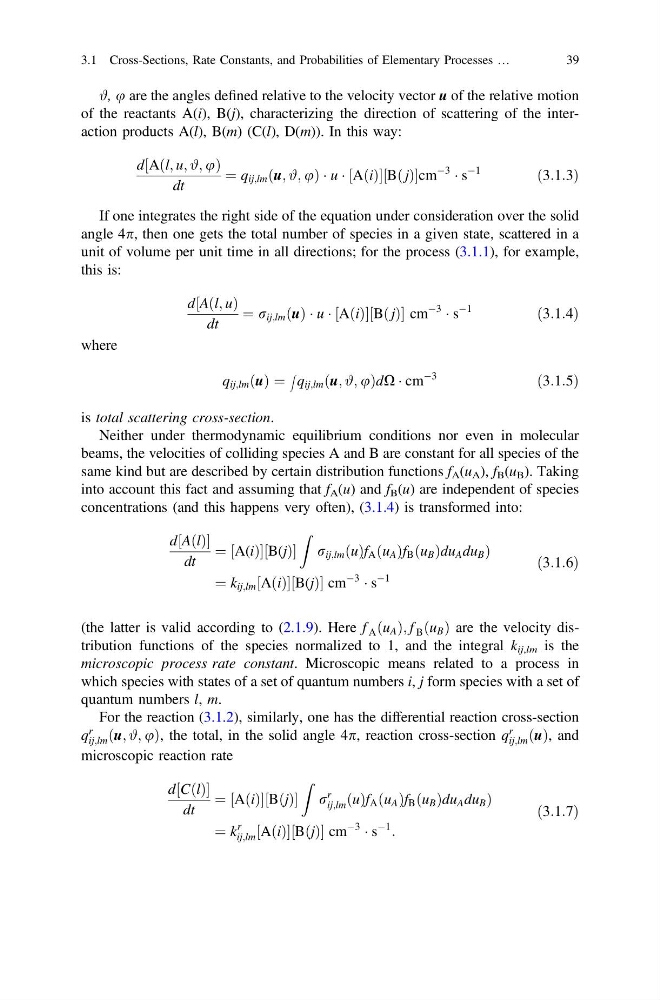
#, u are the angles defined relative to the velocity vector u of the relative motion
of the reactants A(i), B(j), characterizing the direction of scattering of the interaction products A(l), B(m) (C(l), D(m)). In this way:
d½A l; u; #; u
ð
Þ
dt
¼ q ij;lm u; #; u
ð
ÞÁu Á A i
ð Þ
½
B j
ð Þ
½
cm
À3
Á s
À1
ð3:1:3Þ
If one integrates the right side of the equation under consideration over the solid
angle 4p, then one gets the total number of species in a given state, scattered in a
unit of volume per unit time in all directions; for the process (3.1.1), for example,
this is:
d½A l; u
ð Þ
dt
¼ r ij;lm u
ð Þ Á u Á A i
ð Þ
½
B j
ð Þ
½
cm
À3
Á s
À1
ð3:1:4Þ
where
q ij;lm u
ð Þ ¼
Z q ij;lm u; #; u
ð
ÞdX Á cm
À3
ð3:1:5Þ
is total scattering cross-section.
Neither under thermodynamic equilibrium conditions nor even in molecular
beams, the velocities of colliding species A and B are constant for all species of the
same kind but are described by certain distribution functions f A (u A ), f B (u B ). Taking
into account this fact and assuming that f A (u) and f B (u) are independent of species
concentrations (and this happens very often), (3.1.4) is transformed into:
d AðlÞ
½
dt
¼ A(iÞ
½
B(jÞ ½
Z
r ij;lm ðuÞf A u A
ð Þf B u B
ð Þdu A du B Þ
¼ k ij;lm AðiÞ
½
B(jÞ ½
cm
À3
Á s
À1
ð3:1:6Þ
(the latter is valid according to (2.1.9). Here f A u A
ð Þ; f B ðu B Þ are the velocity distribution functions of the species normalized to 1, and the integral k ij,lm is the
microscopic process rate constant. Microscopic means related to a process in
which species with states of a set of quantum numbers i, j form species with a set of
quantum numbers l, m.
For the reaction (3.1.2), similarly, one has the differential reaction cross-section
q
r
ij;lm ðu; #; uÞ, the total, in the solid angle 4p, reaction cross-section q
r
ij;lm ðuÞ, and
microscopic reaction rate
d CðlÞ
½
dt
¼ AðiÞ
½
BðjÞ ½
Z
r
r
ij;lm ðuÞf A u A
ð Þf B u B
ð Þdu A du B Þ
¼ k
r
ij;lm AðiÞ
½
BðjÞ ½
cm
À3
Á s
À1
:
ð3:1:7Þ
3.1 Cross-Sections, Rate Constants, and Probabilities of Elementary Processes …
39
of the reactants A(i), B(j), characterizing the direction of scattering of the interaction products A(l), B(m) (C(l), D(m)). In this way:
d½A l; u; #; u
ð
Þ
dt
¼ q ij;lm u; #; u
ð
ÞÁu Á A i
ð Þ
½
B j
ð Þ
½
cm
À3
Á s
À1
ð3:1:3Þ
If one integrates the right side of the equation under consideration over the solid
angle 4p, then one gets the total number of species in a given state, scattered in a
unit of volume per unit time in all directions; for the process (3.1.1), for example,
this is:
d½A l; u
ð Þ
dt
¼ r ij;lm u
ð Þ Á u Á A i
ð Þ
½
B j
ð Þ
½
cm
À3
Á s
À1
ð3:1:4Þ
where
q ij;lm u
ð Þ ¼
Z q ij;lm u; #; u
ð
ÞdX Á cm
À3
ð3:1:5Þ
is total scattering cross-section.
Neither under thermodynamic equilibrium conditions nor even in molecular
beams, the velocities of colliding species A and B are constant for all species of the
same kind but are described by certain distribution functions f A (u A ), f B (u B ). Taking
into account this fact and assuming that f A (u) and f B (u) are independent of species
concentrations (and this happens very often), (3.1.4) is transformed into:
d AðlÞ
½
dt
¼ A(iÞ
½
B(jÞ ½
Z
r ij;lm ðuÞf A u A
ð Þf B u B
ð Þdu A du B Þ
¼ k ij;lm AðiÞ
½
B(jÞ ½
cm
À3
Á s
À1
ð3:1:6Þ
(the latter is valid according to (2.1.9). Here f A u A
ð Þ; f B ðu B Þ are the velocity distribution functions of the species normalized to 1, and the integral k ij,lm is the
microscopic process rate constant. Microscopic means related to a process in
which species with states of a set of quantum numbers i, j form species with a set of
quantum numbers l, m.
For the reaction (3.1.2), similarly, one has the differential reaction cross-section
q
r
ij;lm ðu; #; uÞ, the total, in the solid angle 4p, reaction cross-section q
r
ij;lm ðuÞ, and
microscopic reaction rate
d CðlÞ
½
dt
¼ AðiÞ
½
BðjÞ ½
Z
r
r
ij;lm ðuÞf A u A
ð Þf B u B
ð Þdu A du B Þ
¼ k
r
ij;lm AðiÞ
½
BðjÞ ½
cm
À3
Á s
À1
:
ð3:1:7Þ
3.1 Cross-Sections, Rate Constants, and Probabilities of Elementary Processes …
39