

characterize the process fully, it is necessary to indicate the relative velocity of the
particles.
What are the possible variants of the process (3.1.1), i.e., a process without
changing the chemical composition?
1. Elastic collision: i = l, j = m, DE ij,lm = 0.
2. Inelastic collision: the sets of quantum numbers of the system before and after
the collision are different, and DE ij,lm 6 ¼ 0. However, the cases, DE ij,lm is equal
to or close to 0, are also possible. Such processes are referred to as resonant or
quasi-resonant, respectively. That means close to 0 depends on the type of
process. This problem will be discussed below.
The number of species scattered per unit volume per unit time in the #, u
direction to the vector of relative motion of particles A(i) and B(j), u, in process
(3.1.1), for example, is proportional to the product u Á ½AðiÞ Á ½BðjÞ (see (2.1.9) and
Sect. 2.1:
d½A l; u; #; u
ð
Þ
dt
$ u Á A(iÞ
½
Á B(jÞ
½
cm
À3
Á s
À1
:
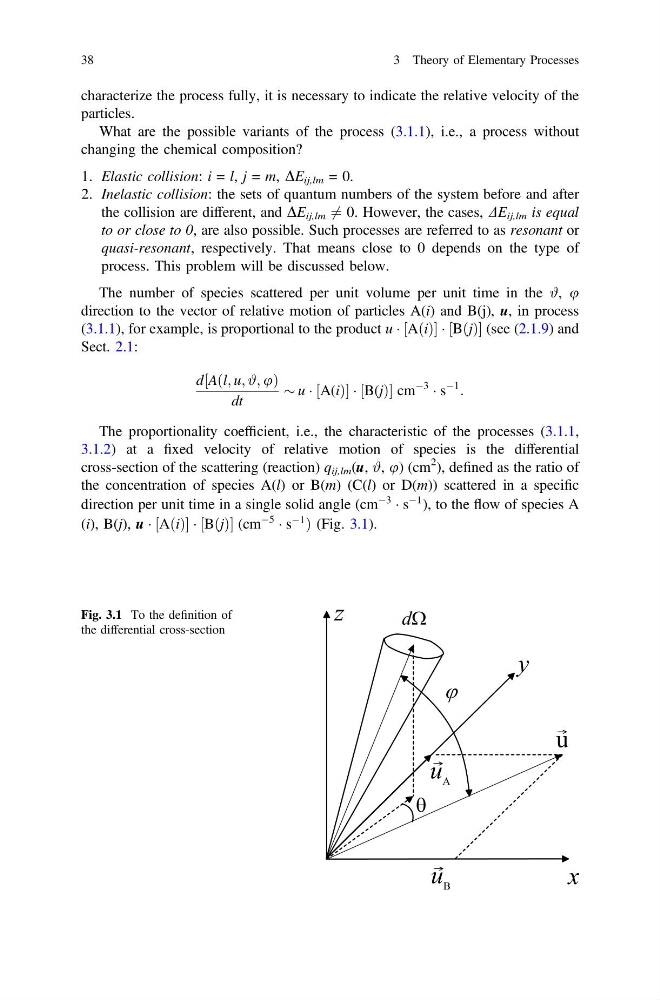
The proportionality coefficient, i.e., the characteristic of the processes (3.1.1,
3.1.2) at a fixed velocity of relative motion of species is the differential
cross-section of the scattering (reaction) q ij,lm (u, #, u) (cm
2 ), defined as the ratio of
the concentration of species A(l) or B(m) (C(l) or D(m)) scattered in a specific
direction per unit time in a single solid angle (cm
À3
Á s
À1 ), to the flow of species A
(i), B(j), u Á AðiÞ
½
Á BðjÞ
½
(cm
À5
Á s
À1
Þ (Fig. 3.1).
Fig. 3.1 To the definition of
the differential cross-section
38
3 Theory of Elementary Processes
particles.
What are the possible variants of the process (3.1.1), i.e., a process without
changing the chemical composition?
1. Elastic collision: i = l, j = m, DE ij,lm = 0.
2. Inelastic collision: the sets of quantum numbers of the system before and after
the collision are different, and DE ij,lm 6 ¼ 0. However, the cases, DE ij,lm is equal
to or close to 0, are also possible. Such processes are referred to as resonant or
quasi-resonant, respectively. That means close to 0 depends on the type of
process. This problem will be discussed below.
The number of species scattered per unit volume per unit time in the #, u
direction to the vector of relative motion of particles A(i) and B(j), u, in process
(3.1.1), for example, is proportional to the product u Á ½AðiÞ Á ½BðjÞ (see (2.1.9) and
Sect. 2.1:
d½A l; u; #; u
ð
Þ
dt
$ u Á A(iÞ
½
Á B(jÞ
½
cm
À3
Á s
À1
:
The proportionality coefficient, i.e., the characteristic of the processes (3.1.1,
3.1.2) at a fixed velocity of relative motion of species is the differential
cross-section of the scattering (reaction) q ij,lm (u, #, u) (cm
2 ), defined as the ratio of
the concentration of species A(l) or B(m) (C(l) or D(m)) scattered in a specific
direction per unit time in a single solid angle (cm
À3
Á s
À1 ), to the flow of species A
(i), B(j), u Á AðiÞ
½
Á BðjÞ
½
(cm
À5
Á s
À1
Þ (Fig. 3.1).
Fig. 3.1 To the definition of
the differential cross-section
38
3 Theory of Elementary Processes