

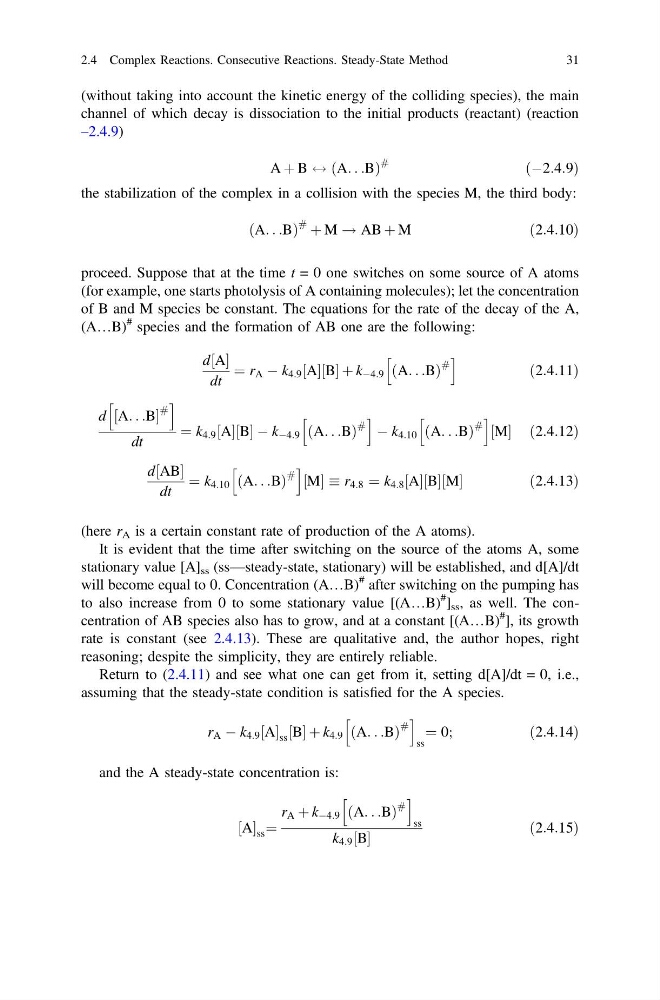
(without taking into account the kinetic energy of the colliding species), the main
channel of which decay is dissociation to the initial products (reactant) (reaction
–2.4.9)
A þ B $ ðA. . .BÞ
#
ðÀ2:4:9Þ
the stabilization of the complex in a collision with the species M, the third body:
ðA. . .BÞ
# þ M ! AB þ M
ð2:4:10Þ
proceed. Suppose that at the time t = 0 one switches on some source of A atoms
(for example, one starts photolysis of A containing molecules); let the concentration
of B and M species be constant. The equations for the rate of the decay of the A,
(A…B)
# species and the formation of AB one are the following:
d½A
dt
¼ r A À k 4:9 ½A½B þ k À4:9 ðA. . .BÞ
#
h
i
ð2:4:11Þ
d ½A. . .B
#
h
i
dt
¼ k 4:9 ½A½B À k À4:9 ðA. . .BÞ
#
h
i
À k 4:10 ðA. . .BÞ
#
h
i
½M ð2:4:12Þ
d½AB
dt
¼ k 4:10 ðA. . .BÞ
#
h
i
½M r 4:8 ¼ k 4:8 ½A½B½M
ð 2:4:13Þ
(here r A is a certain constant rate of production of the A atoms).
It is evident that the time after switching on the source of the atoms A, some
stationary value [A] ss (ss—steady-state, stationary) will be established, and d[A]/dt
will become equal to 0. Concentration (A…B)
# after switching on the pumping has
to also increase from 0 to some stationary value [(A…B)
# ] ss , as well. The concentration of AB species also has to grow, and at a constant [(A…B)
# ], its growth
rate is constant (see 2.4.13). These are qualitative and, the author hopes, right
reasoning; despite the simplicity, they are entirely reliable.
Return to (2.4.11) and see what one can get from it, setting d[A]/dt = 0, i.e.,
assuming that the steady-state condition is satisfied for the A species.
r A À k 4:9 ½A ss ½B þ k 4:9 ðA. . .BÞ
#
h
i
ss
¼ 0;
ð2:4:14Þ
and the A steady-state concentration is:
A
½ ss ¼
r A þ k À4:9 A. . .B
ð
Þ
#
h
i
ss
k 4:9 B
½
ð2:4:15Þ
2.4 Complex Reactions. Consecutive Reactions. Steady-State Method
31
channel of which decay is dissociation to the initial products (reactant) (reaction
–2.4.9)
A þ B $ ðA. . .BÞ
#
ðÀ2:4:9Þ
the stabilization of the complex in a collision with the species M, the third body:
ðA. . .BÞ
# þ M ! AB þ M
ð2:4:10Þ
proceed. Suppose that at the time t = 0 one switches on some source of A atoms
(for example, one starts photolysis of A containing molecules); let the concentration
of B and M species be constant. The equations for the rate of the decay of the A,
(A…B)
# species and the formation of AB one are the following:
d½A
dt
¼ r A À k 4:9 ½A½B þ k À4:9 ðA. . .BÞ
#
h
i
ð2:4:11Þ
d ½A. . .B
#
h
i
dt
¼ k 4:9 ½A½B À k À4:9 ðA. . .BÞ
#
h
i
À k 4:10 ðA. . .BÞ
#
h
i
½M ð2:4:12Þ
d½AB
dt
¼ k 4:10 ðA. . .BÞ
#
h
i
½M r 4:8 ¼ k 4:8 ½A½B½M
ð 2:4:13Þ
(here r A is a certain constant rate of production of the A atoms).
It is evident that the time after switching on the source of the atoms A, some
stationary value [A] ss (ss—steady-state, stationary) will be established, and d[A]/dt
will become equal to 0. Concentration (A…B)
# after switching on the pumping has
to also increase from 0 to some stationary value [(A…B)
# ] ss , as well. The concentration of AB species also has to grow, and at a constant [(A…B)
# ], its growth
rate is constant (see 2.4.13). These are qualitative and, the author hopes, right
reasoning; despite the simplicity, they are entirely reliable.
Return to (2.4.11) and see what one can get from it, setting d[A]/dt = 0, i.e.,
assuming that the steady-state condition is satisfied for the A species.
r A À k 4:9 ½A ss ½B þ k 4:9 ðA. . .BÞ
#
h
i
ss
¼ 0;
ð2:4:14Þ
and the A steady-state concentration is:
A
½ ss ¼
r A þ k À4:9 A. . .B
ð
Þ
#
h
i
ss
k 4:9 B
½
ð2:4:15Þ
2.4 Complex Reactions. Consecutive Reactions. Steady-State Method
31