

Let us analyze in detail on a widespread type of complex and simple (within the
framework of the definitions the author mentioned earlier) processes that are not
elementary, but are a sequence of them. These are the so-called consecutive
reactions in which two or more steps following one another occur:
A ! B; B ! C; etc:
ð2:4:7Þ
As such, one can consider, for example, all the recombination processes
described above. The time dependences of the concentrations of the initial, intermediate, and final products of such reactions in the general case can be quite
complex. In gas-phase recombination reactions, intermediate products, as a rule, or
are very chemically active (atoms, radicals) or short-lived, i.e., they are unstable and
decay in high-rate monomolecular processes, or deactivate (relax) in fast collisional
processes. In such cases, it is very often possible to use the steady-state method,
using which one can get rid of systems of differential equations and reduce them to
algebraic equations.
2.4.1 Steady-State Method
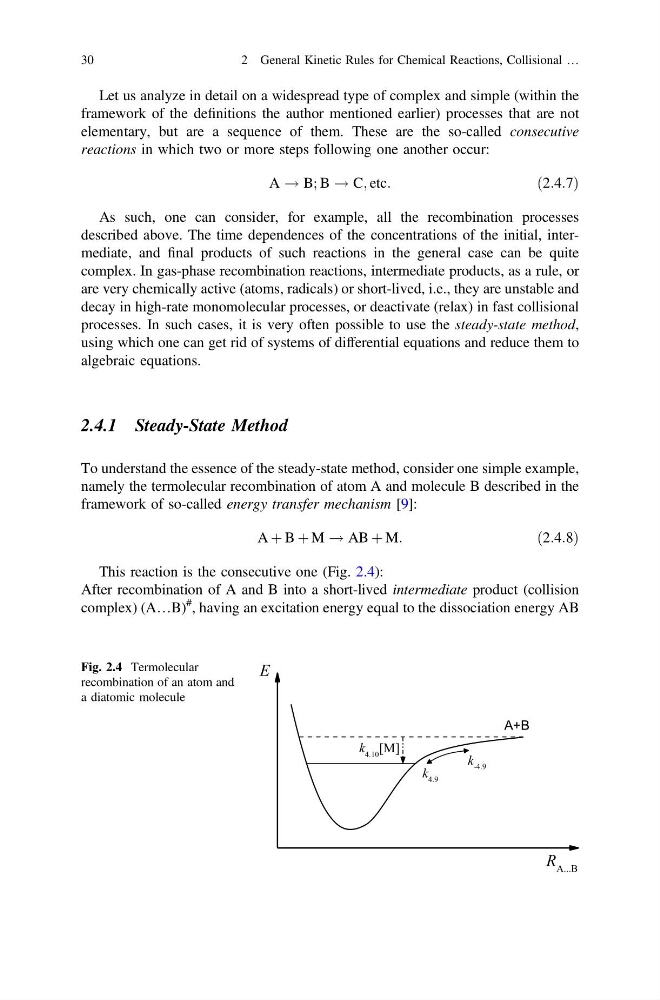
To understand the essence of the steady-state method, consider one simple example,
namely the termolecular recombination of atom A and molecule B described in the
framework of so-called energy transfer mechanism [9]:
A þ B þ M ! AB þ M:
ð2:4:8Þ
This reaction is the consecutive one (Fig. 2.4):
After recombination of A and B into a short-lived intermediate product (collision
complex) (A…B)
# , having an excitation energy equal to the dissociation energy AB
R A...B
k -4.9
k 4.9
E
A+B
k 4.10 [M]
Fig. 2.4 Termolecular
recombination of an atom and
a diatomic molecule
30
2 General Kinetic Rules for Chemical Reactions, Collisional …
framework of the definitions the author mentioned earlier) processes that are not
elementary, but are a sequence of them. These are the so-called consecutive
reactions in which two or more steps following one another occur:
A ! B; B ! C; etc:
ð2:4:7Þ
As such, one can consider, for example, all the recombination processes
described above. The time dependences of the concentrations of the initial, intermediate, and final products of such reactions in the general case can be quite
complex. In gas-phase recombination reactions, intermediate products, as a rule, or
are very chemically active (atoms, radicals) or short-lived, i.e., they are unstable and
decay in high-rate monomolecular processes, or deactivate (relax) in fast collisional
processes. In such cases, it is very often possible to use the steady-state method,
using which one can get rid of systems of differential equations and reduce them to
algebraic equations.
2.4.1 Steady-State Method
To understand the essence of the steady-state method, consider one simple example,
namely the termolecular recombination of atom A and molecule B described in the
framework of so-called energy transfer mechanism [9]:
A þ B þ M ! AB þ M:
ð2:4:8Þ
This reaction is the consecutive one (Fig. 2.4):
After recombination of A and B into a short-lived intermediate product (collision
complex) (A…B)
# , having an excitation energy equal to the dissociation energy AB
R A...B
k -4.9
k 4.9
E
A+B
k 4.10 [M]
Fig. 2.4 Termolecular
recombination of an atom and
a diatomic molecule
30
2 General Kinetic Rules for Chemical Reactions, Collisional …