

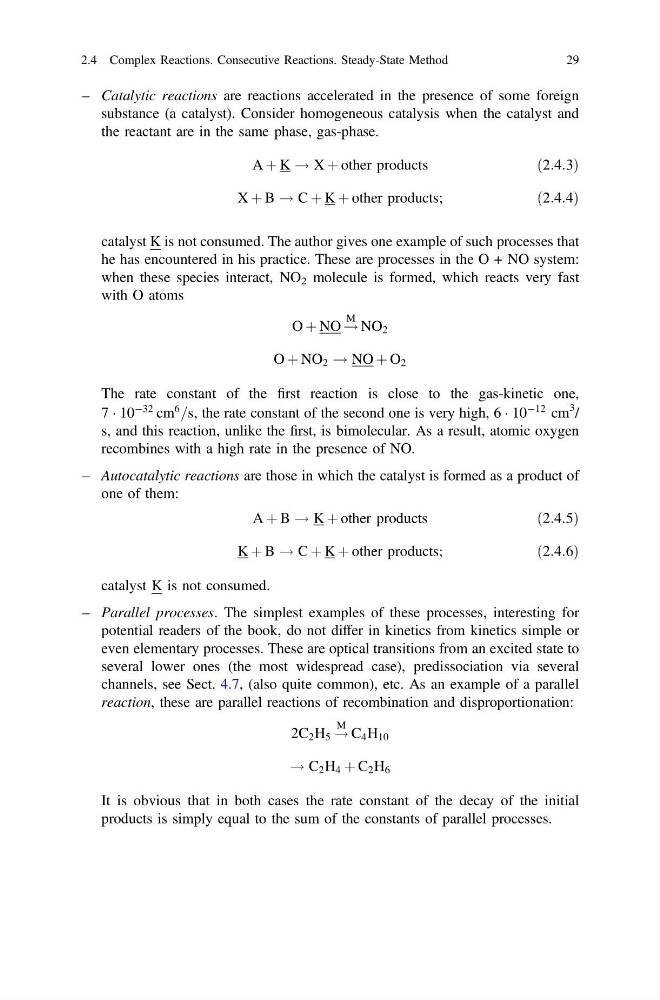
– Catalytic reactions are reactions accelerated in the presence of some foreign
substance (a catalyst). Consider homogeneous catalysis when the catalyst and
the reactant are in the same phase, gas-phase.
A þ K ! X þ other products
ð2:4:3Þ
X þ B ! C þ K þ other products;
ð2:4:4Þ
catalyst K is not consumed. The author gives one example of such processes that
he has encountered in his practice. These are processes in the O + NO system:
when these species interact, NO 2 molecule is formed, which reacts very fast
with O atoms
O þ NO !
M NO 2
O þ NO 2 ! NO þ O 2
The rate constant of the first reaction is close to the gas-kinetic one,
7 Á 10
À32 cm
6
=s, the rate constant of the second one is very high, 6 Á 10
À12 cm
3 /
s, and this reaction, unlike the first, is bimolecular. As a result, atomic oxygen
recombines with a high rate in the presence of NO.
– Autocatalytic reactions are those in which the catalyst is formed as a product of
one of them:
A þ B ! K þ other products
ð2:4:5Þ
K þ B ! C þ K þ other products;
ð2:4:6Þ
catalyst K is not consumed.
– Parallel processes. The simplest examples of these processes, interesting for
potential readers of the book, do not differ in kinetics from kinetics simple or
even elementary processes. These are optical transitions from an excited state to
several lower ones (the most widespread case), predissociation via several
channels, see Sect. 4.7, (also quite common), etc. As an example of a parallel
reaction, these are parallel reactions of recombination and disproportionation:
2C 2 H 5 !
M C 4 H 10
! C 2 H 4 þ C 2 H 6
It is obvious that in both cases the rate constant of the decay of the initial
products is simply equal to the sum of the constants of parallel processes.
2.4 Complex Reactions. Consecutive Reactions. Steady-State Method
29
substance (a catalyst). Consider homogeneous catalysis when the catalyst and
the reactant are in the same phase, gas-phase.
A þ K ! X þ other products
ð2:4:3Þ
X þ B ! C þ K þ other products;
ð2:4:4Þ
catalyst K is not consumed. The author gives one example of such processes that
he has encountered in his practice. These are processes in the O + NO system:
when these species interact, NO 2 molecule is formed, which reacts very fast
with O atoms
O þ NO !
M NO 2
O þ NO 2 ! NO þ O 2
The rate constant of the first reaction is close to the gas-kinetic one,
7 Á 10
À32 cm
6
=s, the rate constant of the second one is very high, 6 Á 10
À12 cm
3 /
s, and this reaction, unlike the first, is bimolecular. As a result, atomic oxygen
recombines with a high rate in the presence of NO.
– Autocatalytic reactions are those in which the catalyst is formed as a product of
one of them:
A þ B ! K þ other products
ð2:4:5Þ
K þ B ! C þ K þ other products;
ð2:4:6Þ
catalyst K is not consumed.
– Parallel processes. The simplest examples of these processes, interesting for
potential readers of the book, do not differ in kinetics from kinetics simple or
even elementary processes. These are optical transitions from an excited state to
several lower ones (the most widespread case), predissociation via several
channels, see Sect. 4.7, (also quite common), etc. As an example of a parallel
reaction, these are parallel reactions of recombination and disproportionation:
2C 2 H 5 !
M C 4 H 10
! C 2 H 4 þ C 2 H 6
It is obvious that in both cases the rate constant of the decay of the initial
products is simply equal to the sum of the constants of parallel processes.
2.4 Complex Reactions. Consecutive Reactions. Steady-State Method
29