

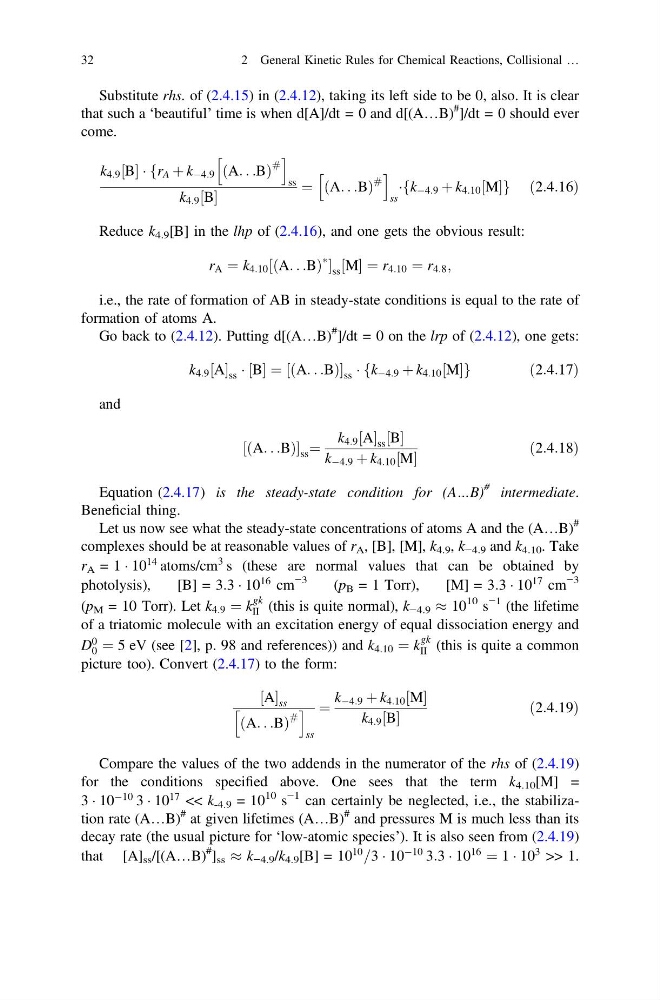
Substitute rhs. of (2.4.15) in (2.4.12), taking its left side to be 0, also. It is clear
that such a ‘beautiful’ time is when d[A]/dt = 0 and d[(A…B)
# ]/dt = 0 should ever
come.
k 4:9 B
½ Á fr A þ k À4:9 A. . .B
ð
Þ
#
h
i
ss
k 4:9 B
½
¼ A. . .B
ð
Þ
#
h
i
ss
Á k À4:9 þ k 4:10 M
½
f
g ð2:4:16Þ
Reduce k 4.9 [B] in the lhp of (2.4.16), and one gets the obvious result:
r A ¼ k 4:10 ðA. . .BÞ
Ã
½
ss ½M ¼ r 4:10 ¼ r 4:8 ;
i.e., the rate of formation of AB in steady-state conditions is equal to the rate of
formation of atoms A.
Go back to (2.4.12). Putting d[(A…B)
# ]/dt = 0 on the lrp of (2.4.12), one gets:
k 4:9 ½A ss Á ½B ¼ ½ðA. . .BÞ ss Á k À4:9 þ k 4:10 ½M
f
g
ð2:4:17Þ
and
A. . .B
ð
Þ
½
ss ¼
k 4:9 A
½ ss B
½
k À4:9 þ k 4:10 M
½
ð2:4:18Þ
Equation (2.4.17) is the steady-state condition for (A…B)
#
intermediate.
Beneficial thing.
Let us now see what the steady-state concentrations of atoms A and the (A…B)
#
complexes should be at reasonable values of r A , [B], [M], k 4.9 , k −4.9 and k 4.10 . Take
r A = 1 Á 10
14 atoms/cm
3 s (these are normal values that can be obtained by
photolysis),
[B] = 3:3 Á 10
16 cm
−3
(p B = 1 Torr),
[M] = 3:3 Á 10
17 cm
−3
(p M = 10 Torr). Let k 4:9 ¼ k
gk
II (this is quite normal), k −4.9 % 10
10 s
−1 (the lifetime
of a triatomic molecule with an excitation energy of equal dissociation energy and
D
0
0 ¼ 5 eV (see [2], p. 98 and references)) and k 4:10 ¼ k
gk
II (this is quite a common
picture too). Convert (2.4.17) to the form:
A
½ ss
A. . .B
ð
Þ
#
h
i
ss
¼
k À4:9 þ k 4:10 M
½
k 4:9 B
½
ð2:4:19Þ
Compare the values of the two addends in the numerator of the rhs of (2.4.19)
for the conditions specified above. One sees that the term k 4.10 [M] =
3 Á 10
À10 3 Á 10
17 << k -4.9 = 10
10 s
−1 can certainly be neglected, i.e., the stabilization rate (A…B)
# at given lifetimes (A…B)
# and pressures M is much less than its
decay rate (the usual picture for ‘low-atomic species’). It is also seen from (2.4.19)
that [A] ss /[(A…B)
# ] ss % k −4.9 /k 4.9 [B] = 10
10
=3 Á 10
À10 3:3 Á 10
16
¼ 1 Á 10
3 >> 1.
32
2 General Kinetic Rules for Chemical Reactions, Collisional …
that such a ‘beautiful’ time is when d[A]/dt = 0 and d[(A…B)
# ]/dt = 0 should ever
come.
k 4:9 B
½ Á fr A þ k À4:9 A. . .B
ð
Þ
#
h
i
ss
k 4:9 B
½
¼ A. . .B
ð
Þ
#
h
i
ss
Á k À4:9 þ k 4:10 M
½
f
g ð2:4:16Þ
Reduce k 4.9 [B] in the lhp of (2.4.16), and one gets the obvious result:
r A ¼ k 4:10 ðA. . .BÞ
Ã
½
ss ½M ¼ r 4:10 ¼ r 4:8 ;
i.e., the rate of formation of AB in steady-state conditions is equal to the rate of
formation of atoms A.
Go back to (2.4.12). Putting d[(A…B)
# ]/dt = 0 on the lrp of (2.4.12), one gets:
k 4:9 ½A ss Á ½B ¼ ½ðA. . .BÞ ss Á k À4:9 þ k 4:10 ½M
f
g
ð2:4:17Þ
and
A. . .B
ð
Þ
½
ss ¼
k 4:9 A
½ ss B
½
k À4:9 þ k 4:10 M
½
ð2:4:18Þ
Equation (2.4.17) is the steady-state condition for (A…B)
#
intermediate.
Beneficial thing.
Let us now see what the steady-state concentrations of atoms A and the (A…B)
#
complexes should be at reasonable values of r A , [B], [M], k 4.9 , k −4.9 and k 4.10 . Take
r A = 1 Á 10
14 atoms/cm
3 s (these are normal values that can be obtained by
photolysis),
[B] = 3:3 Á 10
16 cm
−3
(p B = 1 Torr),
[M] = 3:3 Á 10
17 cm
−3
(p M = 10 Torr). Let k 4:9 ¼ k
gk
II (this is quite normal), k −4.9 % 10
10 s
−1 (the lifetime
of a triatomic molecule with an excitation energy of equal dissociation energy and
D
0
0 ¼ 5 eV (see [2], p. 98 and references)) and k 4:10 ¼ k
gk
II (this is quite a common
picture too). Convert (2.4.17) to the form:
A
½ ss
A. . .B
ð
Þ
#
h
i
ss
¼
k À4:9 þ k 4:10 M
½
k 4:9 B
½
ð2:4:19Þ
Compare the values of the two addends in the numerator of the rhs of (2.4.19)
for the conditions specified above. One sees that the term k 4.10 [M] =
3 Á 10
À10 3 Á 10
17 << k -4.9 = 10
10 s
−1 can certainly be neglected, i.e., the stabilization rate (A…B)
# at given lifetimes (A…B)
# and pressures M is much less than its
decay rate (the usual picture for ‘low-atomic species’). It is also seen from (2.4.19)
that [A] ss /[(A…B)
# ] ss % k −4.9 /k 4.9 [B] = 10
10
=3 Á 10
À10 3:3 Á 10
16
¼ 1 Á 10
3 >> 1.
32
2 General Kinetic Rules for Chemical Reactions, Collisional …